August 21, 2015

Outback 3 Brisbane to Adelaide

Two days, someone said; three, a friend suggested, in answer to the question, how long does it take to drive from Brisbane to Adelaide? The cities are more than 2000 km distant, so we decided three. Even 700+ kilometres a day is going some: it means constant clock-watching; stops that are few and far between; and little if any sight-seeing – if you want to avoid dusk or night-time driving, that is, with its risk to wildlife.

On Wednesday 29 July, we left bang on schedule, at 6 am. It was coming light, fine for driving through Brisbane on the Ipswich Road and Motorway, thence to the Cunningham Highway east of Ipswich. I've never seen so little traffic this side of Cunninghams Gap. It was a cold and frosty sunny morning when we stopped for breakfast on the far side, at Gladfield.
The Cunningham Highway continues to Goodiwindi, 200 km west of Warwick. We stopped at Inglewood, a little beyond halfway, for coffee. It's a pleasant little place, and Queensland's olive-growing capital. The coffee was good. At Yelarbon, 40 km further on and the first of many silo towns, we diverted on to the Border Rivers Tourist Drive, where a surprise awaited. Whoever would have expected spinifex this far east of the Outback? Although close to both, however, we never saw the border or a river.
We had to put our foot down on the Newell Highway for a few hours. Goondiwindi – bye-bye Queensland. Moree – 'Moree Plains Shire' is not a misnomer. And Narrabri – the heart of a major cotton region. Unfortunately, we didn't have time to visit the Australian Cotton Centre on the banks of the Namoi River.

To the west of Narrabri is a place that earned the crazy name of the day award. Then we reached the Pillaga, a name etched on environmentalists' hearts because of the threat posed to this vast expanse of forest and bush by the largest coal seam gas project proposed for New South Wales.
Looking towards Mt Kaputar National Park
We arrived at Barkala Farm and Pillaga Pottery (part of the Outback Beds accommodation network), on the very edge of Pillaga Nature Reserve, around 4. We'd planned to enjoy its remoteness for at least a couple of hours before dark. The 8000-acre property is 10 km down Dandry Road, a dirt track off the Newell Highway 23 km north of Coonabarabran.

Day 1: 692 kilometres.

There were pots everywhere. They're described as European inspired with iconic Australian designs. The pottery was founded in 1983. You can watch free demonstrations in the large workshop; go bushwalking or on a guided bird-watching tour; and your kids can enjoy pony rides or the 'clay-play'. There's a welcoming, relaxed atmosphere with an alternative European feel. I wish we'd been able to stay longer.

First, we had tea and scones in the Blue Wren Cafe: then we headed out to our guest house, the 3-bedroom Eagle Valley cottage, a further 2 km into the bush. A log fire had been lit for us. The fireplace was, sensibly, in the middle of the house, and that night we left our bedroom door open to continue to feel the warmth. We ate wood-fired pizza later in the Cafe, and chatted to the owner and a her friend. She runs the place as sustainably as possible: they're off the grid and self-sufficient. We found like minds when it came to politics and the environment.
Next morning it was frosty in Eagle Valley. After a very short walk, we hit the road at 7.35. The country beyond Coonabarabran was a lot different from the plains and forests of the previous day: it was up-and-downy, with Black Angus and sheep grazing in a prettier landscape. To the west of us was Warrumbungle National Park, on which perches the Siding Spring Observatory. It is part of the Research School of Astronomy and Astrophysics at ANU (Australian National University).
We made a coffee stop at Gilgandra. Aah, the capriciousness of small town/bush coffee. Even if there's a Lavazza sign and you place your usual order, there's no telling what you'll get. You carry a takeaway from cafe to car with trepidation: will it be coffee as you know it or merely tasteless hot milk? (Spoken like a true urban coffee addict, I know.) Gilgandra's was the lifeless hot-milk + instant-coffee-flavoured experience. 

As we approached Dubbo, progress got slower: there were more road works, fewer overtaking lanes, more caravans and trucks. 

Day 2's crazy-name winner was…
Twenty kilometres north of the town of the same name, the Parkes Radio Telescope – famous for receiving and relaying television pictures of the Apollo 11 Moon landing in 1969, as told in The Dish – was a must-see up close even if there was no time for a guided tour. It is run by CSIRO (Commonwealth Scientific and Industrial Research Organisation), who, as you would expect, provide the facts and stats you need on a flying visit. The Dish is off the Newell, on Telescope Road, natch.
Back on the road, we flew through Parkes, Forbes and West Wyalong, where we deserted the Newell for the Mid Western Highway (no hyphen). We were now less than 200 km from our next overnight stop. (Since this first Outback3 post covers three days, I denied myself the opportunity of calling this stretch of adventure Hay Jude.)

As we neared Taleeban, the iPad indicated we'd shortly be crossing into the Fruit Fly Exclusion Zone. Dear gods, what action was required at this point? The tension was mounting… would there be a barrier, the fruit police, enormous bins for dumping? In reality, there was nothing. No sign; nothing. I was a tad disappointed. (Remind me to tell you one day about my first-ever encounter with fruit police, in Far North Queensland.) The next day we found out more, as we approached the Victorian border.
We were entering the Riverina, a vast area of plains in southwest New South Wales in the Murray and Murrumbidgee catchments. It supports rich and varied agriculture, but towards the more arid west is largely saltbush. Trees gave way to nicely coloured fields; silos were a different shape; everything was eventually replaced with nothing much. Rapeseed verges matched cotton bales; black cattle contrasted well. I'd heard of the Riverina; just as once I'd only heard of the Channel Country, or, still, Gippsland. Until you go, you don't know. I rather liked the sun going down on the Riverina, but I can well imagine that on a dull day it's drab and desolate.

Finally, just outside Hay, we stopped for our first glimpse of the mighty Murrumbidgee, Australia's second-longest river, which rises high in the Great Dividing Range and joins the Murray near Boundary Bend on the western Victorian border. The river flows through the heart of the Riverina and, on the map, is one of the wiggliest rivers I've ever seen. Standing in the stillness on its banks was almost soporific.
We stayed in the Bidgee Motor Inn and ate at the Riverina Hotel: both were ordinary. 

Day 2: 722 kilometres.

Next morning we were leaving Hay by 8.30, having taken a look at the town and walked along the river. It was cold and still, which made for good reflections.
Lachlan Street, Hay
Bigger word spaces might have been helpful
The Sturt Highway west of Hay follows the Murrumbidgee for a while, but gradually the give-away tree lining diverges and you're left with a pretty empty landscape. The cotton by the roadside was the only clue to cultivation and that was gradually replaced by sheep amid hummocky grass. 
While looking for somewhere to breakfast 10 km short of Balranald, we stumbled upon the beautiful Yanga Lake in Yanga National Park. Yanga Creek connects the Lake to the Murrumbidgee, and a control weir maintains water in the Lake, which is believed to have formed 128,000 years ago. 

We took our fruit and muesli to the viewing deck and gazed out upon a scene of such tranquility it was hard to move on. There's a homestead, Park office and an easy walk to the water's edge. 
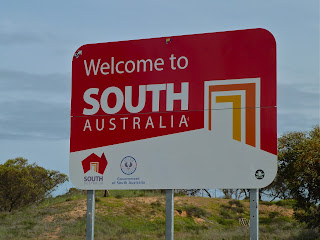
At Balranald there's a decision to be made: continue along the Sturt Highway to Adelaide via Mildura; or take a slightly shorter, more southerly route. We headed south to the wiggly Murray forming the border with Victoria at Tooleybuc. We passed pistachio plantations at Kyalite and orchards at Piangil. Then the Mallee Highway heads west into South Australia. It takes its name from the woody plants that presented early settlers in northwest Victoria with almost impenetrable scrub in the form of multiple stems from underground tubers. Much of the region, known informally as the Victorian Mallee, has since been cleared, but remnants line the road.
Liftspan bridge on the border
Mallee (sounds like Sally)
The place names were entertaining: Manangatang, Ouyen, Galah, Underbool and Boinka. We stopped  for picnic lunch in an almost deserted little town called Cowangie. Many of these towns along the railway track have silos that once supported vibrant communities. Most of Cowangie's homes, shops and services had seen far better days.
We joined the Princes Highway just before Tailem Bend in South Australia. I fancied taking a photo of the aforementioned bend close to the Murray's mouth, but it wasn't obvious how to get off the highway at the right spot. Besides which, the weather had become oppressively cloudy. By Murray Bridge we were in territory covered during our Easter trip to the Adelaide Hills. So we sped to the South Australian capital as quickly as possible. It's an easy run down from the Lofty Ranges right into the centre of the city, but the last couple of kilometres to our hotel were tortuous.

And the hotel? That'll have to wait for the next post. This turned out to have been the last picture of the day.
Day 3: 667 kilometres. In total, 2081 kilometres and four states in three days.

This post was last edited on 4 September 2015

July 31, 2015

The Dutch case

A government is expected to protect its citizens from external threat. If a neighbouring country were to invade these shores, Australians would rely on their government to organise a response.

According to climate science, the warming of the planet poses an immense threat to the every nation in one way or another. Unfortunately, here in Australia the level of consensus on the danger presented is low.

In The Netherlands, however, in 2013, 886 citizens, with the support of an organisation that promotes sustainability, Urgenda, brought a case against the Dutch government for failing in their duty of care to protect their people from dangerous climate change. That year, renewable energy supplied only 4.5 per cent of Dutch energy demand, some way off the country's 2020 target, and well behind European leaders such as Germany and Denmark. The Netherlands were supposed to cut their emissions by 25 per cent from 1990 levels (under international climate treaties), but the government had admitted they were aiming for 16 per cent. Urgenda argued that they should in fact be cutting emissions by 40 per cent, in line with climate science, and in order to ensure that the planet does not warm by more than two degrees. The country was a laggard rather than a leader.

No prizes for guessing which label fits Australia.

Urgenda director Marjan Minnesma came to Brisbane last week to meet with the Environmental Defenders Office* of Queensland and speak to a public meeting about the landmark legal decision that required the government of The Netherlands to tackle climate change adequately.

When governments continually fail in their duty of care to protect the people they represent, then the people will eventually take action to protect themselves. There are increasing numbers of frustrated and alarmed Australians who despair of the feeble attempts of the current Federal government to address even the first stage of preparedness in a climatically challenged continent. It is not surprising that many of them are concluding that only the law can save them now.

'The Dutch Case' was not about environmental law nor human rights issues, but civil law; tort, in fact. Tort is concerned with a breach of duty under Dutch law, and one that affords a right of action for damages. The unlawful act in this case was to not take sufficient action to avoid dangerous levels of climate change.

The Dutch lawyers presented the judge with the facts of the matter: they had written evidence, for example, of the government's meagre target of 16 per cent. And they gave him the scientific evidence. The judge applied logic to the facts to address questions of law, not politics. Does the state have discretionary powers? Yes, but not to do the absolute minimum required.

He judged there to be a new precedent – unlawful hazardous negligence. He concluded from the climate science that the chances of dangerous climate change are very high, and that mitigating measures should be taken expeditiously. The current emissions target was insufficient to achieve only a 2-degree warming. Democratic law protects citizens, and in this case the state has a crucial duty of care to reduce emissions to between 25 and 40 per cent.

Tort law in Australia is different, and constitutional law is conservative. Duty of care is based upon groups of individuals being responsible for care rather than the government. Also, it adopts the 'but for' test to determine negligence and neglect. The 'but for' test simply asks, 'but for the existence of A, would B have occurred?' If the action is yes, then A is an actual cause of the result B. But for the Australian government not taking mitigating measures, would the Australian people suffer harm?

Clearly it is not going to be as easy for citizens in Australia to do what the Dutch did. EDOs across the land are busy considering their options under the law, however.

In the meantime, Ms Minnesma had some advice for citizens to take matters into their own hands. Let the government know what you think they should do and how it is possible. Make your presence felt: write them letters; turn up to street protests. Practise crowd pleading: appeal to like minds and those who might take action with you. Be practical: make your house energy-neutral; use an electric car. She stressed that if something is possible, and you want it to happen, then it can happen.

She was like a breath of fresh air blowing through Brisbane. She gave many jaded climate change and environmental activists new hope. It will be a long tough ride to force the laggard government to act in a necessarily responsible way with regard to reducing this nation's emissions. But we left the lecture theatre in the Queensland State Library with smiles on our faces and renewed energy to continue the struggle.

* http://www.edoqld.org.au


July 23, 2015

Darn crazy Aussie rule of the week

Last Friday we went to Lang Park to a watch a friendly between Liverpool FC and Brisbane Roar.

I bought the tickets ages ago. As the day got nearer, I felt odder, even a bit apprehensive. In the UK, Liverpool is our team's most loathed foe. It seemed a good idea back in February: we are so deprived of Premier League football because we won't subscribe to anything Murdoch.

I felt as if I was in enemy territory, even though we were supporting The Roar in Brisbane, where we live. The stadium was an ocean of red: it was hard to spot orange.
It was bitterly cold. I wore my United scarf. Not an obvious one, which would have been red, like the enemy's, but the one from the 1999 European Champions League final, in which United beat Bayern Munich 2-1 in Barcelona to win 'The Treble' – Premier League, FA Cup and Champions League – in one season. The scarf is black and grey but has a large Manchester United badge at one end, which is unmistakeable. I folded the scarf, of course, so that the badge was visible. A Liverpool fan sitting next to me spotted it immediately. I must have spoiled his evening because he didn't come back to his seat for the second half. This can't have helped.
Unfortunately, that scoreline didn't last. Liverpool eventually won 2-1, but The Roar played better than I've seen them play before, and made a good fist of it against their famous opponents.

But to get to the point… We arrived at the stadium early, checked where our seats were and went to buy a drink. We wandered back to the corner of the stadium, close to where we'd come in. It was a relatively sheltered spot, and there was a good view over 'the Kop', the stand where Australian Liverpool fans were gathering enthusiastically. I wanted to take a specific photograph (below) and this was a good vantage point. We leaned against a railing and watched the stadium filling up.
Forty-five minutes before kick-off, a steward approached and asked us to move back from the railing. We were puzzled. He couldn't explain why he'd been asked to move people away. He had been told to do it, had asked for an explanation, but was not given a reason. He'd protested that it was unreasonable to expect people to stand away with no good cause.

We speculated. Was it health and safety? The crowd need to be in their seats before kick-off, but surely not quite so long beforehand. Was it a security measure? Once the stands are filling up, you can't have people lurking about directly above them. This didn't seem plausible. People were still pouring in and stopping to take their first look at the pitch.

People don't mind rules so much if they understand why they exist. Admittedly, in this nation built on rules, many do as they're told without question, for a quiet life, to avoid penalty points, so they don't get shot, whatever. If you are the questioning sort, however, and you don't know why a particular rule is in place, and when you ask you're not told, for whatever reason, then the rule can seem unnecessary, even silly, and the temptation to flout it irresistible.

There are so many instances when I see a list of rules where I wouldn't expect it (below, in a toilet); or it's so long I lose the will to live before I've finished reading it; or it's accompanied by dire threats and warnings. It makes me contemptuous and disrespectful.

The Lang Park steward was pleasant and not at all officious. He didn't get shirty when we asked why. He was as confused by the order as we were. We stood away from the railing compliantly, and then, for the next 15 minutes or so watched many others do as we had done. Nothing happened to them, and no one appeared to tell them not to. Maybe, by subtle body language, non-conformists attract enforcers.


July 22, 2015

Message to Adani

It is bad enough that the Carmichael mega mine will industrialise pastoral land in the Galilee Basin; decimate the last remaining populations of Waxy Cabbage Palms and Black-throated Finches; run dry a unique spring system in an arid region; carve up floodplains and paddocks with its rail link to Abbot Point coal port; increase bulk carrier traffic through the precious, endangered Reef; and be responsible for enough carbon emissions to rank among the world's top ten emitters. But neither has the project's Indian proponent, Adani, adequately considered the native title rights of the Traditional Owners of regions affected.

Some of those Traditional Owners (TOs) came to Brisbane last week*, to deliver the pledges of thousands of Australians who are concerned about the development of the Galilee for a whole host of reasons but are united as Reef Defenders and protectors of country. Juru elder Aunty Carol Prior led the TOs, and she asked to deliver the pledges personally up to Adani's office. She was not allowed into the building at 10 Eagle Street, however, let alone up to the office. An Adani representative came down, instead. He was William Haseler, Adani's counsel. He explained that the CEO was out of state and that he would accept the pledges on the company's behalf. I recognised this man from the Carmichael case in the Land Court earlier in the year: he was there part of most days.

Aunty Carol explained that the mine's infrastructure would impact on four different tribal lands.
In some areas, it goes right through sacred sites, sacred waterholes. And in my country it's going through 30 metres away from a rock art that's thousands of years old. Our concern is that the dust will destroy that rock art.
Traditional Owners approach Adani HQ
Bill Haseler didn't invite Aunty Carol in
Other Traditional Owners, the Birri, performed traditional dances. In one, they symbolically cleaned the land; later, they performed the Eagle Dance: they were in Eagle Street.
I was introduced to Aunty Carol by a mutual friend. She gave me a hug: I was by now quite moved by the event. I am frequently angered by Australia's treatment of its indigenous peoples, past and present. Seeing these Traditional Owners out of context in Brisbane's alien CBD reinforced my belief that they should not have to lobby for their land rights.
One sign seemed to sum up the mood during this successful, strong yet peaceful protest. It said simply: 'Hey, Adani, we won't stop until you do.'

* The Wangan and Jagalingou Traditional Owners, whose land would be directly affected by the Carmichael mine excavation, have a Native Title claim to much of the Galilee Basin. They have submitted a Defence-of-Country Declaration to the Queensland government, opposing the mine, having failed to negotiate an Indigenous Land Use Agreement (ILUA) with Adani. In May they appealed to the Federal Court, challenging Australia's National Native Title Tribunal's decision that the government of Queensland can issue a mining lease for the mine. Wangan and Jagalingou elder Adrian Burragubba has expressed an intention to take the case to the High Court if necessary.


July 18, 2015

An important promise kept

Last Monday lunchtime I went to Speakers' Corner near Parliament House in Brisbane to join a small gathering of people that included the Hon Peter Wellington. He was certainly in the right place, being the Speaker of the Queensland Parliament.

Mr Wellington expressed his support for the People's Common Rights and Provisions Bill 2014, which aims to restore democracy in a state whose last government momentarily forgot – let's give them the benefit of the doubt – that power resides in the people and is exercised by the people through their elected representatives, not by mining industry lobbyists through donations to those representatives.

We listened to the experience of Aileen Harrison, who bought her ideal retirement home in the eastern Darling Downs, little realising the impact New Hope's Acland mine, two kilometres away, would have on her family's health and happiness. When she finally concluded that life was 'unbearable', but couldn't sell the property, New Hope long resisted her request for an independent valuation. They finally agreed, but disputed the figure and refused to pay the going rate. In addition, some of Aileen's family had to sign a confidentiality agreement. She did not, and so we got to hear of her despair and disillusionment with a system that allowed New Hope to drill 24/7, light-out the night sky, immerse her world in orange dust; in other words, trample her dream.
Frank Ashman (above), like Aileen, is a member of Oakey Coal Action Alliance. He runs beef cattle on 270 hectares currently about eight kilometres from the mine. Frank is concerned, however, that if Acland Stage 3 goes ahead, it will impact on his bores and hence his cattle business.

With people like Aileen and Frank in mind, thousands of people signed a petition in support of the Queensland People's Bill*. One of several important aims of the Bill is to restore the rights of farmers, landowners and communities to object to inappropriate development threatening their livelihoods and good health. Peter Wellington accepted the petition from Aileen and promised to pass it on to the Clerk of the Parliament and Premier Annastacia Palaszczuk.
Aileen hands over the petition
I can imagine the joy of Aileen, Frank and hundreds of thousands of others on Thursday when Dr Anthony Lynham, Minister for State Development and for Natural Resources and Mines introduced the State Development and Public Works Organisation and Other Legislation Amendment Bill 2015, honouring the Palaszczuk government's election promise to restore objection rights removed at five minutes to midnight on a particularly dark night during the previous LNP government's administration. Labor was supported by the Katter Party and Independent (formerly Labor) Billy Gordon, and the Bill was passed the following day.
Frank and Aileen listen to the Speaker
Labor has been working away at this piece of legislation since they were elected at the end of January, and were keen to have it in place for the 'New Acland Coal Mine Stage 3 Project'. For many people it represents a key part of the de-Newmanisation of Queensland. It was a great end to the week, despite the cold.