Showing posts with label Travel in Central Queensland. Show all posts

May 23, 2014

Galilee Road Trip: coal-free communities

It was hard to leave Bimblebox; for those who had made a pilgrimage; for those who had fully appreciated the price we are paying in the name of economic progress for Queensland. I wondered when on earth I would return.

Paola fortified us for the journey with delicious, comforting rice pudding. How could we thank her enough for the last two days? We also had to say goodbye to our friends from Mackay. Bus logistics meant I volunteered to ride in organiser Ellie's car instead: the convoy took a while to roll. Three brolgas took flight but I wasn't quick enough with the camera. The neighbour's cattle were just as bashful as those on Bimblebox, but the horses were bolder. We bade farewell to Alpha and hit the Capricorn Highway. I drove the Alpha-Emerald stint as we left the Desert Uplands behind us. The purply green Drummond Range was a beautiful contrast to red sandy plains, but I'll have to go back: a long day's drive precluded photo stops...
...Except beyond Emerald, where I became a 'coal tourist', according to one of my travelling companions. I have to confess to a sort of fascination with coal trains. I mean, they are unimaginably long: you can never see the beginning and the end at the same time; and they are usually described in terms of kilometre-length rather than number of wagons. They are so long they need locomotives in the middle. The wagons have arrows on them in case you can't work out which way they're going! In this case, east to Gladstone, full, or west to Blackwater and the Bowen Basin mines, empty. Whoever would have thought I'd become a train spotter. The driver tooted as I snapped.
Onwards and eastwards to Rockhampton, and then south on the Bruce Highway – with a brief stop at Mount Larcom for late-lunch potato wedges and fruit salad – then past Gladstone to Miriam Vale. Here we turned southeast down the Bundaberg-Lowmead Road to our final destination of the trip: Avondale, a small community on the Kolan River – but a coal mine and gasfield free community nonetheless. 

Not for the first time on this trip, I found it a bit daunting pitching up in a strange place in the dark, but there was the warmest welcome from the ladies waiting at Penny's place. The campers had a choice that night: their tent on a grassy sward close by Nunginungi homestead, or the Shed, a new construction a bit further away. The temperature was dropping and the air was damp, so it was not a difficult decision for me. 

The trippers and the locals congregated in the Shed before supper. We heard someone describe finding her 'home' in this beautiful, unspoilt part of the world north of Bundaberg, and about others' passion for the area's pristine water and fertile land. We learned of the first surreptitious signs in January 2013 of two coal companies making exploratory moves – just down the road from Penny's place and on a property down by the Kolan River – without so much as a by-your-leave. Beneath the lush farmland of Avondale lies the Maryborough Basin, and there was some excitement about 'a huge coal find'*.

We heard about residents' initial feelings – of disbelief, puzzlement, shock and distress. But the ladies who stood before us were smiling from ear to ear, confident about their decision to defend their community from unwanted development. Their positivity flowed from them and washed over us like a warm tropical wave.
In February last year, a handful of concerned Avondale locals organised a screening of Bimblebox and invited the indefatigable Annie Kia, Community Empowerment Coordinator for the Lock the Gate Alliance, to hold a workshop. Annie worked in the Northern Rivers area of New South Wales to develop a strategy for communities threatened by invasive gas fields (or coal mines), and believes that communities can make a positive difference to future outcomes by means of grassroots participation.

And so gradually there took shape a plan for the residents to lock their gates to the coal companies' geologists or any other representatives, and, if a majority of residents so desired, to declare their streets coal mine and gas field free. In January this year, Avondale and Winfield (on Baffle Creek to the north) declared themselves coal and gas free communities**. Their next goal is to get their own baseline testing done to enable them to prove contamination in future should the need arise. Last weekend they held a major – and successful – fundraising event in support of this aim ($10,000 of $70,000 raised so far).

Now six action groups are part of Coal Free Wide Bay, Burnett and Beyond Inc.

On the way over to the homestead we came upon a sluggish Red-bellied Black Snake who needed to be someplace warmer. It confirmed that my decision to sleep in the Shed was the right one. 

First we had a delicious buffet meal supplied by our hosts. The produce was locally grown, and it showed. The potato salad was simply the best. And the flavour of the chicken reminded me of what chicken should taste like. We chatted... and we danced... and it was going on midnight by the time I crept around bodies in the Shed and crawled into my sleeping bag. 

I awoke at six to beautiful country that I hadn't been able to appreciate the previous evening. There wasn't as yet any running water in the Shed so I washed my face in the abundant dew. The backlit grasses were magnificent and the birdsong extraordinary. Unfortunately, my bird expert was in a tent down the way.
View from a dunny
After breakfast and packing-up we had our final debrief of the Galilee Road Trip, in the Shed. What a journey it had been. Now, there was so much more to do. We walked slowly, if not a little sadly, back to the bus... and headed back to Brisbane.
This post was last edited on 24 May 2014


May 15, 2014

Bimblebox: pause for thoughts

We humans have reinvented God a dozen times in the past 5000 years... Yet divinity is accessible, free and indisputable, all around for all time, every day for everyone – with just one simple law. Nature is sacred. Soil, water, air and all that lives within. Unnecessary disruption is sacrilege. And here, you will know why, for nature still speaks – kindly but clearly – come close, listen to my story, treat me with reverence, and you will live and die well.
It's alone in the wilderness you can find this essential truth, rising above the morass of a troubled humanity that in contrast seems so lost in a contortion of endless fleeting words, exaggerated images, mixed messages, and fickle impulses.
To sacrifice a place that offers so much timeless priceless insight for 30 years' worth of dirty old coal is to lose that last hope for all of us.
Ian Hoch, co-owner of Bimblebox Nature Refuge* 
In the Land Court last year, Paola Cassoni, co-owner of Bimblebox, finished her submission with these words.
Finally, my last word is a tribute to our water.
As a prerequisite of life, water is hardly an optional extra or a luxury of personal choice. Loss of water, or significantly degraded water quality, isn't an inconvenience, it's the end game for the Desert Upland rural communities.
We treat water with reverence and grace. We don't over-extract, and we marvel that even in a year of drought like this one, water still comes to us in our bores, and we know we will be able to survive this dry landscape once again. But for those who have never been short of water, they can't understand our anxiety. We will be living our next 30 years or more, knowing huge voids will be continuously draining our precious water supplies.
By nature's good fortune, we are able to keep the bulk of our water conveniently stored away in shallow, life-giving arteries. With a water supply protected from the drying atmosphere, the Desert Uplands is a gift to the world and to the few who make it their home. 

* from Bimblebox: A Nature Refuge Under Siege, edited by Maureen Cooper (for details, see http://bimblebox.org/books)


May 12, 2014

And so to Bimblebox...

Thursday on the Galilee Road Trip. Just after sun-up. A beautiful morning in the bush. Grabbing a (hot) shower before most other campers. Galahs for company. And today was the day I would finally get to Bimblebox.
Breakfast and packing up with a spring in my step. Into Jericho to fuel up. Indulge me: I loved Jericho.
There was nothing on at the drive-in so we enjoyed an impromptu pavement disco – in increasingly warm sunshine. Well, some of us did. With thanks to Mackay Conservation Group for their musical contributions on this trip. Somewhere there's a video...
There is art in Jericho's street, including fine murals. A slight concern about this character, however.
More than 1000 kilometres northwest of Brisbane and 500 west of Rocky, Jericho is a small town getting smaller. Someone else had up sticks just last week. Parents are increasingly home-schooling their sons and daughters, so numbers are falling at the school. Shopkeepers are doing it tough: as increased costs of bringing in supplies raise prices, people can no longer afford to buy, the shopkeeper can't afford to restock, so the people don't shop there any more. I heard that the cafe once enticing grey nomads and other travellers to stop in the town is now in competition with a tearoom in the tourist information office. Who made that decision in Barcaldine?

How do you stop the young leaving town in search of better prospects? There are townsfolk who believe that the Galilee mines would breathe new life into Jericho and Alpha, and they are alarmed at talk of falling commodity prices and stranded assets. (Some of them had joined us to listen to a talk about this the previous evening – more in a later post). If you argue against exploitation of the Galilee's coal deposits, then your list of alternatives to fossil fuel development has to extend beyond renewable energy sources to different economic activities for already struggling communities.

I wasn't concentrating on the route from Jericho. We turned off the Capricorn Highway sooner than I expected; I think it was at Beta, 20 minutes or so east of Jericho? There was a lot more dust. Then a left turn by the Glen Innes sign. And, finally, Bimblebox. The convoy seemed to be rolling on through the gate, but I pleaded for a photo op. Two years I'd been waiting to get here: I had to record the moment. The bus door opened for consultations and I leapt out. 
We reached camp well before lunchtime. We were to spend two nights at Bimblebox, which felt like luxury compared with our schedule up to that point. Time to relax, even contemplate. Stand and stare. Listen to the silence. The donga* was for cooking and eating, and small study/discussion groups. Alternatively, gatherings took place in the 'field'. After dark we debated around a campfire while above us a thousand million diamonds glinted. How could you fail to be inspired?
We made ourselves useful by doing much-needed weeding, but alas, not enough. We were looking for Seca Stylo. Now graziers like seca because it makes their cattle grow fatter and means they can graze cattle more densely. But it tends to push out native grasses and, being a legume, also acidifies the soil. Bimblebox is not heavily grazed enough to keep it in check, hence the weeding campaign. We had to take out small plants, and leave them to die, but bag up and remove larger, flowering plants so they wouldn't seed and spread this environmental weed, a native of the Caribbean and South America but naturalised in northern Australia.

There was a trip round the property that provided a real ye-har moment – sitting on hay bales on the back of a ute. And birdwatching with an expert, for those prepared to get up early enough.
And – a real treat – landowner and campaigner Paola Cassoni supplemented our provisions with Italian home-cooking, in the middle of the Australian bush. Even instruction on how to make gnocchi. She must be mad to have agreed to 40 opinionated conservationists descending on her haven of tranquility in the Desert Uplands. But there are no bounds to her efforts to inform people of the fate of this Nature Refuge in the hands of an oversized and overbearing investment billionaire who doesn't care for six regional ecosystems in his way.

Our ye-har tour revealed a rich diversity of vegetation – far removed from Clive Palmer's insulting description of Bimblebox as a degraded cattle station. We could see what the neighbouring, cleared property looked like beyond the boundary.
Milky Dam
Spike rush (sedge family)
Silver-leaf Ironbark and Kurrajong
'Decommissioned' itchy grub nest
Sedge
Pigweed
Bimblebox/Box Tree
Heathland ecosystem
Australian Bustard
Few-and-far-between cattle – at dusk
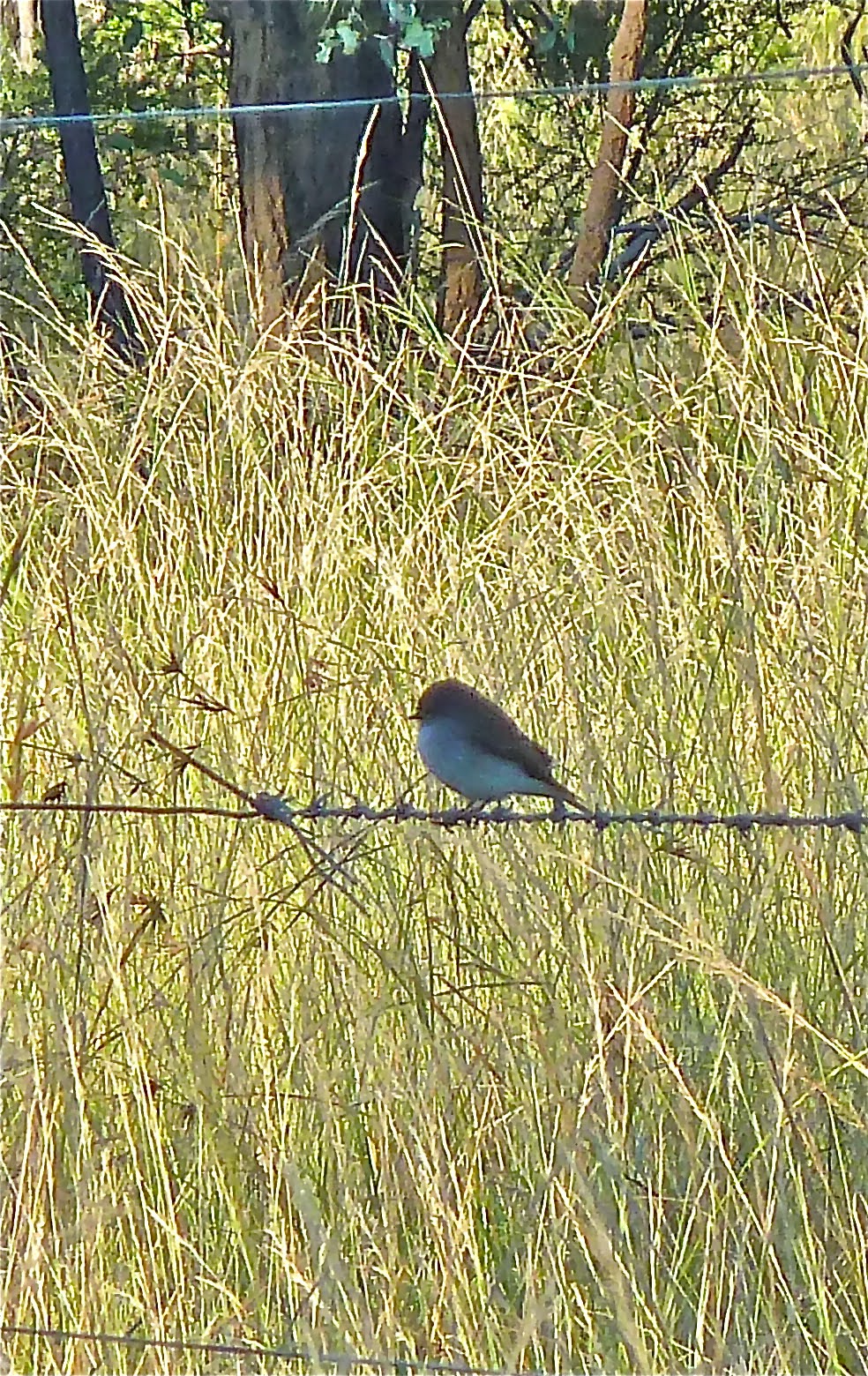
Early-morning bird-watching revealed the following: Little Friarbird, Red-browed Pardelote, Striated Pardelote, White-plumed Honeyeater, Pied Butcherbird, Spiny-cheeked Honeyeater, Royal Spoonbill (in flight), Weebil, Buff-rumped Thornbill, Striped Honeyeater, Raven, Black-faced Cuckoo-shrike, Pale-headed Rosella and Collared Sparrowhawk. For a number of reasons – not least of which was trying to keep up with the fount of all birding knowledge – I only managed to photograph adequately a Jacky Winter, warming up on a wire.
More than 150 species of bird have been logged at Bimblebox since 2003, many of them of conservation significance, and some endangered. There are mammals of conservation significance, and many species of reptile, amphibian and invertebrate. You can read more about the fauna and flora in Bimblebox: A Nature Refuge Under Siege, edited by Maureen Cooper (http://bimblebox.org/book/).

Did I mention how beautiful Bimblebox was? How the sun catches the canopy in the early morning, and the soil matches the pink sky. The Ironbark thickets. And the backlighting at sundown.
My favourite explorer Ludwig Leichhardt passed through the northeastly reaches of the the Desert Uplands in April 1845. He noticed extensively burned Ironbark forest, and observed Aboriginals burning grassland. The region was white-settled in the late 1800s: sheep were reared at first but they weren't really suited to the area. (Barcaldine became known for the shearers' strike of 1891, one of Australia's earliest examples of industrial action.) In fact, much of the Uplands was only used for drought relief by graziers who also held land blocks in the more productive Mitchell Grass Downs. A gradual transition to cattle began. The railway brought development in the region from the 1880s, especially when bores were able to tap into shallow sandstone aquifers, longer-distance fencing was possible and large-scale mechanical land clearance became the norm. More recently, Buffel grass has enabled graziers to upgrade pasture.

In 2000 the present owners purchased the Glen Innes property – which came with a clearing permit – to ensure that it was never cleared. Two years later, the Bimblebox Nature Refuge Agreement was signed with the Queensland State Government. It promised protection in perpetuity. 
More than 95 per cent had never been cleared; nor had it been extensively grazed by previous owners. The state government contributed two-thirds of the price of the property in order to protect the conservation values of this intact ecosystem. The Nature Refuge's guardians had to provide a land management plan, and they continue to report on progress to the federal government every two years. Research into the compatibility of cattle grazing and nature conservation is ongoing at Bimblebox, and has ranged from developing (stock) carrying capacity models for the Desert Uplands, to understanding vegetation change in grazed woodlands, and the use of fire in maintaining open eucalypt woodland. Years of hard graft by the owners and their helpers have eradicated many invasive species. 

Back in 2002, no one envisaged the likes of Waratah Coal – acquired by Clive Palmer in 2008 – baying at the gate in the knowledge of valuable coal seams beneath the Galilee's 'pretty droughty sort of desert' landscape. Waratah's Environmental Impact Statement in 2011 confirmed the worst news for Bimblebox; half of it to disappear in an open pit and half to be literally undermined by a longwall operation. The battle for Bimblebox had to be raised to a whole new level†. One hundred and ten Nature Refuges are currently at risk from (coal) mining leases in Queensland. It would appear 'perpetuity' has been redefined.

The last few months have seen increasing activism among environmental protectors. Governments are just not listening to their concerns: for the conservation of biodiversity; for the preservation of Australia's remarkable landscapes, the security of prime agricultural land. I always believed if the call came one day to make a stand at the gate I insisted on photographing in April that I would answer it. My recent pilgrimage to Bimblebox – for it truly was a spiritual experience – only served to render that commitment a certainty. And I know I won't be alone. 

If you enjoyed reading this – and the other Galilee Road Trip posts – please share with friends and connections. One of our principal aims in making this journey was to spread the word about the Galilee Basin.
Nobbi Dragon
* a makeshift or temporary dwelling, often used on remote work sites or as low-cost tourist accommodation 

With thanks to all those who helped identify plant and animal species
This post was last edited on 15 May 2014