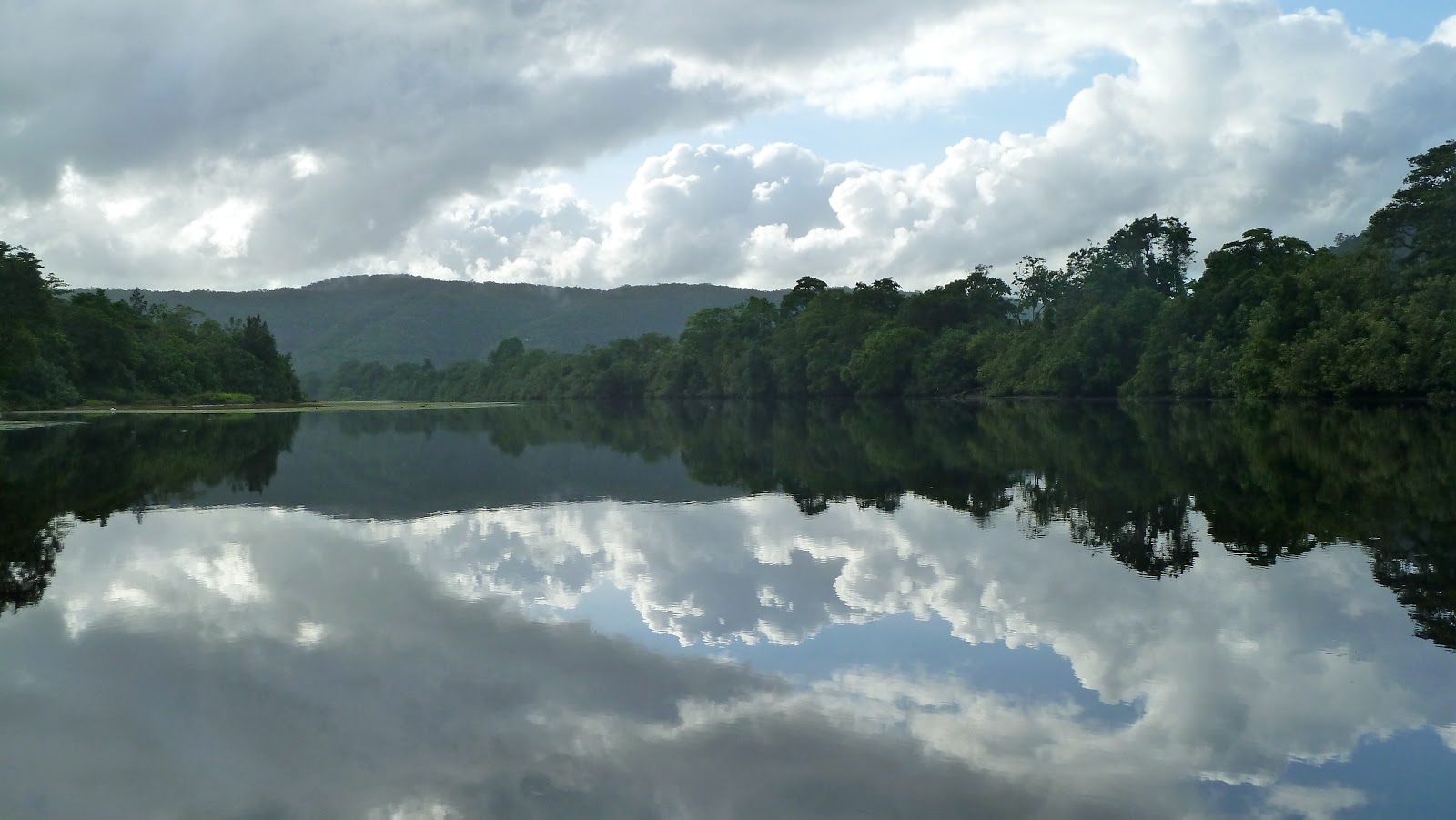
In the past I've debated the relative concept of Far North as opposed to North (see
Roadtrip 1: Heading up North, July 2010). But for the sake of argument, let's just agree that last week I spent three wonderful days in Far North Queensland. It's a special place.
I flew into Cairns and drove straight out again, heading north for Port Douglas along what must be one of the world's most beautiful coastal drives, except it was close to midnight so I barely saw a thing, save when breaking waves glinted in headlights. But I knew the ocean was just there. And within easy reach was the mystical world of the Daintree, an ancient and lush, largely forested world that abuts the Coral Sea in palm-fringed and pale-sanded gems of beaches.
Turning off the Captain Cook Highway for Port Douglas, there's a seemingly endless six kilometres of golf and other resorts. Fine if you like big resorts, but if I were you I'd stay right in the heart of Port Douglas, just off Macrossan (we stayed in The Pavilions apartments) or Wharf streets, with their excellent restaurants and cafes, small shops and still-villagey feel.
The first day was spent researching a suitable location for observing the total solar eclipse the following day, the reason we were here (see
A total solar eclipse... not, November 2012). We also booked a Daintree River trip, shopped Macrossan, dodged heavy showers in Anzac Park, and generally mooched around lovely Port Douglas. (Fourth picture below: a young Osprey seemed unperturbed as we walked beneath him at the southern end of Four Mile Beach.)




That evening we ate at Nautilus, which will have its 60th birthday next year. We chose to share the oldest option on the menu – their 35-year-old special, whole Coral Trout dusted with light Asian spices, and crispy rosemary and garlic potatoes. It was delicious but I almost preferred my starter, crisp skin of pork belly with Granny Smith apple soufflé and piccalilli. My friend began with duck ravioli. And, since I seem to going backwards describing this meal, we relaxed before going to our table with a mango daiquiri (above), and drank to a successful eclipse. The restaurant has a deep-in-the-forest feel even though it's just north of the main drag. There were still showers about, but we didn't care, especially while enjoying a Chandon Pinot-based rosé.
As far as the eclipse went, this crescent sun is probably the closest we got to totality visually. But we viewed from a beautiful setting, there was a convivial atmosphere among observers, and the silvery light show was intriguing.
After breakfast we needed a mission so we didn't hear many more people talking about how clear it had been where they were. We headed inland along the Mossman-Mt Malloy Road. It climbs steeply over the Range with views back over the coast to the north.
Before Julatten we turned right and climbed Mt Lewis Road as far as a grassy clearing and followed a track into the forest. Many of the high rainforest-clad peaks of the Wet Tropics World Heritage Area are not easily accessible: Mt Lewis is an exception. Along the way we came upon some birdwatchers and compared notes. There wasn't much they didn't know about upland rainforest species, and they pointed out Yellow-throated Scrub Wrens (in the centre of the picture below – how's that for camouflage?), a Grey-headed Robin and a Shrike-thrush. We also saw what we're fairly sure was a Lemon-bellied Flycatcher (below but one).
This was Golden Bowerbird territory and our twitcher friends had heard the call. They went 'off-piste' to track him down and found his bower, but that's not what you're supposed to do. The Golden is Australia's smallest Bowerbird but it constructs the largest bower, which is a display area for the males to attract females. Bowers are made of twigs at the base of two young saplings: the twigs are stuck together with saliva and embellished with moss, lichens, flowers and fruit. The male hangs out on a branch or buttress linking the bowers and struts his stuff, but I've only seen that on David Attenborough.
The forest included huge palms and smaller interesting bits and pieces.
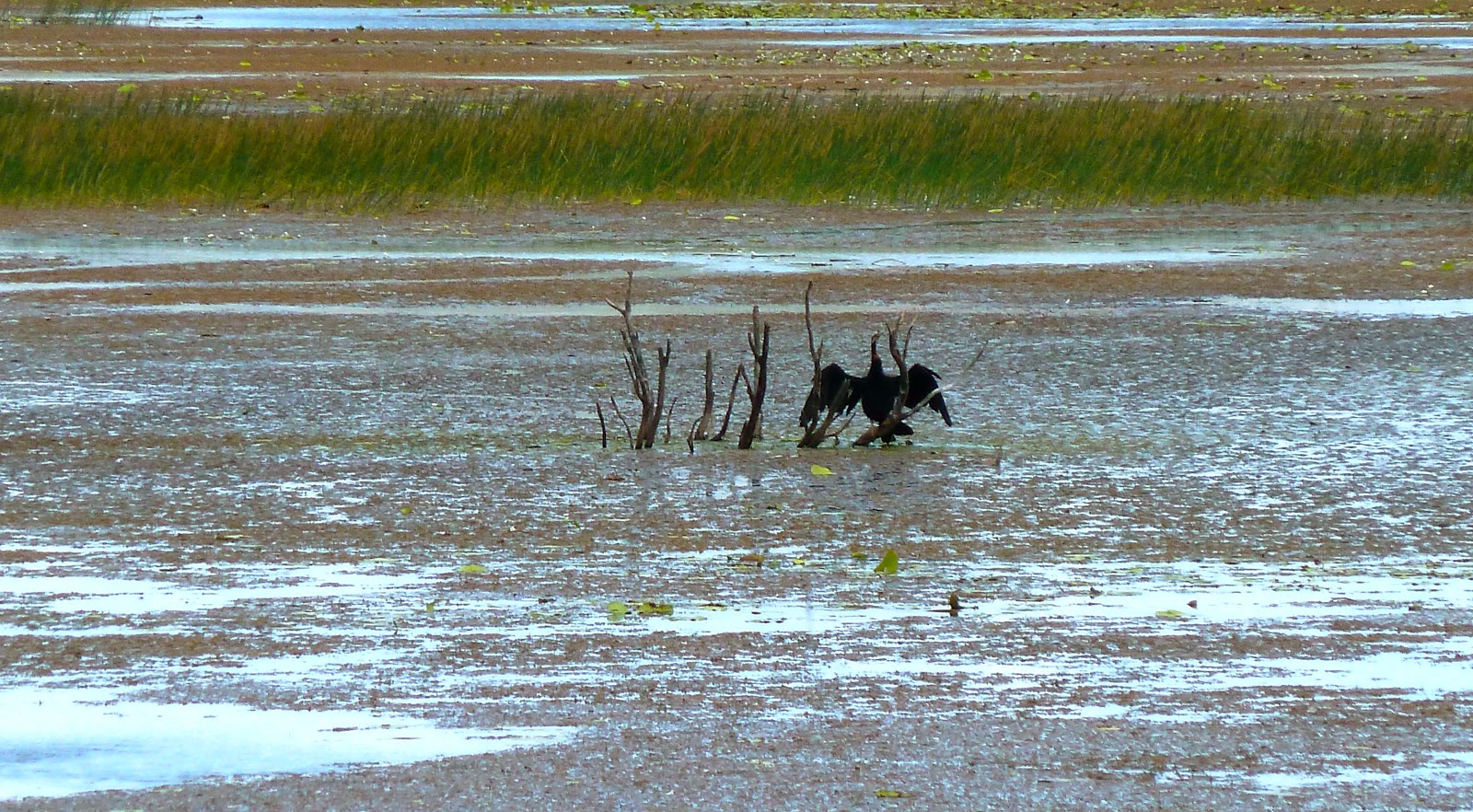
Mr Twitcher gave us a useful tip when I told him we were off to Lake Mitchell on the Mulligan Highway between Mt Malloy and Mareeba. You can pull off the road to view the Lake but you need binoculars to make out any wildlife – and you might have to compete with a van-load of Japanese tourists with far too much equipment. We drove up a dirt road that had gates pretending to be private: the chain and padlock were for show. By the water, big heat contrasted with the shady rainforest.
Black swans swam peacefully with Hardhead and Green Pygmy ducks; there were Brolgas and Magpie Geese and Cattle Egrets in their breeding colours; and Darters with wings out to dry.
On the way back to PD we stopped off briefly at the unfortunately named but prettier than expected Abattoir Swamp. Even though there was a bird hide, there were few to see, with the exception of a family of White-cheeked Honeyeaters making a to-do by the boardwalk.
That evening we soothed our totality-deprived souls by eating at On the Inlet. We began with Jansz bubbles; shared delicious prawns to start (throwing the debris over the side of the deck to opportunistic fish); I followed with barramundi; and then affogato. As we sat down, the light was fantastic, the White-breasted Woodswallows were cute, and boats were returning to Dickson Inlet. All was well with the world again.
Our last-of-three days started with the second consecutive 04.30 alarm. It was still dark as we set out for Daintree village: we were scheduled to leave on our Daintree River Wild Watch with Ian 'Sauce' Worcester at 6. The magic of this mighty river, however, deserves its own post (see
Reflections on the Daintree, November 2012).
After hearty cooked breakfasts and large strong flat whites in the village, we started what was in fact the journey back to Cairns, but we meandered and relaxed and took most of the day. The idea was to visit some tropical beaches that we hadn't visited before; perhaps even sit and read awhile on one of them. We began at Rocky Point (aka Dayman Point) between Wonga, which we visited on our roadtrip in 20120, and Mossman, and ended at Wangetti 50 or so kilometres north of Cairns. For a beachfest, see
How will I live without these, November 2012.
We dipped into Palm Cove, Trinity Beach and Yorkeys Knob among Cairns' northern beaches, but – perhaps with the exception of Palm – they're rather too urbanized for me.
I love this part of the world. It's peaceful and distant and tropical and beautiful. As far as I can see, there'd only be one problem with living here – the stingers that would prevent swimming in the sea for a huge chunk of the year, if not all year round, depending on whom you talk to. So it was with reluctance that I flew back to busy Brisbane and South East Queensland, but with the seeds of plans for future long weekends perhaps.
This post was last edited on 26 November 2012