Showing posts with label Reflections. Show all posts

September 15, 2016

Blogger's block

Bloggers blog with varying frequency: some may produce several short sharp bursts a day; others create infrequent measured treatises seemingly unconstrained by format or deadline.

I'd like to think I blog when I have something to say – recounting a road trip; outraging about an environmental violation; pontificating about grammar; calling politicians to account; or commenting on mores in my adopted country – rather than writing because of an intention I once had to produce five or six posts a month.

I constantly battle time. Editing photographs; fact-finding; tempering passionate beliefs into measured reporting; editing and reworking. All these gobble up time that could be spent lobbying the state or federal government; researching for my volunteer organisations; even studying hundreds of must-read articles and documents I have previously filed away until there was time.

Do I still have things to say?

A week or so ago I moved house (yes, again, for the fourth time in six and a half years). And then, unsurprisingly, I succumbed to a horrible long-lasting coughing bug that's doing the rounds. But for weeks I should have been writing about California's Joshua Tree National Park; drafting a letter to Queensland's Environment Minister Steven Miles on behalf of The Bimblebox Alliance; researching mangrove die-back in the Gulf for Protect the Bush Alliance; and reporting on two rallies in Brisbane, yet another visit to the Land Court, and a presentation by the Environmental Defenders Office (EDO) about the abject failure of mining companies to clean up their mess.

Once there's a backlog, how do you prioritize topics, especially when there are stacks of removal boxes waiting to be filled, and then emptied? And where do you find the wherewithal to keep banging on about the same topics when, inevitably some days, you feel precious little progress is being made?

The first of the rallies was in support of the Palaszczuk Government's legislation – an election commitment – to amend the Vegetation Management Framework Amendment Act of 2013 which 'relaxed' vegetation laws that had been successfully reducing land clearing before Campbell Newman and the LNP came along. In 2014 alone, nearly 300,000 hectares were cleared, mainly to create yet more pasture. Queensland's poor land clearing record had been re-established.

The problem for Labor in passing their legislation was that, since the two Katter Party MPs had declared they would be voting against, the government was dependent on three remaining Independents to get the bill through. Unfortunately Billy Gordon also voted against. Many environmental organisations as well as Government ministers (Deputy Premier Jackie Trad, watched by assorted Cabinet ministers, preaches to the converted at the rally, top) had worked hard to bring the legislation to Parliament, so there was deep disappointment when it failed at the last hurdle.

On the day of the rally (and the vote), I spoke to Rob Pyne, who confirmed his commitment to support the bill. I phoned Peter Wellington's office: as Speaker, he might be called upon for a casting vote. A lady listened, and assured me she'd taken notes and would pass them on, as I made the case for leaving trees be. I rang Bill Gordon's office and left the same message, but in vain. His reasons for voting against were complicated, he explained to others. I suspect the prospect of jobs for young Indigenous men in high-value agriculture had more than a little to do with it.

Barely ten days later some of us were back at Speaker's Corner 'For the Love of Queensland'. This gathering was organised by Lock the Gate to celebrate everything Queenslanders love about their country, and to express concern about food-producing land, water resources and ecosystems at risk from unsafe coal and gas mining. Speakers included Peter Wellington, Rob Pyne and ex-Senator Glen Lazarus, as well as residents of the Western Downs whose lives have been blighted by the actions of unscrupulous mining companies.

Talking of which, I attended an EDO LawJam entitled 'Cleaning up after miners walk away: are you OK with footing the bill?' The speakers were Tim Buckley, Director of Energy Finance Studies (Australasia) at the Institute for Energy Economics and Financial Analysis; Lock the Gate's Mine Rehabilitation Reform Campaign Co-ordinator, Rick Humphries; and Dr Peter Erskine, Senior Research Fellow at the Centre for Mined Land Rehabilitation at UQ's Sustainable Mineral Institute.

If you're angry at the prospect of Santos developing 6100 new coal seam gas wells in the Surat Basin of South-Central Queensland that will, over 30 years, extract 219 billion litres of water, then you'll be furious when I tell you there are 50,000 abandoned mines across Australia, 15,000 of them in Queensland. Of those 15,000, not a single one has been 'relinquished', which I think refers to the surrender of the mining lease following adequate rehabilitation. According to Rick Humphries, in Queensland there is a coal industry financial assurance deficit of $3.2 billion. So who will fund a statewide clean-up?
Whether it's compelling miners to clear up their mess at the end of the extraction process, or, 30 years beforehand, enforcing sufficiently robust environmental conditions attached to an Environmental Authority (EA) before the excavators move in, it is highly questionable whether legislation drafted last century is up to the job today. The absence of a legislative framework that considers emissions reduction obligations, habitat loss and biodiversity extinction, comprehensive cost-benefit analysis, adequate hydrogeological modelling, practical offset management planning preceding mining, and so on, provides grist to the mill for environmental protectors and those defending threatened farmland, communities and areas of high conservation value.

A couple of days ago I attended the Land Court, where the Aldershot and District Against Mine (AADAM) community action group are trying to prevent the Colton Mine from going ahead two kilometres from their homes near Maryborough. Counsel for Colton glibly declared that conditions attached to its EA embraced the precautionary principle; and its expert witnesses unanimously agreed that thousands of litres of waste mine water discharged into the beautiful Mary River – which flows into the Great Sandy Marine Park and the Great Sandy Dugong Sanctuary – would not present a threat to aquatic ecosystems. He pointed out that the duty of the Court was to consider factual evidence, not 'concerns'.

I have concerns till they're coming out of my ears. That the recently re-elected Turnbull government (how did that happen?) is proposing to cut funding to the Australian Renewable Energy Agency, and Labor is not opposing the idea – because they accept donations from the fossil fuel industry, too.

That August was the hottest August on record, as was July. And that neither Australia nor the UK have ratified the Paris climate treaty yet.

That, if it weren't bad enough that Pauline Hanson's One Nation Party has four representatives in the Senate, one of them is a climate change denier with a loud mouth. And it is still possible that Donald Trump could become the next President of the United States.

The blogger's block seems to have been eased. Where to from here? Back to California… perhaps.


July 31, 2016

Hiatus

I haven't written in a while.

I went to Europe; principally the UK but also the Balearic island of Mallorca. I've been back in Bris for a couple of weeks, but went to Victoria for five days.
One of few advantages of long gaps between visits to the home country is that you look around with fresh eyes that provide pleasant surprises. I was struck by the grandiose Victoria and Albert Museum and the postcardy streets of Kent country towns. I admired commonplace red brick and hung tile house construction in Surrey; and marvelled at green-tunnelled narrow lanes near home.
It was almost seven years since I'd been to Mallorca, and I had forgotten how beautiful are the streets of Pollença hill town and the narrow ways through flowers and fincas (large inland properties) along the pretty route to the Pollença Bay and Puerto de Pollença.
Even London surprised. I had expected noise and dirt and overcrowding. Instead, I found the place invigorating. We revisited the familiar: from Waterloo Bridge my friend counted 42 cranes. We noticed that St Paul's is more lost then ever in a heavy towering skyline. In contrast, The Shard is barely there and at times almost ghostly. I explored some new. I met a dear friend I hadn't seen for five years one warm sunny day. We talked long and serious over a Greek lunch at Limonia on Regent's Park Road – where among individual shops was the best display of rosés I've ever seen – and then sat and stared from the top of Primrose Hill. It was as if I'd seen my pal only last week: that's what friends are for.
 
Despite my former employer, London's Evening Standard, declaring more than a year ago that the hipster was finally dead*, Gordon Ramsay's Union Street Cafe in Southwark still sported one or two. The food was far from awesome, and overpriced. I left hungry. Our waiter continually topped up the glasses – the oldest trick in the book – so that several bottles of equally extortionate wine made for a scarier bill than any of us intended. The next evening, Buenos Aires in Reigate seemed enormously good value by comparison. The carefully tailored Argentinian steaks, chubby chips and chimi churri sauce were delicious, filling and didn't break the bank. As we left, a beautifully Turneresque sky reminded me of what I probably miss most in Queensland – late light summer evenings. (Spot the passenger jet headed for London Gatwick.)
Another food experience I hadn't realised I missed so much was shopping in Waitrose (a supermarket, for the uninitiated). Oh, the joy of being able to buy wine or beers as well as food; sustainably sourced fish; fresh pasta shapes other than long thin or filled varieties; several options of Cheshire cheese; rich and chocolatey mini chocolate rolls; mini Melton Mowbray pork pies; delicious freshly made pastries; and generally high-quality stuff. Even cut-price Robert Harris novels. I looked for excuses to visit daily.

In Pollença, the Sunday morning market was just as ever it was.
Politically, these past weeks have been a nightmare. On 23 June, 17 million citizens of the so-called United Kingdom voted in a referendum for their country to leave the European Union: 16 million of us voted to remain a part of Europe. I do not think it is an exaggeration to say I was devastated. Dumbfounded. In shock. It took until the following day for anger to set in. It's still there. I cannot bear to go into the details of this extraordinarily selfish, short-sighted and stupid exercise, or explain why and how it came about, except to say that the complexity of the issue of whether to go or stay was way beyond the intellectual capacity of vast numbers of voters, and should never have been reduced to a one-liner on a referendum ballot paper. 

I am a European first and foremost: always have been; always will be. I will not now work towards or support a long, tedious and expensive process of extraction that will be detrimental to my children's and my children's children's future; not to mention my return.
Two days prior to this day of disaster, I went to Australia House to vote ahead the federal election on 2 July. Postal voting ballot papers had not been printed before I left Australia for London, and I was not going to rely on two directions of unreliable postal service, with time limits. It was a rather pleasant experience, and an education, it being the first federal election in which I was eligible to vote. In my youth, I remember Aussies I shared houses and work spaces with having to do this periodically. Never did I imagine I would be grappling with the concept of above- and below-the-line choices of candidates, and voting papers more than a metre long. I was surprised to see enthusiastic canvassers outside the 'polling station', handing out 'how to vote' leaflets just like they do here.
I wonder if such pamplets might have educated Brexiters so that they hesitated before picking up their pencils to cast my home country adrift after 42 years of EU membership. Of course, the results of the Australian election weren't good either. They trickled through painfully slowly, and even though it looked like a hung parliament for a while, too many Aussies voted for more of same-old Mr Smarm. But only by one seat, I have learned today, as the final recount saw Labor claim the former Liberal stomping ground of Herbert in Queensland. Mr Smarm therefore achieved nothing by calling a double dissolution election (for the House of Representatives and the whole of the Senate): he will have exactly the same problems getting unpopular policies through as he did before.

All that remains is for the US to vote Trump into the White House for the world to spin off its axis. This last week, Hillary Clinton has won the Democratic nomination. I dare to hope that an even greater catastrophe than Brexit can be averted in November.

It takes time to readjust to being back after weeks away. You miss family, friends, animals; and the unique characteristics of the place. This was a new friend I made while gardening. It's a good job Eric doesn't spend much time in the garden these days.


May 30, 2016

So much to be sorry for

March 26 is National Sorry Day in Australia. It was instigated following a report* entitled Bringing Them Home, tabled in 1997. The report made 54 recommendations including healing initiatives, reparations and a formal apology for those affected by the policy of forcible removal of Aboriginal and Torres Strait Islander children from their families and communities – between the late 1800s and the 1970s – in the name of 'assimilation' and 'protection'.

These children become known as the 'Stolen Generations'. The children were raised in institutions or fostered by non-Indigenous families. Few were allowed visits from their families; most were so far away as to make that impossible. Such removal was official government policy until 1969, although the practice didn't stop then. In fact, it is alleged that these days far more Aboriginal children are removed from their homes than during the Stolen Generations, except that now they're described as being in 'out of home care'.

Some victims never recovered from the trauma of losing their family and the isolation from their culture and the all-important connection to country. Long-lost family members are still being reunited by means of organisations such as Link-Up Queensland which, as well as helping people search for and reunite with their relatives, provides counselling for those suffering from the trauma of separation.

The following day, the 27th, is also a significant day, being the anniversary of the referendum in 1967 in which Australians voted to include Aboriginal peoples and Torres Strait Islanders in the census and to empower the Australian government to legislate on behalf of those peoples. It took a number of years, however, for the government to pass laws for the benefit of Aboriginal people. Gough Whitlam established the Department of Aboriginal Affairs in 1972, and in 1975 he gave the Gurindji people of the Northern Territory the title deeds to part of their traditional lands.

The 27th marks the start of National Reconciliation Week, a time to celebrate shared culture, history and achievement towards reconciling the peoples of Australia. Each year there is a theme, and for 2016 it is Our History, Our Story, Our Future. June 3 marks the end of that week and is the date of the famous Mabo decision in the High Court in 1992 that upheld the native title rights of Aboriginal peoples and Torres Strait Islanders over their lands post British colonisation. Eddie Mabo from the Murray Islands in the Torres Strait had challenged two assumptions under Australian law: that Indigenous peoples had no concept of land ownership before colonisers arrived in 1788, making the continent and its islands terra nullius, land belonging to no one; and that British sovereignty gave ownership of the land to the Crown and abolished any rights that might have existed previously.

The journey towards Reconciliation between Indigenous and non-Indigenous Australians continues. Link-Up counsellors are still busy soothing the pain of the Stolen Generations, and not all the Bringing Them Home recommendations have been realised. Debate rages about precisely where Reconciliation should go from here, and opinions are divided. Recognition of Aboriginal and Torres Strait Island peoples in Australia's constitution** is one of the thornier issues still requiring national debate.

A formal apology for past mistreatment was made by Prime Minister Kevin Rudd in 2008 (below, the plaque in King George Square, Brisbane: click on image to read).
It included a proposal for a commission to close the gap between Indigenous and non-Indigenous Australians in terms of educational achievement, health equality and life expectancy, and economic opportunity. That gap is still considerable. I quote from journalist Stan Grant's speech as part of an Intelligence Squared debate in October 2015.
My people die young in this country. We die ten years younger than average Australians, and we are far from free. We are fewer than three per cent of the Australian population and yet we are 25 per cent, a quarter, of those Australians locked up in our prisons, and if you are a juvenile, it is worse, it is 50 per cent. An Indigenous child is more likely to be locked up in prison than they are to finish high school.
If you are tempted to conclude that Indigenous people should 'move on' from, or 'get over' two centuries of mistreatment and disadvantage, then read Stan Grant's book published earlier this year, Talking to My Country. It makes for sobering reading, but you will be enlightened about how it feels to be an Indigenous person – even an enormously successful one – in Australia in 2016.

It is not my intention to insult my host country, but many Australians have a lot to learn about Indigenous culture and experience. I have learned a huge amount, especially from other recent publications. Lesley and Tammy Williams's Not Just Black and White tells of Lesley being sent away from home by the Queensland government to work as a domestic servant, aged 15. This was in the 1960s. Her wages were kept in trust by the government even though she didn't know she had earned them until years later. Her nine-year battle to claim back her 'savings' presented an almost bigger challenge than being separated from her family. Her enormous courage resulted in a more than $55 million reparation package for Indigenous workers in Queensland.

The case for greater attention to 'Our History' is made starkly by Bruce Pascoe in Dark Emu Black Seeds, recent winner of a NSW Premier's Literary Award. Pascoe systematically destroys the myth of a continent populated by hunter-gathering roamers prior to colonisation. Based on evidence from explorers, drovers and early settlers, he describes the construction of permanent dwellings, dams, wells and storage facilities; the cultivation of grain, the baking of bread, and the transformation of unpalatable plants into everyday staples; large-scale fishing methods; conservation, economics and spirituality. He has to conclude that deliberate and concerted denial of experience combined with wilful destruction and massacre was employed to justify the seizure of a land from its rightful occupants. The obliteration of facts has been perpetuated. 'Such is the tenacity of the Australian delusion', Pascoe says, 'it encourages an impoverished national debate.'

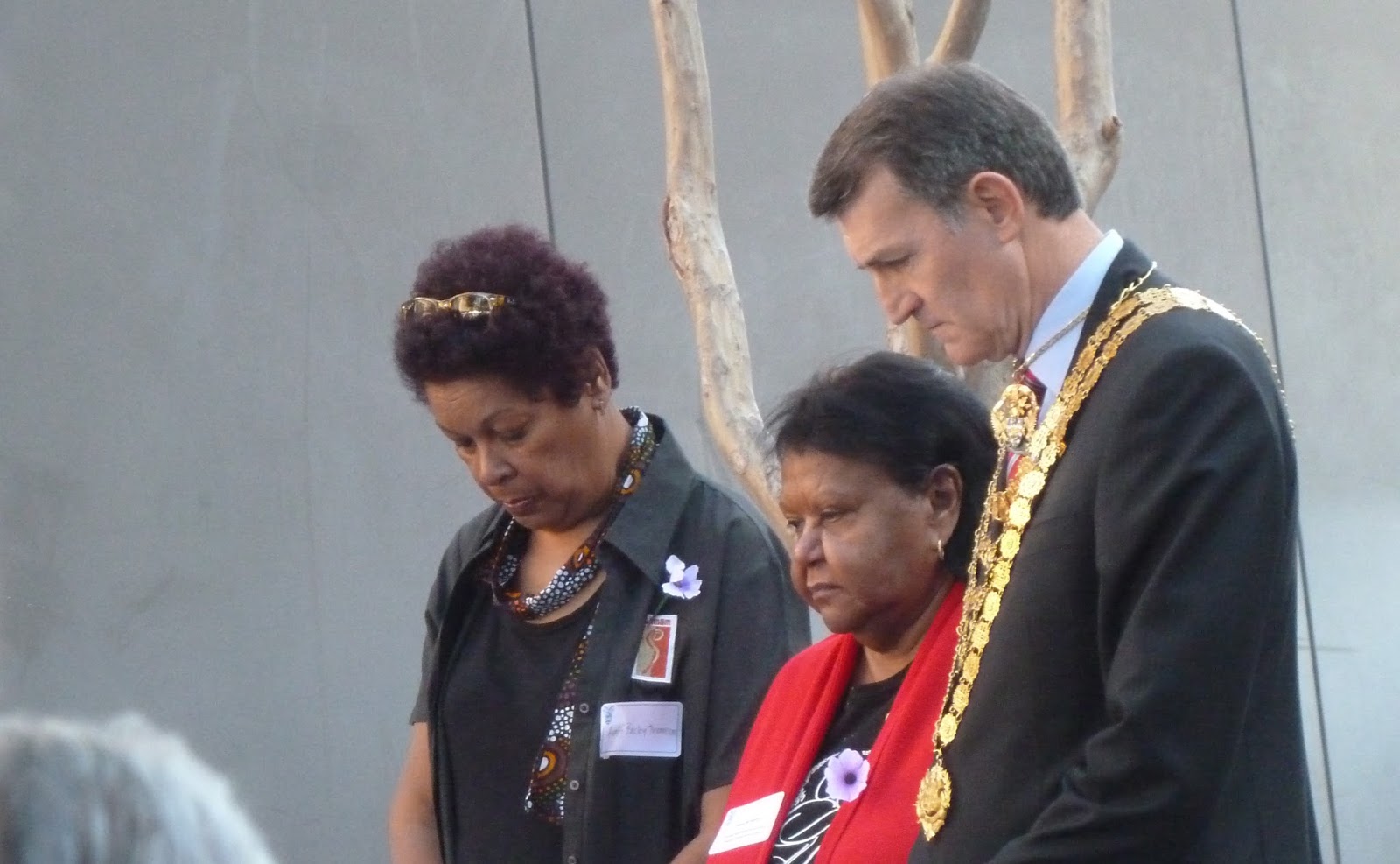
It was a glorious late-autumn day in Brisbane as we gathered to commemorate National Sorry Day in King George Square. It was a solemn and moving affair. What on earth was I doing there, you might ask. I was there in solidarity, I suppose, with a people sorely wronged in the past and still waiting for their chance at a fair go.
* The report was produced by the National Inquiry into the Separation of Aboriginal and Torres Strait Islander Children from Their Families, established by federal Attorney-General Michael Lavarch (Labor) in 1995
** http://www.recognise.org.au


January 6, 2016

The tyranny of distance

It was the time of year when you realise all over again that christmas in subtropical climes will never be right. When for weeks you want time to accelerate; and then stall; but naturally it does neither. When passenger planes giveth, and taketh away.

The worst part of that last bit is when you've dropped your precious cargo off hours prior to long-haul, and they wait apprehensively in Departures while you sit forlornly in an oddly silent lounge 15 minutes down the road. Can't bear that interval.

Our family's norm is a half-planet separation. In this continent of vast proportions, even the Great Ocean Road contingent is a major mission from Brisbane: at least two hours' flying time, then a one-and-a-half-hour drive. There's no popping down for an impromptu Sunday lunch. Our mutual christmas gift was ten days' togetherness.

A phrase often heard in Australia, The Tyranny of Distance (How Distance Shaped Australia's History) is the title of a book written by Geoffrey Blainey, first published in 1966. It's a must-read for an Australian education, like The Lucky Country, The Australian Ugliness and A Secret Country*.

These days, it often describes the tribulations of large-hatted Independent federal MPs who work in Canberra but represent sparsely distributed constituents in regions of Queensland larger than an average European country. Or long lonely journeys through hitherto unimaginable and inhospitable remoteness, which some folk actively seek but others avidly avoid.

And the emotional angst of expats briefly reunited with nearest and dearest before being brutally wrenched apart again by an inevitably untimely farewell.

In the days before the first arrivals, clutching many to-do lists during countless shopping forays, I tripped across town to collect a real christmas tree. I asked if I could linger awhile in their yard, inhaling pine nostalgia. I hadn't realised how much I missed it. Some things never leave you despite the best of adventures in new lands.

We were blessed with cooler-than-hot temps and lower humidity than usual for many of the ten days, but the passions of close family members deprived for an unacceptably long time were not to be dampened by the temporary absence of Queensland's summer. All was not trauma and tears, however: long-overdue tellings evolved from confessionals; we were all aMaezed; and in the end, the love you take is equal to the love you make; they say.

Then the aftermath… once-busy rooms stripped of bedding and joy; decorations down three days early; borrowed extras returned; and hours of escape into 700+ pages of the 2015 Man Booker shortlisted A Little Life.

Normal service will resume shortly.

* by Donald Horne, Robin Boyd and John Pilger respectively


December 13, 2015

We'll all remember Paris

Polar bears in Paris (credit: Matt Dunham/AP)
This morning was like waking up the day exam results are due. Important exam results. Overnight, while we slept in a country far away from climate change action, a 31-page agreement was adopted by all 196 countries of the world, in Paris. As we had gone to bed, the UN and French organisers of COP21 were making their last heartfelt appeals. In stressing the last opportunity to be history makers putting the planet on course to avert calamitous climate change, they were cleverly making it well nigh impossible for any country to put the kibosh on a deal. Imagine the global opprobrium.

The key difference between exam results day and the finale of the Paris climate conference is that pass marks soon become less meaningful as time passes; whereas the lesser or greater degree of commitment to defined and necessary actions agreed at the Conference of the Parties will be of increasing significance in a warming world over the next couple of decades. Exactly how we will remember Paris is the point.

While I am pleased about delegates' positivism about their achievements, it's highly unlikely I would ever have been happy with the outcome. I do, however, acknowledge that it could have been far less satisfactory. For two weeks, the attention of the world has been focused on climate change, all the more so because the leaders of the world's greatest powers took it seriously. And renewable energy will get a bigger profile as a result; witness Malcolm Turnbull's reversal today of That Idiot Abbott's ban on government funding of wind power.

There are big buts, however. 'Parties aim to reach global peaking of greenhouse gas emissions as soon as possible, recognising that peaking will take longer for developing country Parties…' is disappointingly woolly, and no more than an aspirational statement.

There's no statement of intent to leave all coal reserves in the ground. That means no new mines, anywhere, from this day forward. Coal isn't mentioned at all in the agreement, in fact. Nor oil. There is no directive that says further fossil fuel exploitation must cease. Now.

There's nothing about protecting the oceans, from death by oxygen depletion, acidification or overfishing. And no suggestion of curbing the vast emissions from animal agriculture. Or details of how to accommodate large numbers of climate refugees forced to move by overpopulation, harvest failures, dust-bowlification, rising sea levels, and so on.

Worst of all, the biggest issue didn't even get a look-in at COP21. System change. Was it even on the agenda of a fringe meeting, bearing in mind that the world's largest corporations and industrial lobbyists funded the whole shebang and packed it out? Business as usual is simply not compatible with big enough action on climate change. Alternatives to capitalism have always been in the too-difficult box, however, and no one took along the key with them to Paris.

It's admirable that everyone agreed that a 2-degree rise in global temps was too high and a maximum of 1.5 degrees should be the target. But the pledges (Intended Nationally Defined Contributions, or INDCs) to curb emissions made by countries before they got to Paris would see temperatures rise by 2.7 degrees, and don't forget that Earth has already warmed by one degree. So, the hard work starts once delegates are back home and left to their own devices. That's why there's going to be a 'stock-taking' of emissions achievements every five years. The INDCs, though recognised by the Paris agreement, are not legally binding, so a review mechanism is essential to ramp up pledges so that the target temperature is met. It could be argued that, given the degree of warming already, five-year gaps in monitoring are too long. And where are the fines (with proceeds to the climate aid fund) for laggards?

In addition, mechanisms were put in place recognising 'the importance of averting, minimising and addressing loss and damage associated with the adverse effects of climate change'. And to make finance available for developing countries to adapt to climate change and make the transition to clean energy. In case you think these points are obvious and must have been relatively easy to insert into the agreement, bear in mind that Saudi Arabia, a 'developing country' apparently, lobbied for financial aid beyond the point at which the bottom drops out of the oil market completely.

In years to come, perhaps people will ask, 'Where were you when the climate change talks in Paris changed the course of the world?' I'd like to think so. I'd also like to think my awareness of an accelerating sea change is more than wishful thinking. It's not where I am right now, on the bottom right edge of the planetary map, but it's out there. It was in Paris, but among the 10,000 who filled the streets, post-COP, and created red lines of danger o'er which we step by not doing enough soon enough. There are reasons to be cheerful, as long as you relish the prospect of the challenge facing everyone in future. Ostensibly not much has changed, but maybe it's too early to see that everything has.

Goodnight.


December 30, 2014

Flying home for christmas

The great escape… from heat and humidity and terrific storms.

Taxi at 9 pm.
A no-wait, painless check-in at Brisbane's International terminal: reassuringly normal service from Singapore Air.
But a new rule: a strict weight limit on hand luggage. Since the G20, they said. Carry your laptop separately, they said.
Departure just about midnight. Strange time to fly anywhere.
A full meal is served: I am not hungry but I eat. I get hungry on planes despite doing nothing. And not being in control of my next meal makes me anxious.
Timelessness: night or day will be largely irrelevant for 24 hours.

A couple of hours' disrupted sleep. Then bright lights, hot flannels and breakfast. Still two hours out from Singapore.
Smooth landing at Changi. Still dark.
Coffee, shops, half-hour massage.
Slight delay to board our Airbus A380.
We had reserved seats A and C in the vain hope of an empty one between us. The intruder is an Asian lady who doesn't want the window seat. I won't give up the aisle, so my friend and I sit apart for the duration.

Thirteen hours and 40 minutes to LHR…
Sudoku, a second breakfast, 100 pages of Richard Flanagan (The Narrow Road to the Deep North), a little sleep, a film (The Hundred-Foot Journey), lunch, another 100 pages of Flanagan, a second film (Tracks), a further sleep.
My new policy: sleep when the need arises.
Flight-path wiggle north of Delhi. To avoid a storm? I ask why but never get an answer. They're busy.
Unusual route over Europe, not across the Aral Sea and almost as far north as Moscow. Where is Ukraine?
Stacked over Essex. Twenty minutes late landing.

Terminal 2 dysfunction. The longest walk to immigration. Vast queues. Passport scanner doesn't work for me. I am directed to a short queue for scanning failures.
Massive baggage reclaim hall but not all carousels are in use. Our flight sharing with another. Cases being taken off by airport staff and piled on the floor. Not easy to monitor piles and conveyor belt.
No signage. Where are car rentals? Where are the buses to car rentals?
Lovely Turneresque wintry sunset.
Bus ride to Avis complete with cheeky-chappy-Cockney chatterer.
My friend's name is not on the Preferred list ready for pickup. The car is brought to us. Small, sporty and only comfortable enough for two. Aggressive red. Tiny boot; cases on the back seat.

How do we get out of here? Wrong way along the Perimeter Road. The M25 seems crazy-fast after Australia. But no variations in the maximum speed limit, yay.

About half an hour later we arrive at our destination. Dorking, Surrey. Beep-beep-beep. Big hugs.

It is 6 pm. That's 30 hours door to door.


June 17, 2014

Killing the golden goose

We humans have a penchant for killing golden geese. We can't help ourselves. We come across a good thing, enjoy the experience in one way or another, desire more of the same, and so do it again, and again. And then we think of ways we can have the experience more often or more easily, expand its boundaries or intensify its effects: in other words, we get greedy.

When I escaped to my first Greek island, I couldn't fly there direct. In fact, I took a train from London through France and Switzerland to Brindisi on Italy's Adriatic coast, from where I sailed to Patras in Greece. Then I went by train to Athens, from where an island-hopping ferry took all day to reach my destination. Late in the evening, I climbed a steep cliff path, worrying about a donkey carrying my backpack. I walked the narrow uneven streets of a tiny main town looking for a room or roof space where I could sleep. These days, Santorini has an international airport and many boutique hotels offering luxury service typical of a myriad establishments elsewhere.

When I first snorkelled on the Great Barrier Reef, I took a Chinese junk with fewer than two dozen people from Port Douglas to an offshore island. The boat came to a halt somewhere between the two and the boatman had to dive beneath to fix it while we sat soaking up the sun and gazing across the Coral Sea. We got there eventually. Now you can travel with hundreds of people on hundreds of high-speed catamarans to multi-level pontoons that provides a variety of services. Reef tourism generated more than A$6 billion in 2013, employed more than 60,000 people, and brings about two million visitors a year (figures from the Great Barrier Reef Marine Park Authority). Inexperienced snorkellers and divers can break bits of coral off to be washed up on the beaches of Cape Tribulation. A recent report confirms that the state of much of the coral, particularly on inner reefs, is 'poor'.

Anyone who reads this blog will know how often I return to Byron Bay in New South Wales. This most easterly point of the Australian mainland has five magnificent beaches, its own resident pod of dolphins and a je ne sais quoi that repeatedly draws its fans back, almost slavishly. The residents have fought hard to prevent high-rise development, monstrous burger bars and antisocial water sports, and to preserve the town's quirky alternative culture that evolved from surfing and hippiedom decades ago.

Now they have a real battle on their hands, however, in the form of a proposed large development on the west side of town. This will increase the permanent population of Byron Bay by a significant proportion and bring many more visitors, whose cars will clog already congested streets and whose numbers will pack out cafes and bars way beyond already stretched capacity. The local Byron Shire council have rejected the proposal three times. But the developer obviously considers himself above the democratic rights of citizens to determine how their town 'progresses', and has appealed to the state government for approval. That New South Wales government is of the political persuasion that supposedly espouses the 'small state' and devolution of decision-making, so it will be interesting to see how they resolve the dilemma of dogma versus greed.

Inevitably, the West Byron project will have an adverse environmental impact. Not far beyond the furthest part of Belongil beach in the picture above is a creek of the same name. There are no homes nearby, holiday or otherwise, and most people do not venture that far up the beach, so the creek has excellent birdlife and a tranquility that belies the town's hustle and bustle. It is feared that koala colonies will be disturbed by the proposed plan and the pristine creek waters put at risk of pollution.

There are even fatter, shinier geese along Australia's remarkable east coast. Hundreds of thousands if not millions of people aspire to live in 'harbour' developments of ostentatious houses complete with their own docks. Others want to moor their boats in posh marinas, even if it's at the expense of Indo-Pacific Humpback dolphins that don't like deep water. Or drive their 4WDs along beaches on the world's largest sand islands, leaving their plastic behind from camping and fishing and restricting the range of the nation's last few pure-bred dingoes. Land is cleared or reclaimed and sea channels dredged to build ports that accommodate bulk carriers transporting Australia's coal and gas riches to demanding Asian markets.

And the coal and the gas comes from more and more mines and wells spreading out like grabbing fingers across the land, some of it prime agricultural land. Queensland, not content with developing the Surat Basin and the Bowen Basin and the Moreton Basin, has huge plans for the Galilee Basin and the Maryborough Basin. Much of the product is not for Australian power stations but to generate export revenue to get the states back in the black. You see, not so long ago coal brought in lots of dosh, creating a 'coal boom' that got everybody excited, and addicted to the wealth. Unfortunately, falling commodity prices have coincided with right-wing state governments that have no misgivings about sacrificing landscapes and all who live within in order to solve their budgetary deficit problems. But if current economic trends continue, the land will have been despoiled and the mines will be stranded assets: the goose will have been poisoned and there will be no more riches to be garnered.


May 15, 2014

Bimblebox: pause for thoughts

We humans have reinvented God a dozen times in the past 5000 years... Yet divinity is accessible, free and indisputable, all around for all time, every day for everyone – with just one simple law. Nature is sacred. Soil, water, air and all that lives within. Unnecessary disruption is sacrilege. And here, you will know why, for nature still speaks – kindly but clearly – come close, listen to my story, treat me with reverence, and you will live and die well.
It's alone in the wilderness you can find this essential truth, rising above the morass of a troubled humanity that in contrast seems so lost in a contortion of endless fleeting words, exaggerated images, mixed messages, and fickle impulses.
To sacrifice a place that offers so much timeless priceless insight for 30 years' worth of dirty old coal is to lose that last hope for all of us.
Ian Hoch, co-owner of Bimblebox Nature Refuge* 
In the Land Court last year, Paola Cassoni, co-owner of Bimblebox, finished her submission with these words.
Finally, my last word is a tribute to our water.
As a prerequisite of life, water is hardly an optional extra or a luxury of personal choice. Loss of water, or significantly degraded water quality, isn't an inconvenience, it's the end game for the Desert Upland rural communities.
We treat water with reverence and grace. We don't over-extract, and we marvel that even in a year of drought like this one, water still comes to us in our bores, and we know we will be able to survive this dry landscape once again. But for those who have never been short of water, they can't understand our anxiety. We will be living our next 30 years or more, knowing huge voids will be continuously draining our precious water supplies.
By nature's good fortune, we are able to keep the bulk of our water conveniently stored away in shallow, life-giving arteries. With a water supply protected from the drying atmosphere, the Desert Uplands is a gift to the world and to the few who make it their home. 

* from Bimblebox: A Nature Refuge Under Siege, edited by Maureen Cooper (for details, see http://bimblebox.org/books)