Showing posts with label Natural world. Show all posts

January 23, 2014

Teach your children

A few months ago I asked Brisbane City Council if they would plant a tree outside our house. There always used to be one, on the nature strip, but it did not survive the renovations. Council approved my request and, early one Sunday morning late in November, they planted a Tuckeroo sapling that I'd promised we would care for, by mulching and watering.

Little Tree, as it has come to be known, has flourished. A couple of weeks ago, my neighbours were seeing off some visitors who were parked alongside Little Tree. The children were loitering: their mother obviously wasn't saying goodbye fast enough, and the boy starting pulling Little Tree over by its leaves and letting go, so it sprang back. His sister pulled a couple of leaves off to pass the time. Ordinarily, I would have asked them to stop, but our neighbours are strange and I wished to avoid confrontation. 


Earlier this week, while walking in a local park, I watched in dismay as a young woman let two fast, powerful dogs chase two Masked Lapwings across the football pitch – twice. The park is not a dog off-leash area.


These incidents got me thinking about how we raise children with regard to the natural world. It's not rocket science, but I am frequently surprised that what I consider to be obvious, obviously isn't.


* There's a good reason for 'Don't feed the wildlife' signs – our food doesn't suit most animals – so don't do it. And don't set the precedent: 'Let's go and feed the ducks, roos, etc...'.

* Respect all living things. A bat is just as worthy as a koala, just not as cute... or as good at earning tourist dollars.
* Take home ALL your rubbish and belongings after picnicking, camping, swimming, fishing, sailing, sunbaking etc. Leave only your footprints, not your broken thongs.
* You don't have to have two dogs or more: one's just fine (working dogs in the bush being the exception). Multiple dogs in the city is not clever nor good for your carbon footprint†. Adopt a Phillip Island penguin instead*.
* Always keep your dog on a lead if there is any wildlife nearby, or the possibility that there might be. And keep your dog quiet, especially at night: if it's a yapper, bring it in from the yard.
* Go quietly. If you're walking in the bush or along the beach, remember that other people may be listening to birdsong, waves breaking or simply the silence. You'll never see animals if you crash about.
* If you're driving off road, respect the land and those who work and use it: leave gates as you find them; always watch out for animals, not just at dawn and dusk; never disturb seabirds resting on the shoreline; and don't even think about circle-turning on the sand or carving your name in wood or rock. Leaving your mark is not smart, it's dumb...

Above all, set an example of wonderment and celebration in biodiversity and landscape. Teach your children to see clearly, and to explore what they see; to value it and to question those who would exploit it for the gain of a few at the expense of the many. With a bit of luck we'll produce committed guardians of a planet under siege. 

A few weeks ago I read a piece in a magazine OneEarth, an online forum for thought and opinion about the environment. It is a long piece but I recommend you read it. It's the story of three people who paddled 92 miles down the Kobuk River through the boreal forest in arctic Alaska, and is an inspiring celebration of raw experience in a wild, wonderful place. A place that will be obliterated by mining and roads if the governor of Alaska has his way. In the face of madness, the writer concludes:
It's not so much that we are trying the save the beauty and efficacy of the natural world; rather, it saves us.
† http://theconversation.com/what-about-your-carbon-pawprint-9878
* https://penguinfoundation.org.au/donation/?newForm=1
** http://www.onearth.org/articles/2013/12/alaska-kobuk-valley-open-pit-mines


March 24, 2013

Head in the clouds

On the way back from a trip last weekend, we spotted this amazing cloud. The lower frill resembled cascading water. I had to veer off the Bruce Highway and dash to Deception Bay to get a better look. Ever in search of a roll cloud (see below), I dared to hope this might be the moment. I think, in fact, this was a shelf cloud, but I'm not a hundred per cent sure, and would love some advice from a seasoned cloud gazer.

I love clouds, even grey ones. Huge billowing thunder clouds, while they may be deeply disconcerting, are at the same time irresistible. Benign grey skies can provide a wonderful respite from burning hot blue. But not formless Tupperware, thanks. That's as oppressive as ever it was.
Tonight, we have had the most extraordinary storm: no fork lightning, thankfully, but almost continuous sheet lightning, which appeared green as the storm approached. There was another shelf cloud. It went dark an hour early thanks to this mother.
Clouds represent meteorological drama: they are portents; prophets. In the UK, we used to look up with dismay at a mackerel sky approaching towards the end of a summer's day: it meant the end of warm sunshine for a while. I love advancing frontal lines that herald weather that may be still back over the horizon but is inexorably on its way.
The photograph immediately above is one of my favourites: it's Brisbane-on-sea.

There are all sorts of creatures among the clouds. There might be a crocodile lurking in the CBD; a tropical sea monster guarding South Molle in the Whitsundays; or a polar bear-Chewbacca cross giving chase. Even Abe Lincoln came to watch the cloud show one day. Oh, c'mon: use your imagination.
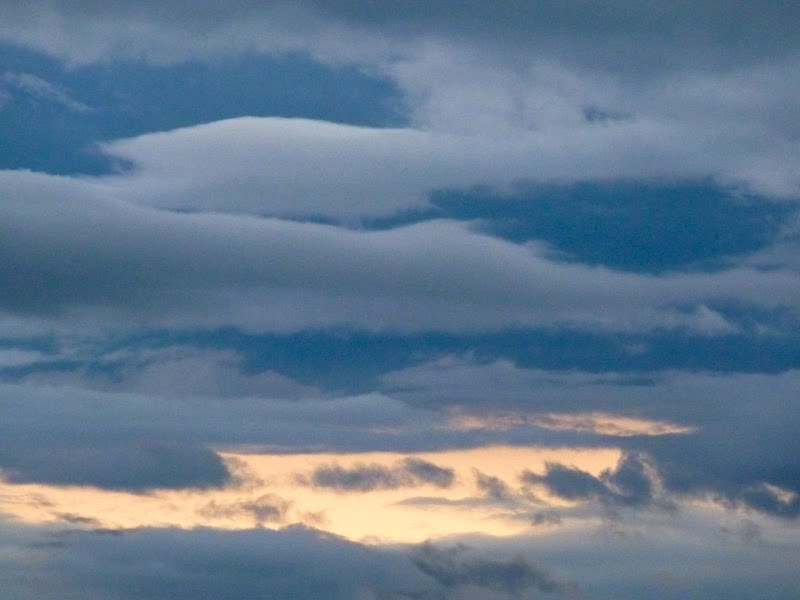
Layering produces great colours.
Sometimes there are light shows...
Or interesting lines...
And then there's plain old drama. Once I saw a cloud drowning.
I have great cloud ambitions – mammatus, lenticular, barrel. And the most famous roll cloud of all – Morning Glory. A roll cloud is a low, horizontal cloud like a tube. It differs from a shelf cloud by not being attached to another cloud or associated with storm clouds. Morning Glory is the only roll cloud that can be predicted, roughly. Its formation depends upon frontal systems over central Australia, high pressure over northern Australia, and high humidity and strong sea breezes over the Gulf of Carpentaria and Queensland's Pointy Bit. It occurs between late September and early November: there may be one cloud or a series, each up to 1,000 kilometres long. Sometimes it occurs over land, but your best bet is from over the sea. I wish I could say I'd taken this image. Maybe one day...


September 29, 2012

Fire and rain

In cool, damp Northwest Europe the only time you see a wildfire is on the television news, and only when it has been particularly bad, such as in Victoria in February 2009, when there was the greatest ever loss of life (173) in an Australian bushfire. Hundreds more were injured.

Here bushfires are so common there's even a season for them – that is, when it gets hot, dry and windy. Many plant species have adapted to them or are even dependent on them, for seed dispersal or stimulating new growth. Indigenous Australians have used fire for thousands of years to clear tracks and extend areas of grassland for hunting purposes. (See also Bushfire Season, September 2011.)

Right now Queensland is on high alert, and has been for a while. There's been very little rain since the middle of July and temperatures have regularly been above average. We've already hit 30C, which we didn't do till December last year. And it's frequently very breezy.

Another problem is that firefighters are not happy bunnies. Firies have joined ambos and thousands of other frontline workers outside Parliament House in Brisbane to protest about Campbell Newman's job cull and proposed cost cutting that will affect working conditions. The State government also managed to upset Rural Fire Service volunteers when a memo proposing to cut paid staff was 'prematurely circulated'. A U-turn, or backflip as they call it here, swiftly followed.

The term bushfire can apply to burning grass, scrub, bush or forest. It's grass fires that are of particular concern at the moment. There's been above average rainfall since we arrived in Australia nearly three years ago (thanks, guys), following years of harsh drought during the Noughties. What this means is that grass growth has been profusive. There are now thousands of hectares of grass 'fuel' out there, as dry as a bone and waving in the wind, just waiting for some idiot with a carelessly tossed butt or bottle. Grass fires burn fast and furious – 20-30km/hour faster than a fire in a forest.

For weeks fire services have been encouraging Queenslanders to prepare their properties in these high-risk times. There are extensive lists of instructions readily available*, based on many years of experience, especially Victoria's Black Saturday in 2009. We weren't in Australia then but I vividly remember hearing descriptions of the noise of the rapidly approaching fire – like a jet engine, victims said. I can barely imagine such a terrifying prospect.

On Thursday morning there was a strong smell of smoke – and a blue haze everywhere. Turns out there were grass fires burning just west of Brisbane, and had been for four days.
And the rain? There have been sprinkles, but nothing like as much as this parched landscape needs. And we're still a couple of months off The Wet. Weather people are telling us that we are headed for an El NiƱo event, which may well mean lower than average rainfall and higher than average temperatures. More bad news for the firies.

* http://ruralfire.qld.gov.au/Fire%20Safety%20and%20You/Prepare%20Act%20Survive/Index.html