Showing posts with label Life in Australia. Show all posts

May 30, 2016

So much to be sorry for

March 26 is National Sorry Day in Australia. It was instigated following a report* entitled Bringing Them Home, tabled in 1997. The report made 54 recommendations including healing initiatives, reparations and a formal apology for those affected by the policy of forcible removal of Aboriginal and Torres Strait Islander children from their families and communities – between the late 1800s and the 1970s – in the name of 'assimilation' and 'protection'.

These children become known as the 'Stolen Generations'. The children were raised in institutions or fostered by non-Indigenous families. Few were allowed visits from their families; most were so far away as to make that impossible. Such removal was official government policy until 1969, although the practice didn't stop then. In fact, it is alleged that these days far more Aboriginal children are removed from their homes than during the Stolen Generations, except that now they're described as being in 'out of home care'.

Some victims never recovered from the trauma of losing their family and the isolation from their culture and the all-important connection to country. Long-lost family members are still being reunited by means of organisations such as Link-Up Queensland which, as well as helping people search for and reunite with their relatives, provides counselling for those suffering from the trauma of separation.

The following day, the 27th, is also a significant day, being the anniversary of the referendum in 1967 in which Australians voted to include Aboriginal peoples and Torres Strait Islanders in the census and to empower the Australian government to legislate on behalf of those peoples. It took a number of years, however, for the government to pass laws for the benefit of Aboriginal people. Gough Whitlam established the Department of Aboriginal Affairs in 1972, and in 1975 he gave the Gurindji people of the Northern Territory the title deeds to part of their traditional lands.

The 27th marks the start of National Reconciliation Week, a time to celebrate shared culture, history and achievement towards reconciling the peoples of Australia. Each year there is a theme, and for 2016 it is Our History, Our Story, Our Future. June 3 marks the end of that week and is the date of the famous Mabo decision in the High Court in 1992 that upheld the native title rights of Aboriginal peoples and Torres Strait Islanders over their lands post British colonisation. Eddie Mabo from the Murray Islands in the Torres Strait had challenged two assumptions under Australian law: that Indigenous peoples had no concept of land ownership before colonisers arrived in 1788, making the continent and its islands terra nullius, land belonging to no one; and that British sovereignty gave ownership of the land to the Crown and abolished any rights that might have existed previously.

The journey towards Reconciliation between Indigenous and non-Indigenous Australians continues. Link-Up counsellors are still busy soothing the pain of the Stolen Generations, and not all the Bringing Them Home recommendations have been realised. Debate rages about precisely where Reconciliation should go from here, and opinions are divided. Recognition of Aboriginal and Torres Strait Island peoples in Australia's constitution** is one of the thornier issues still requiring national debate.

A formal apology for past mistreatment was made by Prime Minister Kevin Rudd in 2008 (below, the plaque in King George Square, Brisbane: click on image to read).
It included a proposal for a commission to close the gap between Indigenous and non-Indigenous Australians in terms of educational achievement, health equality and life expectancy, and economic opportunity. That gap is still considerable. I quote from journalist Stan Grant's speech as part of an Intelligence Squared debate in October 2015.
My people die young in this country. We die ten years younger than average Australians, and we are far from free. We are fewer than three per cent of the Australian population and yet we are 25 per cent, a quarter, of those Australians locked up in our prisons, and if you are a juvenile, it is worse, it is 50 per cent. An Indigenous child is more likely to be locked up in prison than they are to finish high school.
If you are tempted to conclude that Indigenous people should 'move on' from, or 'get over' two centuries of mistreatment and disadvantage, then read Stan Grant's book published earlier this year, Talking to My Country. It makes for sobering reading, but you will be enlightened about how it feels to be an Indigenous person – even an enormously successful one – in Australia in 2016.

It is not my intention to insult my host country, but many Australians have a lot to learn about Indigenous culture and experience. I have learned a huge amount, especially from other recent publications. Lesley and Tammy Williams's Not Just Black and White tells of Lesley being sent away from home by the Queensland government to work as a domestic servant, aged 15. This was in the 1960s. Her wages were kept in trust by the government even though she didn't know she had earned them until years later. Her nine-year battle to claim back her 'savings' presented an almost bigger challenge than being separated from her family. Her enormous courage resulted in a more than $55 million reparation package for Indigenous workers in Queensland.

The case for greater attention to 'Our History' is made starkly by Bruce Pascoe in Dark Emu Black Seeds, recent winner of a NSW Premier's Literary Award. Pascoe systematically destroys the myth of a continent populated by hunter-gathering roamers prior to colonisation. Based on evidence from explorers, drovers and early settlers, he describes the construction of permanent dwellings, dams, wells and storage facilities; the cultivation of grain, the baking of bread, and the transformation of unpalatable plants into everyday staples; large-scale fishing methods; conservation, economics and spirituality. He has to conclude that deliberate and concerted denial of experience combined with wilful destruction and massacre was employed to justify the seizure of a land from its rightful occupants. The obliteration of facts has been perpetuated. 'Such is the tenacity of the Australian delusion', Pascoe says, 'it encourages an impoverished national debate.'

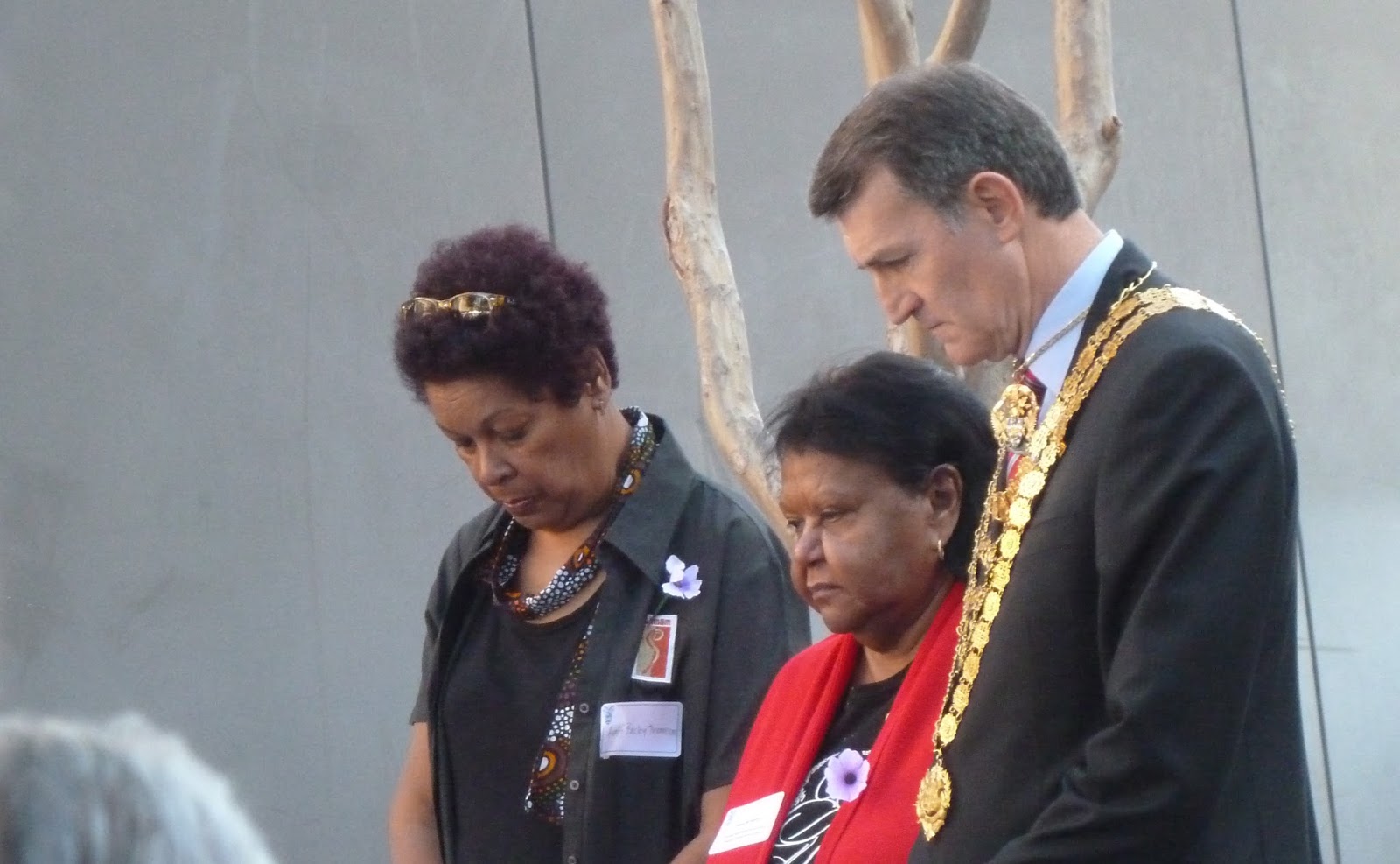
It was a glorious late-autumn day in Brisbane as we gathered to commemorate National Sorry Day in King George Square. It was a solemn and moving affair. What on earth was I doing there, you might ask. I was there in solidarity, I suppose, with a people sorely wronged in the past and still waiting for their chance at a fair go.
* The report was produced by the National Inquiry into the Separation of Aboriginal and Torres Strait Islander Children from Their Families, established by federal Attorney-General Michael Lavarch (Labor) in 1995
** http://www.recognise.org.au


May 10, 2016

Votes in the time of transition

Four Outback towns in Queensland experienced their hottest May night on record last Saturday. In one of them, Birdsville, the temperature didn't fall below 25.4 degrees: the May night-time average for the town is 12. The next day, 700 kilometres to the northwest and almost at the Northern Territory border, it reached 38 at Urandangi aerodrome, which is ridiculous.

It seems that gone are years with cooler May days and doona-nights heading into winter. Sundown here in the South East is already far too early – nearer 5 than 6 – but mozzies are still biting and there are too many sultry days. Hot and humid Noosa on Labor Day weekend felt more like Brissie in February.

While Urandangi sizzled on Sunday, in Canberra Malcolm Turnbull went to visit the Governor-General to request a double dissolution of Parliament. He had been threatening this for a while if the Senate didn't pass his bill to resurrect the Australian Building and Construction Commission. He had recalled Parliament to give them one last chance; but they refused to be bullied. I have yet to meet anyone who believes such a policy is necessary, or that it is an issue worthy of dissolving both houses and the considerable costs of a general election. The last double dissolution was in 1987.

My third federal election will take place on 2 July, when I will be in the UK. Between now and then will be eight long weeks of campaigning, for at least one whole day of which I will be at 35000 feet and blissfully oblivious of the policy ping-pong beneath.

The most important issue is without doubt how this nation will tackle climate change: how it will execute its international obligations to reduce global carbon emissions; how it will prevent further harm to the Great Barrier Reef caused by a warmer, more acidic ocean; how will it transition from fossil fuels to renewable energy; how will it scale back rampant consumerism into much more sustainable living.

'Jobs and growth' is not the most important issue, but it is already the most annoying slogan. In the Turnbull government's budget last week, Treasurer Scott Morrison declared that Australians know that their country's future depends on how 'we transition from the unprecedented mining investment boom to a stronger, more diverse new economy', but he didn't finish the sentence. '…A more diverse new economy based on renewable energy', is what he should have added.

Labor's climate action agenda, while more ambitious than that of the Coal-ition, falls far short of brave and bold. Brave and bold is what is required. So scared is Labor of suggesting anything that could be construed as a great big new sort of carbon tax, it has compromised*, instead of declaring that all remaining coal deposits must stay in the ground. Adani Mining should be shown the door. No more faffing; no more approval conditions tacked on. Adani, go home.

Labor's problem is Australians' cognitive dissonance: that is, they have inconsistent thoughts or beliefs, especially relating to behavioural decisions and attitude change. So, they might be aware that the koala is virtually extinct in South East Queensland, but they don't protest the relentless encroachment of development into koala habitat. They know there is more plastic in the ocean than fish, and that fish populations have collapsed, but it doesn't stop them going to buy kilos of barra to fling on the barbie next weekend, and it wouldn't even occur to them to ask their fishmonger if the prawns were sustainably caught. They want more jobs for Central Queenslanders, but the Galilee Basin coal mines will render the Reef beyond bleached, for sure, and ongoing drought will no longer support 29 million cows eating their way across a parched continent.

This problem isn't confined to Australians, of course. But it's particularly marked here because many people can't begin to imagine modifying their beachy keen lifestyle. Australians don't want to go it alone on the world stage, in case they lose out competitively, but in fact they should be a global leader. Blessed with more sunshine than practically anywhere else, they should set an example of what to do with it. Like slip slap slop, but orders of magnitude greater.

Sustainability is about more than recycling or taking your own shopping bags to the supermarket – although, dear gods, not enough people even do that. It's about owning fewer gadgets and repairing them rather than throwing them away; using water sparingly every day; eating less meat; reducing your power consumption; catching fewer planes; owning fewer cars; using public transport; owning fewer dogs; having fewer children; thinking beyond your own little bubble.

It reached 28 today in Brisbane, as predicted. The weather system that kept temperatures up in the far west over the weekend, and subsequently brought much needed rain in some places, rolled mistily over the city yesterday morning. There's still cloud lingering today, which has meant dramatic front lines and a beautiful sunset.

We're fortunate in this corner of the globe, but time and luck are running out. The necessary transition will be extremely challenging, and you need to think long and hard over the next couple of months about who will be best equipped to face the challenge. This time, you can't put it off until next time.
* http://www.9news.com.au/national/2016/04/27/06/51/labor-pledges-emissions-trading-scheme


May 8, 2016

Courting disaster

The Federal Court of Australia sits in all state capitals. Brisbane's is on North Quay, a step away from the northern access to the Kurilpa Bridge. So, after a morning of brain-bending legal technicalities, you can wander across this striking construction – the largest hybrid tensegrity* bridge in the world – and grab a bite of lunch at one of my favourite riverside attractions, the Gallery of Modern Art.

Over two days, the Australian Conservation Foundation (ACF), represented by the Environmental Defenders Office Queensland (EDO CEO Jo-Anne Bragg and ACF CEO Kelly O'Shanassy met the press outside court, top) made its case for the review of the decision by the Federal Minister for the Environment, Greg Hunt, to approve Adani Mining's proposed coal mine in the Galilee Basin of Central Queensland and its associated infrastructure. QCs representing both the Minister and the coal company defended his position.

The Minister's approval of Adani's Carmichael mine had already been challenged last year in the Federal Court of New South Wales and 'set aside'. It was alleged that Hunt had failed to consider global greenhouse gas emissions and Adani's history of environmental negligence, but it was his lack of regard for conservation advice concerning two Federally-listed Vulnerable species – the Yakka Skink and the Ornamental Snake – that was the undoing of his decision in August 2015.

On 15 October, however, Minister Hunt announced his re-approval of the mine with additional compliance conditions.

Round 2 of the Carmichael mine approval battle was staged in Brisbane last week. ACF alleged that the Minister had failed to comply with specific legislative requirements under the Environment Protection and Biodiversity Conservation Act (EPBC).

The Great Barrier Reef is included in the World Heritage List because of its 'outstanding universal values'. Australia is a signatory to the World Heritage Convention and is therefore obliged 'to ensure that effective and active measures are taken' for its protection, including appropriate legal measures necessary for that purpose – primarily by means of the EPBC Act. The ACF argued that the Minister, when deciding whether or not to approve Adani's mine, should have acted consistently with Australia's obligation under the World Heritage Convention, and attempted to quantify the likely impact of the combustion emissions generated by Adani's coal on the world heritage values of the GBR.

The two greatest threats to the GBR are from the warming and acidification of seawater resulting from the increased greenhouse gas emissions associated with anthropogenic climate change. The Outlook Report 2014 produced by the Great Barrier Reef Marine Park Authority rated these threats as 'almost certain' to occur and to have 'catastrophic' consequences.

After his first decision was set aside in August last year, the Minister received new material about the impact of greenhouse gas emissions on the GBR. The first few months of 2016 have seen the worst bleaching event ever recorded, with more than 90 per cent of the northernmost reaches of the Reef being effected, eliciting global opprobrium.

Projects that are likely to have a significant impact on matters of national environmental import must be appraised by the Australian government under Part 8 (assessment) of the EPBC Act. Minister Hunt, however, took guidance from the Co-ordinator General (CG) of Queensland under a bilateral agreement between the state and federal governments. Adani had produced an Environmental Impact Statement (EIS) for consideration by the CG, who then prepared an Assessment Report for Minister Hunt.

The problem with an EIS is that it does not require consideration of Scope 3 emissions** arising from the transportation of the coal (during its export, not from mine to port) and combustion of the coal at its destination. Combustion emissions would appear, given the global scientific consensus and the perceived effects on the Reef of increased ocean temperatures, to have a 'relevance impact' in this case.

Much debate over the two days in court centred on Section 527E of the EPBC Act, concerning the 'indirect consequences' of an action. You can read about this in greater detail than I could adequately explain at http://www.environment.gov.au/system/files/resources/f96c4a92-ffb1-4b77-befe-e2fd9130b0d8/files/epbc-act-policy-indirect-consequences.pdf. Justice Griffiths soon realised that the 'unpacking', or interpretation, of 527E was at the heart of the case.

The ACF contended that the Minister had asked himself the wrong questions about the indirect consequences of the action of developing the mine, not based on criteria sourced from the EPBC Act, and therefore had not considered the indirect consequences that pose the greatest threat to the GBR.

The Minister dismissed the relevance of Scope 3 emissions in the context of Australia's national emissions inventory, and determined that any impact attributable to the Carmichael coal's emissions was speculative. He concluded that it was 'difficult to identify the necessary relationship between the taking of the action [of developing the mine] and any possible impacts on relevant matters of national environmental significance which might occur as a result of an increase in global temperature'. The Minister's counsel conceded that 'the necessary relationship' was Hunt's 'shorthand' for substantive cause. Justice Griffiths found it curious that the Minister, with Departmental advice (and lists of mandatory considerations and other factors to be taken into account), wasn't more sensitive to the importance of clarity in his deliberations and direct reference to 527E.

In the absence of certainty, the Minister should have applied the precautionary principle: this was the ACF's third ground for bringing the case. Minister Hunt's elimination of the 'impact level' of assessment at an early stage of his considerations meant that an 'active intellectual engagement' failed to occur at a later stage in the process. His inability to establish a substantive cause between the action and the impacts meant he was under no obligation to consider 527E, his counsel concluded, because in his opinion there were no impacts.

I have attended several cases in which environmental protectors sought to compel government to exercise caution in the face of uncertainty, whether concerning the recharge of groundwater, the location of core populations of threatened species, or the global impact of burning massive amounts of Queensland coal, no matter where, on this nation's beloved Barrier Reef. What all these cases have highlighted, without exception, is that old legislation is inadequate at a time when rapid transition to a climatically changing world is imperative.

Justice Griffiths will announce his decision in three to six months. He seemed a reasonable man, so I live in hope.
* defined as 'a stable three-dimensional structure consisting of members under tension that are contiguous and members under compression that are not; the characteristic property of such a structure'
** as defined under the Greenhouse Gas Protocol, an internationally recognised accounting system for the measurement, reporting and management of greenhouse gas emissions


March 11, 2016

The joy of stats

The Reef's fastest fish
Statistics isn't one my favourite subjects, but this week some savoury stats have been injected into familiar debates.

The Newcastle Herald reported on Wednesday that Labour Federal Member for Hunter (New South Wales), Joel Fitzgibbon, was calling for the development of a regional strategy to promote economic transition in mining areas, following BHP Billiton's announcement of nearly 300 jobs to go at it Mount Arthur mine near Muswellbrook. The total number of anticipated job losses in Hunter Valley mines so far this year has reached 1000.

The same paper reported this morning that the amount of Hunter Valley coal exported through Newcastle fell by about 9 per cent in January and February of this year compared with the same months last year. Previously, sales volumes had remained relatively strong despite the plummeting price of coal on commodity markets. (I am advised, however, that these figures may reflect production lost as a result of flooding in April last year.)

Last night I attended a Reef and Coal Forum organised by the Queensland Conservation Council, GetUP! and the Australian Marine Conservation Society. Speakers included Ove Hoegh-Guldberg, Director of the Global Change Institute at the University of Queensland and best known for his work on the effects of climate change on coral reefs; Mark Ogge, a researcher at progressive think tank The Australia Institute; Tony Fontes, a dive operator in the Whitsundays who arrived from California in the 1978 to dive the Reef and never went home; and Pat O'Neill, prospective ALP candidate for the Brisbane electorate on a keep-all-fossil-fuel-reserves-in-the-ground platform.

With a coral bleaching episode currently evidenced on the Great Barrier Reef, there were lots of stats flying around. Professor Hoegh-Guldberg told us that anything greater than a 1.2-degree increase in ocean temperatures would mean the Reef would no longer be a coral-dominated environment. Mark Ogge surprised us with the news that there had been a 15 per cent increase in coal production in Queensland in the last two years. And Tony Fontes described the huge variety of life on the Reef from the largest whale shark to the smallest gobies; from the fastest sailfish to the slowest seahorse.

In the light of the coal production figures, it was less of a surprise that Queensland's emissions have risen over the last year, significantly more than in any other state of the Commonwealth. This was mainly as a result of the use of electric motors powering equipment in coal seam gas fields. You can read more about greenhouse gas emissions indices and energy trends at http://www.pittsh.com.au/assets/
files/Cedex/CEDEX%20Electricity%20update%20Feb%202016.pdf.

The state's increasing carbon pollution also results from reliance on coal for electricity generation, huge fuel consumption for transportation, the processing of gas ready for export, and an increase in land clearing, facilitated by legislation under Campbell Newman's LNP government. In 2012-14 land clearing doubled to 300,000 hectares, and the same is expected in 2014-15. All in all, the chances of Australia meeting its emissions targets pledged in Paris are remote, while seriously undermining the Federal government's 'Direct Action' policy.

This didn't stop New South Wales Liberals calling on PM Malcolm Turnbull this week to fund public debates on climate change, including the question of whether or not the science is 'settled'. This would be laughable if it weren't so tragic for Australia's already tardy climate action policies. The successful motion will be conveyed to so-called Environment Minister Greg Hunt so, fortunately, we can expect no further action.

This Liberal idiocy coincided with Melbourne's hottest March night since records began; Canberra equalling its March heatwave record of nine consecutive days above 30 degrees; and Sydney's record-breaking 31-day run of temperatures above 26 degrees.

Great days for the beach and burying our heads in the sand once more.

(I found the splendid sailfish at lazerhorse.org)


February 10, 2016

You couldn't make it up… The Passports Saga part 2

Where were we? Ah yes. Both our passport applications had entered the system (see also, I never thought it would be easy, January 2016). We waited.

I was the first to get a call from the Passport Office. My photograph had been rejected. The facial recognition machines at (some) airports might not positively identify me because there was hair too close to one of my eyes. The Passport Office lady was helpful. If I went to the main post office in Brisbane – in Post Office Square, natch – 'they take a nice photo there'. Then all I had to do was walk two blocks to 150 Charlotte Street, up to the 17th floor, to hand in two new photos, which wouldn't need re-certifying. Bob's your uncle.

I also arranged with the Passport Office lady to collect our passports the day before our departure for the US in mid-Feb since, with the photo hiccough having stalled the process, there wouldn't be time for them to be posted.

I know it's probably hard to believe, but I was agitated waiting in line at the post office the next day. I knew what would happen: 'Just move your fringe out of the way'; 'lower your chin'; and the picture would be shite, whatever. There was an even more anxious lady behind me in the line: she needed an express queue (there wasn't one); then she had to fax things places; and she had to do all this yesterday. I was relaxed, by comparison.

I trotted off to Charlotte Street with the photos, which could have been worse but not much. The first hurdle: I couldn't find 150. Do you know why? The number is inside the building, not on the exterior. Helpful, right?

[I have a theory. I reckon it's pretty dull working in the Passport Office. The atmosphere is sombre and reverential: the employees are all-powerful; their clients fearful in case they put a foot wrong. So the powerful ones have come up with a game. Mostly, they process everything straightforwardly; but occasionally, if they're faced with a Pom or a non-native-English speaker, they decide to have some fun, by putting any or all of a series of hurdles before them to see if they crack. The game's called You want an Aussie passport? Let's see how much you want it.]

On the 17th floor a little man sat at a desk right outside the lift. I had to explain to him why I was there and he then directed me to the appropriate booth inside a waiting room full of apprehensive applicants. My queue didn't take that long, it being only for queries and delivery of additional stuff, not 'interviews'. The Passport Office lady on the phone had recommended I complete a stat dec requesting them not to put 'Stockport Third' as my place of birth. The man behind the glass accepted it and told me they would call me if there was a problem. I didn't doubt that. On my way out, the little man was asking another rather desperate-looking chap if he'd achieved whatever it was he was after. He put his head in his hands and scurried into the lift. Just as well the windows are non-opening on the 17th floor.

Two days later my friend received a phone call from the Passport Office: the photocopy of his birth certificate that the post office had made during his 'interview' wasn't legible. Could he photograph the original and email it to the Passport Office? He could and he did.

The next emails, rather confusingly, were headed 'YOUR PASSPORT IS COMPLETED', although the first paragraph said, 'Your passport is now being prepared'. I phoned up just to clarify, and to request collection on an earlier date than I'd arranged. I didn't want to turn up on the 9th and discover they were in the 'For collection on the 11th' box, did I? I checked again what I needed to take with me.

Yesterday was the day. I went to 150 Charlotte Street and, hey, there was no queue. It wasn't where I was supposed to collect the passports either, but no one had told me. I had to go to the main post office, where there was a long queue. To pass the time, I phoned my friend to joke about the misinformation, believing it to be the final twist in the story. I couldn't reach him.

Neither was it the final hurdle. When I got to the counter, and handed over my receipt of application for a passport, my friend's receipt of application, a stat dec from him authorising me to collect on his behalf, and my driving licence for ID purposes, the man said, 'And do you have your partner's driver's licence?'

I didn't. Because the frickin' requirements for collection given to me in that first phone call hadn't included it. I think it was at this point I came closest to tears. It had just been too difficult, and I was so near and yet still so far. Our passports must have been just over there; just beyond that screen. The man went to ask his supervisor if we could proceed without it. We couldn't. It was needed to verify my friend's signature on the stat dec: I might have forged it, you see. My friend's signature was on his passport, of course, but that was in a sealed envelope that I couldn't open for the man because he wouldn't give it to me because he couldn't verify my friend's signature authorising me to collect the envelope.

I think the man felt sorry for me. He suggested my friend photograph his licence and send me the picture to show the supervisor. I still couldn't contact my friend, either on his mobile or through his company's switchboard. I noticed I didn't have a signal so went outside to try, and fail, again. The man offered me the post office's landline. I reached my friend's desk phone through the switchboard but he didn't pick up.

I was beginning to conclude there must be something wrong with my phone. The man said he would only be there for another 20 minutes, and then I'd have to go through all this again with someone new. I'd tried phoning, text messaging, emailing (it wouldn't send) and WhatsApping. I had to give up. I wandered out into Queen Street, where I had a thought: I went into the Apple Store a couple of doors away to see whatsup with my phone.

It was then I learned that Telstra had gone into meltdown in most of Australia's state capitals.

A young greeter took pity on me. She tried bypassing Telstra – something I would happily do permanently – and Facetimed my friend using Apple's wifi. It didn't work. She then put me on a computer so I could use Facebook. I had doubts he would be on Facebook at work, but I sent a message anyway. I think Telstra must have sorted the problem at that juncture, for a moment later he phoned and a couple of minutes later I received the all-important photo evidence by text.

I raced back to the man in the post office in the nick of time.


February 6, 2016

Doolally decisions

It's been a week of mixed emotions. Some good news; some really bad and stupid. I would have to conclude I'm at the Mrs Bloody Angry of Balmoral end of the spectrum rather than the 'Hey, guys, we're making good progress'. And it's only the first week in Feb.

First up, on Tuesday, the Queensland Department of Environment and Heritage Protection granted Adani their Environmental Authority for the Carmichael Mine in the Galilee Basin. This was inevitable, because a state in big debt has to be seen to encourage wealth generation, even though the Indian company is far from securing finance for a project with much reduced estimates of jobs and royalties. The Minister for the Environment absolved himself of responsibility. On his Facebook page, Stephen Miles wrote: 'The decision to issue an Environmental Authority is not a political one. It is made by the environmental regulator in accordance with applicable legislative provisions. Under Queensland law I had no role in the decision-making process.'

Minister Miles is head honcho in his department, presumably, and could table new legislation if he saw fit. The approvals process is in dire need of reform*: hydrogeological and ecological research, for example, should not be left to those with vested interests. The fact that the EA comes with a raft of conditions, some of which in this case were handed down by the Land Court, brings little solace to environmental protectors who insist coal reserves must be left in the ground. Politicians always refer to lists of conditions in an attempt to mollify outrage. Conditions need to be followed through, and on many occasions previously monitoring and enforcement have been found wanting. The Department just doesn't have the resources to do the job properly. I have noticed in the Land Court proponents who are defending inadequate impact management plans try to divert attention with promises of how they'll rehabilitate enormous holes in 30 or 60 years' time. A century and a half's history of deficient, or even non-existent, mine rehabilitation in Australia doesn't instil confidence in those claims either.

There was great news from New South Wales, on the other hand. AGL Energy announced they were abandoning their controversial 330-well coal seam gas project in the stunningly beautiful Gloucester Valley, citing inadequate economic returns resulting from volatile commodity prices and long development lead times. The Groundswell Gloucester lobby group popped the champagne corks and basked in a tidal wave of relief. AGL are selling off a couple of their natural gas assets in Queensland, too.

Unbelievably, Mike Baird's response to AGL's announcement has been to offer new areas for gas exploration, in remote regions out west where opposition is likely to be less organised than in the east. He's also hoping to resurrect applications for gas exploration leases put in by the NSW Aboriginal Land Council. Mining is a deeply divisive issue among Indigenous groups. While some see it as a means to greater financial independence, others consider it anathema to their role as custodians of country.

Then came the shocking news that CSIRO (Commonwealth Scientific and Industrial Research Organisation) was laying off 350 researchers over the next two years, mainly from the departments observing and modelling climate change. According to chief executive Larry Marshall, a former venture capitalist in Silicon Valley appointed to the job last year, there's nothing to worry about: the question, is the climate changing?, has been answered, and now he wants to get on with 'putting the "I" back in CSIRO. Hmm.

Not everyone at CSIRO believes climate change research should be put on the back burner just yet, however, especially in the light of commitments Australia made at the Paris climate conference in December, to improve observations and investigate early warning systems. But a hundred of the jobs will go from units researching sea level rise, ocean temperature and acidification, and recording greenhouse gas levels. The last of these includes an air pollution monitoring station in remote northwest Tasmania, the only one of its kind in the southern hemisphere, established in 1976 but now at risk. At Cape Grim on Tassie's tip, the air is as fresh as a daisy, having been blown across thousands of miles of ocean, and therefore a good candidate for 'average' air, for the study of its constituents.

The sky remains dark with chickens coming home to roost following the Abbott government's austerity budget measures in 2014.

It's reported that Malcolm Turnbull's cabinet has been working away at tax reform for this year's budget in May. I would love to think they've reviewed tax collection from international corporations and exceedingly wealthy individuals, but I doubt this was ever on their agenda. They could also sort out fuel tax anomalies that subsidise the resources and airline industries. More expensive flights might get the people thinking about inconvenient truths they'd rather ignore. They might even stop baying about cheaper electricity prices once increased tax revenues were diverted into the renewable energy industry. Now that would be good news all round.

* While attending the case brought against GVK Hancock's Kevin's Corner mine in the Land Court last October, I concluded: the existing approvals process is not sufficiently wide ranging in terms of scope, or sufficiently thorough – from baseline studies to impact management strategies – to adequately inform important decision makers; and decision makers who are already challenged in a transitional economy clinging to an obsolete free-for-all mentality, and on a continent at serious risk of climate change impacts and loss of biodiversity.


January 30, 2016

That day at the end of Jan

Every year since we came to live in Brisbane, we've taken advantage of the public holiday on the 26th of January to explore wild places within 100 kilometres or so of the city. We soon learned that many Queenslanders leave town for their favourite haunts. They make an early start, to bag parking space, barbie and picnic bench. They don't seem to mind being close to many others doing the same thing in the same place: the herding instinct appears quite strong.

We're the opposite. We want wild places to ourselves. We're basically antisocial, but mainly it's because we want to be able to hear birds call and animals rustle.

The first year, we made a leisurely start down the Cunningham Highway, marvelling at how little traffic there was. By the time we reached Lake Moogerah it was rammed. Watery places will always be so.

With each passing January, it has seemed more and more appropriate to find as remote a spot as possible to appreciate the land more like it was when the original Australians lived without foreign intervention. A time before timbergetters and miners and farmers who tried to impose alien practices on harsh country. One reason is that the thing about Australia we celebrate most is its landscape and fauna and flora – from unspoilt beach to unforgiving desert – and I spend a lot of my time advocating for their protection and conservation. But the second and more important reason is that I feel increasingly uncomfortable celebrating a past event that is remembered from a totally different perspective by those here ab origine. And that discomfort is greater now we are citizens ourselves.

Of course, we use trails I suspect were originally cut by loggers and are now enjoyed by off-roaders.
How and when 'Australia Day' should be celebrated has become a much hotter topic of late; opinions more polarised. The best things about Australia vary from one individual to another; from one time of year to another. While more and more people acknowledge that 26 January was 'Invasion Day' and massive wrongs still need to be fully acknowledged and atoned, there are those who believe Kevin Rudd's apology* in 2008 was enough, and we should all move on. How convenient.

Those who remain to be convinced that there's a lot more work to be done to achieve reconciliation should listen to Stan Grant's speech** during an Iq2 (Intelligence Squared) debate on racism last October, but only released the week before Australia Day, rather provocatively some say. His words came directly from the heart, not pages of text. Take note of the comparative figures of premature death and juvenile incarceration. Observe the faces of the audience, which speak further volumes. They know how much more there is to do to truly make Australia the country of the fair go.

I am aware how much effort is required. I felt uncomfortable in Alice Springs in the face of widespread evidence of disadvantage: I visited the wonderful Desert Park, but saw nothing of the Indigenous town camps. They are the last places travel or government sites recommend you go. In Yulara and Uluru, I bought beautiful Indigenous wooden artefacts but they were sold to me by white distributors. As was the art we purchased in The Alice. What would I have said or done had it been otherwise? I only think of this now, but I was probably subconsciously relieved at the time. 

I am ashamed of the fact that in six years I have only had two meaningful conversations with Indigenous people. The problem is, I have no idea what to do for the best. But not celebrating the 26th of January with champagne and fireworks seems to be a very small step in the right direction. 


January 28, 2016

Where to from here?

I've never been one for New Year's Resolutions. In Australia, they seem even more doomed to failure since everyone's on the biggest holiday of the year. There's no change of behaviour required of climate activists or environmental protectors, however. Regroup and make plans; the issues haven't gone away during the summer.

Following the excitement of the Paris Climate Conference at the start of December – and if you believe all remaining coal reserves should stay in the ground then it was not a good outcome – the focus now becomes this year's federal election here. Australia's poor climate-action rating in the planetary scheme of things, charted in the Sydney Morning Herald on 8 December (below), was exemplified by the December 2015 quarterly emissions report (to June 2015) released extremely quietly on Christmas Eve, always a good day to bury bad news. It showed Australia's emissions rose by almost one per cent 2014-15, compared with the previous year*.
Things are unlikely to improve unless there is a change of government. Minister 'for' the Environment Greg Hunt has recently been sitting in his office striking out conditions previously attached to coal mine approvals, making it easier for proposals to get off the ground and for resource companies to make profits. Wouldn't his energies be better employed working out how to make mining companies ultimately responsible and accountable for the rehabilitation of their mine sites? This is a huge problem in this country, and the public should pressurise the federal government to make polluters pay.

Clive Palmer's Queensland Nickel refinery is a fine example of how companies extricate themselves from their environmental obligations, if we are to believe the Australian Financial Review**. As QN totters on the edge of the precipice, taxpayers in this cash-strapped state are least likely to be able to pick up the bill when 'financial assurance schemes' prove massively inadequate. (See Post script below.)

There are more than 50,000 abandoned mines across Australia, where, in the early days, mining companies just upped and left when profits dried up. Has anything changed? When a company obtains an approval to mine these days, it pays a woefully inadequate rehabilitation security and the terms of clean-up are woolly and protracted. Stringent measures are required to ensure that pollutants cannot contaminate land or water; that the landscape is stable and safe for grazing animals and cropping; and that land is rehabilitated sustainably.

In mid-December, the environmental ministers of those states beholden to the coal industry – namely Queensland and New South Wales – ensured that Australia's National Clean Air Agreement did not embrace World Health Organisation clean air recommendations. Victoria and the ACT independently adopted WHO's pollution guidelines, but it doesn't look likely that we'll be getting covers for coal trains trundling through Southeast Queensland any time soon. That fight continues.

Last November, an Asian partnership won the tender to build a gas pipeline across the Northern Territory from Tennant Creek to Mount Isa in Queensland. This will serve the NT's shale gas industry, bringing fracking to the region and constructing a pipeline across 622 kilometres of arid lands where, so far, no ecological field surveys have been conducted. Job opportunities blind state governments to conservation concerns.

The pipeline plan is in addition to the Queensland government offering 11,000 square kilometres of Channel Country for exploration by international oil and gas companies (in May last year), allegedly without prior consultation with Traditional Owners of the land. Native title rights cannot be swept under the carpet in the pursuit of profit. Neither should limited and ephemeral water supplies be compromised. Water, in fact, must be placed at the top of the list of priorities across all economic sectors.

Despite a poll last October than indicated the Australian public had got a sense of perspective about the coal industry and its environmental damage†, a poll published last Friday showed that PM Malcolm Turnbull's popularity has increased against that of Opposition leader Bill Shorten††, despite Turbull's lack of action – apart from smugly smiling, that is.

So, I'm opening my election campaign with this thought. I know the Australian Labor Party and the LNP are almost indistinguishable when it comes to transitioning from fossil fuels to renewables, and I support neither for this reason alone. But I believe Labor will be quicker than the self-aggrandising Liberal Coalition to grasp that we have no alternative course of climate action.
Post script 29 January 2016. I wake this morning to a report in The Guardian about an opportunistic 'mining minnow' buying an Anglo American cast-off (the Callide mine in Queensland's Bowen Basin) for a pittance. The $640,000 question – that's a saying, the cost of rehabilitating the mine would be at least $120 million – is how will they raise sufficient funds to clean up? This will present an ever larger and more widespread problem as coal becomes an ever dodgier commodity. http://www.theguardian.com/environment/2016/jan/29/coal-giants-abandon-unprofitable-mines-leaving-rehabilitation-under-threat?CMP=share_btn_tw

* http://www.environment.gov.au/system/files/resources/cb14abbb-3a4b-406f-a22d-86f565674c3e/files/nggi-quarterly-update-jun-2015.pdf
**  http://www.afr.com/business/mining/clive-palmers-qld-nickel-cut-287m-set-aside-to-clean-up-toxic-sludge-20160118-gm8pt6
† http://350.org.au/news/majority-of-australians-agree-coal-is-bad-for-climate-reef-and-health/
†† http://www.theguardian.com/australia-news/2016/jan/22/turnbulls-popularity-soars-over-summer-as-shortens-suffers-poll-shows


January 19, 2016

I never thought it would be easy

I may have told you: I once knew a couple in the UK; she was an Aussie and he was a Brit. They got married and moved to Australia because that was where they wanted to bring up kids, in the great outdoors and the sunshine and all that. They returned in less than two years, however: Aussie bureaucracy had driven them crazy; in particular, having to get a new driving licence every time they moved interstate. Perhaps she'd forgotten the rules. The joke is, Brits who haven't lived elsewhere think the UK is a bureaucratic nightmare. Trust me; it's not.

The first hurdle when we moved here was, of course, the visa. My friend and I aren't married, and that makes-life-easier tick-box can eliminate several hoops of fire at a stroke. We had evidence of jointly designated utility bills (but for too few years); bank-statemented evidence of financial transactions going back to the '90s (but not a joint bank account); and even proof of being each other's beneficiaries (of pensions, for example). But none of that was good enough. We were asked to make declarations about our relationship, to be constructed around the answers to questions of such a deeply personal nature I decided moving to Australia wasn't such a good idea after all. I offered instead to be interviewed in Australia House in London to prove I wasn't a cling-on to an engineer seeking a different life downunder.

Was I prepared to sacrifice a wonderful opportunity for the sake of my privacy principles? I never found out because the visas were granted in record-quick time before I had to choose whether or not to write a fairytale romance.

Four years later came Permanent Residency, and a new range of obstacles, such as police reports – from the UK and Australia; medicals – requiring two appointments because we didn't realise we had to take our passports to the doctor's; and stat-decs (statutory declarations) by Australian citizens who had to have known us for three years. Fortunately, there were one or two.

In trying to be truthful, I inadvertently made more work for myself. In providing details for the British police, I listed another name I'd used in the past, the surname of my children's father. Way back then it had made life easier, because some people in small towns still found it odd if a child's name differed from its mother's, although I had never changed my name officially when I got married. I did not declare this name in the Australian paperwork because it wouldn't have been found here in connection with me. Some eagle-eyed legal in Sydney noticed the discrepancy and asked me to explain. Another stat-dec had to be generated.

A little over 12 months following the granting of Permanent Residency, we applied for Australian citizenship. So soon after PR, this proved to be a relative doddle. The only stress factor was that my friend got his before I did, and the cling-on factor reared its head momentarily.

You might think, after all this, that an Australian passport would be a formality. Nope. A different department presents new challenges, largely in the form of the Post Office, agents for the Passport Office. Last week I was in my local PO and witnessed a poor chap having his passport applications rejected. He'd used blue ink; his signature had escaped the box; and his children's birth certificates were not quite in order. He didn't say a word; he just looked awfully dejected, and completely lacking in the will to continue.

My friend and I checked each other's paperwork, and then checked it again. And one more time. Then, last Saturday, we took in the forms, with trepidation, citizenship certificates, Queensland driving licences, Medicare cards, and photographs duly witnessed by yet more Aussie citizens who'd known us for three years. We'd written in black and kept within the boxes. But we didn't get far: we didn't have our birth certificates with us. They hadn't been included in the list of documents required but were mentioned elsewhere on the form and we hadn't noticed. My photograph was rejected: I was ever-so-slightly inclining my face; my fringe was too long; and the hair at one side was obscuring my face. It wasn't hiding an eye or anything important, just cheek extremities. In addition, we hadn't initialed changes. (When you're afraid of making mistakes on a serious form, you're sure as hell going to make some, aren't you?) My photo-verifier had made a mistake in the naming of names; and my friend's photo-verifier had used blue ink. Go back to start.

My friend took his form into a PO near his office yesterday. His photo was rejected: it was too small, even though it had been taken there, last year. They took another one, and approved his application to go into the system. This morning, I returned to the same place as on Saturday, with most amendments as requested. A different person checked it. He had a query about my birth certificate that I couldn't have answered to save my life: why did it say 'Third' after the name of the town of my birth? I had never noticed that. I guessed wildly: 'Third administrative district?'. He would have to add 'Third' to my application form, he explained, or there'd be a discrepancy with the accompanying photocopy of my birth certificate. 'But, please,' I said in a small voice, 'They won't put "Stockport Third" as Place of Birth on the passport, will they, because there's no such place in the UK?' He went away to call the Department, and then noted my request on the form. He made no comment whatsoever about my photo, unchanged since Saturday. I paid the $254 fee, my application went into the system, and I left as quickly as possible.

Others have mentioned a high rejection rate; how they took the same form to a different PO and had it accepted. If my friend and I hadn't had two different experiences on two different occasions I might have some faith that new Aussie passports will eventuate (at the end of a maximum of 21 working days) without further ado. But I know we're not out of the woods yet. I know some random nit-picky job's-worth processor in the Passport Office – if their bus was late, or they were having a bad hair day, or their favourite team lost the footie last night – might take exception to my fringe. I'm also afraid I'm tempting fate by writing this before I'm clutching an Australian passport in my clammy little hand.

Go back to start? I'm just not sure I could bear it.


January 14, 2016

When the Sunshine State sizzles…

There is no such thing as a cold tap.

Parking spaces beneath trees cannot be found for love nor money.

Cold air escapes from the open doors of airconditioned outlets as they chuck loadsa money at the power companies with ne'er a thought for energy conservation (not-so-Smart State).

Folks flock to cinemas (where the aircon is often on sub-arctic setting all year round) or shopping malls in order to bask in the cool.

They sit in stationary airconditioned vehicles with the engine running for ages, adding to Australia's emissions and filling nearby homes with unnecessary fumes.

Uninsulated walls and tin roofs absorb heat, rapidly warming your home as soon as you give the aircon a rest.

People fling themselves into water – any water – with even more gusto than usual.
Walking anywhere for more than ten minutes is not an option after 11 am.

Most washing dries outside in a matter of minutes, but people still use dryers.

Even scaredy-cats look forward to storms – as long as there's no hail, which can be enormous and damaging and more noisily terrifying than any other storm element.

One storm cell may produce tens of thousands of lightning strikes.

There are more unexplained power outages than usual.

At home, you live largely in a twilight zone, with blinds down from mid-morning until early evening.

Several showers and changes of clothes a day may be necessary, especially if humidity is high.

Sometimes you're secretly relieved there's no Daylight Saving Time as you yearn for the merciless sun to drop beneath the horizon.

You marvel more than usual at the fact that most roofs are not plastered with solar panels.

You consider the hitherto unimaginable: owning more than one pair of 'thongs' and shopping in shorter shorts than you'd have worn to the beach in another life.

It's too hot to wear jewellery.

Even the birds pant.

It may well be hotter in Australia's other state capitals (except Hobart) than it is in Brisbane.


January 8, 2016

Watch on weather: cats 'n' dogs

The first time it rained like it did the other day, we'd been living in Australia three or four months, in 2010. It didn't stop for about three days. Technically, it wasn't even the Wet season. My friend had driven the car to work; we had no bicycles then; we'd brought cold-weather gear with us (for visiting New Zealand) but as yet hadn't appreciated the need for waterproof trousers during flooding rains. It was only a 10-minute walk to the shops, but in such a downpour I'd have been drenched by the corner of the road. Our original Australia advisor – the Irishman who recommended my friend for the job – had told us there was no point to an umbrella in torrential rain here. He was not wrong.

I cobbled together scraps of this and that from the fridge for supper for a couple of days. I'd got into the French way of food shopping: each day I walked to buy ingredients because it got me out of the house and familiarised me with my new surroundings. So the fridge wasn't stocked. But, I tell you; there is no incentive to venture out into such hard rain.

I didn't blog in those days, but my diary mentions hours of continuous heavy rain – and marvels that I was already complaining about the weather, having been in Australia a matter of weeks.

On Tuesday, our weather station told me we received almost 60 mm in 24 hours. 'It's raining cats 'n' dogs,' it said on the screen. How colloquial. There was lots of rain all over southeast Australia.

In the week before christmas, a supercell tornado ravaged south Sydney about the same time as Higgins Storm Chasers were warning that a cyclone might develop in Far North Queensland. Lots of areas did get rain, but without the damaging winds. Further south, however, in Central Queensland, many of those stricken by the ongoing drought received a few tens of millimetres at best. This week I wished I could have swapped weather with my friend near Alpha.


December 16, 2015

Has Australia learned nothing from Paris?

Courtesy of Kim Maute, BTFRT
President (of the Land Court) Carmel MacDonald kept us waiting 10 minutes yesterday. If I'd have been her, I, too, would have preferred to drink tea in my rooms rather than come to the bench and announce the most ludicrously bad decision, just two days 'after Paris'.

Within seven minutes, and without a shred of emotion, she told us that she was recommending that the relevant Queensland government departments grant mining leases and environmental approvals for Adani's Carmichael Mine in the Galilee Basin, but with additional conditions to improve the survival prospects of the endangered Black-throated Finch and the Doongmabulla Springs.

She may have made her decision last week, or several weeks ago. She may even have known since the last day of the case, back in the autumn*. Unless she lives in a sealed box, however, she cannot have missed the salient point from COP21. One may have been disappointed by the absence of a concrete commitment to keep coal in the ground, or the vague aspirational statements of intent all the countries of the world agreed to in the final agreement, but there was an overwhelming impression of the coal industry's days being well and truly numbered. Hence this headline in The Guardian this morning.
Europe's chief coal lobbyist is concerned about the bad press his industry has been getting lately. You and I, of course, haven't looked at the science and worked out for ourselves that more coal mines will mean the world warms by degrees less than comfortable; no, we've been 'brainwashed' by the United Nations' lies about climate change, and bullied by the 'mob rule' of world governments (what, all of them?) and protestors at the climate summit.

He can't know much about Australia, this chap, otherwise he'd be confident we wouldn't let the United Nations tell us what to do. About the Great Barrier Reef; or the massive coal mines that will transform the Galilee Basin if both state and federal governments continue to get their way.

How they do this is by basing the framework used by resource companies to obtain approvals on outmoded (input-output) economic models based on 'best' assumptions that often lead to overstated economic benefits rather than a true cost-benefit analysis of real-world social, economic and environmental impacts that are harder to assess. Member MacDonald drew attention in her comments to the inflated numbers of jobs the Carmichael mine would create claimed initially by Adani, and their similarly enhanced estimates of royalties that might flow to the Queensland treasury.

Unfortunately, however, she did not accept that declining demand for thermal coal would make the Carmichael mine economically unviable.

Community action such as that brought by Land Services of Coast and Country in this case is often criticised by the right wing of politics as merely delaying tactics on the part of rabid greenie/leftie fringe activists rather than the legitimate concerns of conservationists in a country with a long history of land clearance and degradation that has impacted severely on biodiversity. The research of expert witnesses in this instance performed a necessary part of the assessment process as new information about the Black-throated Finch's range, as well as the inadequacies of surveying done by Adani's ecology team, came to light. The birds' core habitat, formerly believed to be further east, would be destroyed by the mine, and Member MacDonald's recommendations for additional monitoring – by the appropriate people, that is the Black-throated Finch Recovery Team (BTFRT) – underlies her concern about the 'serious or irreversible environmental damage to the continued survival' of the BTF.

Similarly, she noted that groundwater modelling should have included the ecologically important Doongmabulla Spring Complex. This exemplifies other flaws in the approvals framework which include insufficient scope of baseline studies, limited ecological field work, and inadequately researched potential biodiversity offsets.

Arguably the most contentious part of the Land Court's findings was that greenhouse gas emissions produced by countries importing and burning Galilee Basin coal had been correctly excluded from an assessment of the Adani mine's environmental impact. This was justified by what its critics call the drug dealer's defence: that is, if Adani don't supply Indians with coal, someone else will. This is a specious argument if ever there was one. By the time a suitable alternative supplier was found, there is more than a distinct possibility renewable sources of energy will be on stream, rendering the burning of coal unnecessary; and/or the price of coal will have fallen to such a level as to render exporting it an undesirable option.

Member MacDonald's overall conclusion that the mine should be approved seemed particularly inappropriate following as it did what is claimed to have been a ground-breaking climate conference, during which, unfortunately, Australia's reputation as a reluctant climate change activist was further enhanced rather than allayed. It is not, of course, the Land Court's place to make a course correction on behalf of the Australian government. Neither was it likely that the President of the Land Court would stick her neck out like Member Smith did in the Alpha case. Hence the huge disappointment of conservationists hoping for an early sign of a much-needed change of mindset in Canberra.

Despite Ms MacDonald's efforts, Adani do not yet have the go-ahead. The Queensland government has not approved the project and the Federal government's re-approval faces appeal in the Federal Court by the Australian Conservation Foundation. Let's hope sense soon prevails in a country with a hell of a lot of catching up to do.

* for the background to this case, see also Another little bird, Leaky aquitards, A model of imperfection, Hope springs eternal, Waxing lyrical and BTF?, from this blog in April 2015; and Would members of the public please leave the Court, A financial folly and Not the end of the matter from May 2015


November 3, 2015

Dead fascinators

If you want to know how big Melbourne Cup is in Australia, look at the length of its entry in Wiki, and the level of detail. You'll find out all you need to know, so I won't have to explain. It's so big it doesn't need any qualifiers. When people consult their diaries, they say, 'It's Melbourne Cup'. Not '…the Melbourne Cup', or '…Melbourne Cup Day'.

I spotted my first outrageous outfit by about 7:15 this morning, as I dropped my friend off at Bulimba ferry. There wasn't much to it: short-short; with billowing sheer white appendage; and vertiginous heels, natch. Don't get me wrong. I adore fabulous outfits. Talking of which, I went to see The Dressmaker yesterday. Loved it, for many reasons. But I'd choose stylish over stunning any day.

Eighteen hundred kilometres and a time zone away from Flemington, Brisbane workplaces come to a halt for 'the race that stops a nation'. Don't try to fix a meeting for that time. Colleagues will exclaim, 'But it's Melbourne Cup!' In Victoria, the first Tuesday in November is a public holiday; unless you live in a country town that has its own 'Spring Carnival', in which case you can choose which day to holiday. Daycare facilities are closed, so heaven help you if you're a parent working in essential services that, thankfully, don't stop for a horse race.

The people of this betting nation part with hundreds of millions of their hard-earned dollars on this day. You probably wouldn't believe the figures for all the major sports fixtures during a year, but have a read of http://www.dailytelegraph.com.au/news/nsw/proof-australia-is-a-nation-of-punters-with-a-record-26-billion-spent-on-race-and-sports-betting-this-year/story-fni0cx12-1227102194583?sv=cfb36744344d24144f19b5c08eef9db1. And until 19 November
you can still catch this deeply disturbing programme from a few weeks back: http://iview.abc.net.au/programs/ka-ching-pokie-nation/DO1406H001S00. Even country town RSLs have ranks of pokies to rival venues on Las Vegas Strip.

Is it me or is this madness?

The first couple of years I lived here, I was away on Melbourne Cup Day. I heard all about the champagne flowing from the 'three-course meal and three-hour beverages packages'. My friends who went looked so smart and beautiful in the photos, and I was almost sorry I'd missed the fun. Another year, I decided I didn't want to spend hundreds of dollars on a new outfit and accessories I'd probably only wear once, and a meal with more booze than I could put away in a weekend, never mind at lunch. By last year I'd admitted that racing isn't for me. I don't like what happens to the horses, either as 'encouragement' to run faster or as a result of injuries they sustain in doing so*. Punters are shielded from the grim realities of a cruel sport. I don't have any inclination to bet, and I find it disquieting that betting is so openly encouraged in a nation in which gambling is such an enormous social problem.

Former racing journo Michael Hutak, writing for The Drum yesterday, observed, 'It may have serious ethical issues, but racing is so embedded in the vernacular of Australian social and public life, many of us are happy to look the other way in the Spring sunshine'.

I heard on the radio this morning that hats are back. Fascinators… aren't. Finalement, les fascinateurs sont passés. So, what happens to them, fascinators that are finished with? There are still 64 on David Jones's website. I rather like one of Mimco's (top). Shame I've got a fringe.

* Post script The ABC's 7.30 Report on Tuesday evening told the hopefully happy-ending story of a Melbourne Cup favourite, Red Cadeaux, who many feared would have to be put down after he injured a fetlock during the race. In the end he didn't even have surgery. He has been retired and will be able to heal slowly. How many people remember what happened last year, when two horses died? http://www.theage.com.au/sport/melbourne-cup-2015-horses-for-courses-as-spring-racing-carnival-in-full-flight-20151030-gkmul9

Post script 29 November 2015 Sadly, Red Cadeaux's recovery took a turn for the worse and I learned this week that the horse had to be put down. http://www.abc.net.au/news/2015-11-21/red-cadeaux-euthanased-due-to-melbourne-cup-injury/6960812


November 1, 2015

Imaginary lines

I'm sorry for the gap in coverage of the Kevin's Corner case in Brisbane's Land Court: from the first day to the last, in fact. (See also Not in Kevin's Corner, October 2015.) Friday was final submissions day: there was some urgency to finish, and Court was adjourned by lunchtime. In between there had been six days of evidence, a large proportion of which was devoted to groundwater. Mid-point, I was poised to write about water issues again, but key elements haven't really changed since the Alpha case in 2013: the uncertainty of modelling outcomes; misjudged priorities (profit trumps groundwater); and expedient decision making preceding adequate research.

Nevertheless, here is some of the evidence… interspersed with a few of my observations, and pictures, for light relief.

An early witness was Andy Mifflin, GVK Hancock's Executive General Manager Development Projects, a title with a word missing, surely. He sounded like a Northerner to me, but one who'd had the humour and friendliness beaten out of him by many years in a contentious industry; more like a dour Scot, in fact. He told the Court that he had monitored the approvals process for the Alpha mine, and that reports and documents produced for Kevin's Corner (KC) were different because it has underground operations; that rail infrastructure required for the KC mine was the responsibility of a different company, Hancock Coal Infrastructure; that KC coal is slightly below the Newcastle benchmark; and that GVK's longterm contracts are with equity partners (such as energy companies) so current low futures trading figures for coal are irrelevant.
Coal train heading for Gladstone
Grazier Bruce Currie, representing himself in Court, has so far been unable to secure a make-good agreement with GVK. His property is west of the 0.5 metre drawdown contour, ie further away from the mine site, but he was concerned about the absence of a 0 metre contour. GVK cannot, however, be 100 per cent sure that Mr Currie's bores will never be impacted. He believes that make-good agreements are failing landowners, but the judge, Member Cochrane, explained that he could neither make nor change the law; only use the law to adjudicate on the issue of this case: should a mining lease be granted, and, if so, with what conditions? The proposed Water Management Plan would include monitoring bores, but bore surveys to date have been for groundwater modelling purposes. Mr Currie's bores have not been surveyed, but Mr Mifflin assured him he was not being ignored. At one point, Member Cochrane told Mr Currie to 'stop fishing' for information to further his cause rather than arguing his case. Mr Currie was seeking reassurance, of course, and was rather harshly reined in. However, I sensed that GVK's counsel, Damian Clothier QC, was resisting at least some of his jack-in-a-box urge to object to Mr Currie's cross-examination on subtle legal grounds that Mr Currie was completely unaware of.

Ecologist Dr David Dique was called by GVK. There was some discussion about how to define 'the region' in which to assess cumulative impacts of mining. In Dr Dique's opinion, it would include other Galilee coal projects but not mines in the Bowen Basin further east: ongoing Cumulative Impact Assessment (CIA) might encompass additional areas in the future. 'Regional' and 'local' definitions seem to vary in specificality: so Regional Ecosystems (REs, eg Natural Grasslands of the Queensland Central Highlands) are clearly defined, but the concept of 'local' for certain environmental values might be less clear. CIAs are complex, Dr Dique said, and they compound a level of uncertainty already present in the complex scenario surrounding a project such as KC. (I think it was at this point that Member Cochrane first mentioned the term 'motherhood statement', which means vague, feel-good platitudes – often used by politicians – that few people would disagree with.) Dr Dique acknowledged that the CIA was not complete, but for those ecological communities identified, the KC mine will have a low rating of impact.
Drummond Range, east of Alpha
Dr Dique detailed the need for longer-term field studies of species that move from one location to another because of changing conditions such as water availability. There are no Black-throated Finches recorded for the KC mine lease area, but GVK have gone beyond the call of duty in surveying for them anyway and, assuming that the birds may be there one day, have committed to resurveying at intervals in the future. With regard to revegetating degraded land, Dr Dique confirmed the uncertainty of its success because of the long periods required, but quickly moved on to what he regarded as successful offsets in the Bowen Basin, and the sound measures in place in Queensland to mitigate the potential for environmental harm. I'm sure we can all rest easier in our beds having thus been reassured.

By day 2 I had become aware of the lever arch file phenomenon. Mr Clothier and his two juniors – Clothier's clones I shall call them – had many files with them, so many they took over part of the prisoner's dock (this was the Magistrates Court). Whenever Coast and Country's counsel Dr McGrath referred Member Cochrane to a particular document submitted to the Court, Clothier and the clones would hastily grab the relevant files, loudly snapping open and shut the folder's mechanism. This appeared to be an ostentatious ritual that no one else at the bar table deemed necessary, and it became increasingly irritating during the proceedings.

It was Groundwater Day for what seemed like eternity. With the best will in the world and a determination to understand why the expert witnesses don't agree about groundwater behaviour in the Galilee Basin, the keenest student would be dulled by a couple of hours' debate about the definition of potentiometric surface – an imaginary surface representing the elevation and pressure head of groundwater and defined by the level to which water rises in a well*. Even His Honour was 'completely befuddled' at one point.

Mark Stewart, hydrogeology expert for GVK, took the stand on Wednesday morning of the first week: he was still there on the Friday. He began by explaining standard bores and vibrating wire piezometers. He talked about the MODFLOW groundwater modelling program (which I misheard as mudflow, an inappropriate name I thought). The same conceptual model was used for KC as for Alpha but with modifications for KC's underground section. Under slow and deliberate cross-examination by Dr McGrath, Mr Stewart explained potentiometric head in confined aquifers (ie those overlain by a confining bed of significantly lower hydraulic conductivity – the movement of fluid through pore spaces or fractures – which hinders the vertical movement of water). By this time, rock strata were being called 'units', which didn't help those already being bombarded with unfamiliar terminology. Further exchanges reduced our somewhat diminished will to live.

Next day there were endless minutiae about bore log readings and the interpretation of hydrographs. 'Is this line of questioning going somewhere?' asked Member Cochrane at one point, rather less than politely. It was, as it happened: Dr McGrath threw the position of the 300 metre drawdown contour into doubt, which was significant. Its revised position would back up the hypothesis of Dr Webb (see below) of recharge from the west. It was particularly hard for those lacking a contour plan to follow this argument.

And then, at 3pm, a new topic. Hurrah! Types of modelling boundaries. Sigh. The selection of boundary type – a no-flow boundary or a constant head boundary – is of critical importance to the simulation of reality. Every model needs a system of boundary conditions to establish a link with its real surroundings. 'Help me, what's it mean [sic]?' cried the Judge, speaking for us all. Constant head boundaries are used where there are no obvious natural boundaries such as a river – at the north and south boundaries in this case. This is fine as long as the boundaries are sufficiently far away from the area of drawdown (the fall of the water table caused by the pumping of groundwater out of coal seams), otherwise the impact of drawdown in the model will be affected. Are you still with me?
Milky Dam, Bimblebox Nature Refuge
Dr John Webb, hydrogeology expert witness for Coast and Country, took the stand on Friday and continued on Monday. Mr Clothier was clinical in his attack. I've seen him at work before and knew what to expect. His cross-examination seems fairly innocuous at first, lulling the witness into a false sense of security, until he identifies a flaw in the evidence. He'll worry it, adding other errors or omissions, until he goes in for the kill, in this instance undermining Dr Webb's reputation as a hydrologist and an expert witness. Dr Webb admitted his errors – indeed, the development of a hypothesis is on occasion enabled by them – but, eventually bullied and worn down, he conceded to Clothier that his work had not been that of a competent professional. At times his testimony was agony to watch: surely it is enough to get a witness to admit his or her mistakes, without being humiliated to boot. While under oath, Dr Webb was not permitted to talk to others about the case during recesses, during which he cut a lonely figure.

At the core of Dr Webb's hypothesis had been the folding of strata and the resultant fractures of the otherwise low-conductivity Rewan formation through which water might flow (see also A model of imperfection, April 2015). Ultimately, this might impact on drawdown. Information made available to Dr Webb since the Alpha case, namely seismic data, had ruled out the possibility of an anticline in the east. He stood accused of not removing it from his subsequent submissions soon enough. Mr Stewart's 'oversight' on the other hand, had supported Dr Webb's belief that there is recharge (replenishment of water in an aquifer) from the west. There wasn't as much mention of recharge mechanisms as in previous cases against proposed mines in the Galilee Basin. According to Mr Stewart, when describing input and output of the groundwater model, recharge represents a small part of the water balance in the system.

One potentially worrying implication of Dr Webb's corrections to his hypothesis is their bearing on the judgment of the Alpha case. Then, Member Smith set a precedent by recommending that the mine not be approved unless further investigation and monitoring of groundwater was put in place. Of course, nothing can change that judgement, and what is clear from this case is that there remains huge uncertainty about groundwater behaviour and the impacts of the development of so many large mines on a limited and precious resource. 

The economic argument sounded very familiar, too: the input-output model vs cost-benefit analysis. Mr Brown (of Economics Associates, who did the modelling) was first up, in defence of input-output. Within the terms of reference for a mining company's application to mine in Queensland, this is the model required. 'Does it create a negative number?' inquired the Judge. 'No', came the reply. How convenient, I thought. Roderick Campbell (of The Australia Institute) was much more interesting. Mr Clothier may have regretted electing one of the clones to cross-examine someone who dealt ably with questions to the extent that he interwove his opinion at the end of each answer. He made the case for welfare economics: cost-benefit analysis was essential in a project such as KC. Input-output assumes a limitless supply of arable land, water, other resources and workers for the mine rather than taking away any of these things from other sectors, hence this models's overstated economic benefits. He felt that decision-makers (such as the Co-ordinator General) should have been made more aware of the shortcomings of the model used. Mr Campbell preferred that decision-makers use their brains to consider a whole rack of social, economic and environmental factors in estimating the 'costs' of a mine.

Finally, there was environmental scientist Robert Storrs, whose company authored the CIA. Kathryn Kelly, representing the North Queensland Conservation Council, highlighted the inadequacies of the report. It failed to provide numerical values for 'high', 'medium' and 'low' cumulative impacts in a table. It had omitted the Adani mine and its rail link to port, the port development itself, and the passage of coal bulk carriers through the Great Barrier Reef. It had omitted the impacts of related projects on which KC will depend such as a new power station, power supply network and water supply system. The overall impression was of patchy data, some of it based on desk-top research when there was relevant additional and accessible data in the public domain (relating to the Carmichael mine, for example). The CIA was not sufficiently robust or consistent with the precautionary principle to adequately assess potential environmental harm. So, for example, there was no data for habitat loss in 19 other projects in the area, nor was there scheduled to be.
Remnant woodland of the Desert Uplands
In the beginning, I found Member Cochrane's approach interesting. His constant questioning seemed to be in everyone's interest, clarifying cloudy issues and holding arrogant lawyers to account. As the case progressed, however, he exhibited bias and even bullying tactics. He was inconsistent, on occasions advising participants to take their time; on others becoming irritated by their less-than-obvious line of questioning. Sometimes he went as far as almost rephrasing the less experienced objectors' questions for them; but he was hard on Dr Webb for 'fencing' with Mr Clothier who, frankly, made unnecessarily demeaning demands. In my opinion, His Honour could be petulant – ticking off one young chap for bringing a takeaway coffee into court as if he were a naughty child – and egotistical, showing off his knowledge of hydrogeology or economic theory rather than asking a genuinely enlightening question, and correcting typos in final submissions that he had given the parties fewer than two days to complete. 

I have no doubt he will find that GVK Hancock did everything that was required of them within the terms of reference, and therefore recommend their mining application is approved. The conclusion I have reached from three cases of this kind is that the existing approvals process is not sufficiently wide ranging in terms of scope, or thorough – from baseline studies to impact management strategies – to adequately inform important decision makers. And decision makers who are already challenged in a transitional economy clinging to an obsolete free-for-all mentality; on a continent at serious risk of climate change and biodiversity reduction; and in a nation whose political leaders are not yet fully recognisant of major change in numerous other so-called Western democracies.

Member Cochrane thinks it is unlikely he will hand down his recommendations before 6 December. This is the date on which the final components of the former LNP government's Water Reform and Other Legislation Amendment Act (WROLA) will be proclaimed by default unless the Palaszczuk government extends the Act's non-proclamation period or tables its own water reform bill. The fate of WROLA will determine whether or not GVK Hancock have to obtain a water licence in addition to mining approval. The potential abolition of this requirement is a further complication in the already vexed issue of Galilee Basin development.
* the potentiometric head in a well in an unconfined aquifer is at the elevation of the water table. In a well in a confined aquifer, the potentiometric head is typically at a higher elevation than the top of the aquifer due to the confining pressure