And I'm not talking about disaffected youth with grudges, religious mania or a right to keep and bear arms under the Second Amendment.
I'd had the same email address for donkey's years, provided by a British telco company. I kept it when I moved to Australia so that old work contacts would still be able to find me to offer employment. (In fact, that's only happened twice in more than six years.) Long after I no longer had a telephone line or internet with the telco, they began to charge for my email, but only about £1.20 a month, which was acceptable. A few months ago however, without warning or explanation, they increased that charge by more than 300%. I thought that was a bit rude. The Direct Debit Guarantee (UK) stipulates that you must be notified in advance of any changes to the amount, date or frequency your of direct debit. I never received such a notification, but that doesn't mean it wasn't sent.
When I was in the UK a few weeks ago, I phoned them. I had to hang on for 15 minutes before I got through to a real person. There was no apology; nor an explanation of the size of the increase; only that I wasn't on a contract so I had to pay more. A contract for an email? Were they serious? I could be on a contract for £1.80 – still a 30 per cent increase – or non-contract for little short of £6.
Then we got cut off. So I was cross as well as outraged. I went online banking and cancelled the direct debit immediately.
Before I returned to Australia, I called them again. I'd decided it was time to start using my other, dormant email. I offered to pay the telco for three months, to give me time to let everyone know of my 'new' address, and asked if I could then close the account online. No, I would only be able to cancel by phone. Call from Oz with the hang-on waits the company is famous for? I don't think so. The woman said she would transfer me to billing, but I couldn't face another lengthy wait.
I returned with the intention of getting the new address up and running right away, but there were distractions and more urgent jobs to do. Two weeks later my email stopped working. Of course, I assumed it was because I hadn't paid them. I frantically sent out notifications of the alternative address to my contacts, and started working my way through a long list of organisations who either email me or use my email as ID.
All went smoothly at first. Some updating processes were more straightforward than others.
Recently, I have observed increased sensitivity – some would say over-sensitivity – to perceived security breaches. Twitter, for example, frequently sends an email telling me they've 'noticed a recent login attempt from an unusual device or location'. This usually follows me accessing Twitter on my mobile rather than my computer! They recommend a change of password, which I ignore.
Then one day, they locked my account (see top). I had to change my password to 'secure' my account before I could access Twitter again. You can probably guess what's coming. Once you start the process they have to send you an interim password, to the email address they have on file, the one I could no longer use. Believing there must be a way to solve the problem, I spent hours going round in circles but always coming back to the dead end, my unusable email. I sent Twitter 'Support' three, increasingly desperate, messages. I explained that I do not use my account for frippery; to follow celebrities, friends or sporting idols; but to further my environmental research for the blog or my volunteering. I explained that my email address had been terminated for me, not by me, and that contacting the provider was unlikely to achieve a result for a number of reasons.
Twitter don't care to use discretion, however; to consider a plea for reinstatement on its merits. This was their final over-and-out, you're on your own, mate, response, after which they went deathly quiet. (Click to enlarge.)
Having built up a number of followers, starting up a new account wasn't an option. My followers' details were locked away in my current account. I didn't believe that phoning the UK telco would get me anywhere if they'd terminated me.
I beat my head against a brick wall for a few more days. I was stumped. I missed tweeting, and checking the latest enviromental news via trusted followees.
There was no alternative: I had to phone the telco; throw myself at their mercy; throw money at them; plead my case for reconnection; anything, to get Twitter back.
There was such a narrow window, at the beginning of the UK working day, 5pm in Oz, to avoid hanging on to the point of financial ruination. The first time, I spoke to a helpful chap, but he was puzzled because my account had not been 'restricted'. He concluded that I would have to speak with the email team. I had already seen in online chat rooms that the email team waits were particularly lengthy and problematical. So, I tried a couple of times to 'chat' online with an advisor. They confirmed what the first man had said.
I summoned up all my strength and wherewithal and rang the number they gave me. I was convinced, even if I reached a real person, that all attempts to reconnect my old email would be thwarted. But, surprise, I got through quickly, and discovered they hadn't annihilated me. Without further ado, the lady gave me a temporary password and talked me through restoration.
So, a result, and easier than anticipated. But I could have so easily been condemned to Twitter silence forever more. I have yet to tackle the same problem with LinkedIn, which I am living without much more easily.
The most pertinent issue remains, however. According to Twitter's so-called support, these almost insurmountable hurdles, aka account verification requirements, are in place to protect accounts and private user data. But if the measures lock out the account holder to the extent they prohibit any course of action, then data protection is a secondary issue. Security hoops are held ever higher and they're flaming: it is time to introduce flexibility and discretion into the madness. An end to faceless 'support' would also be helpful.
One lesson here is clear. If your email is 'compromised', act quickly, otherwise problems will quickly escalate and your stress levels head off the scale.
Showing posts with label Social comment. Show all posts
August 15, 2016
May 30, 2016
So much to be sorry for
March 26 is National Sorry Day in Australia. It was instigated following a report* entitled Bringing Them Home, tabled in 1997. The report made 54 recommendations including healing initiatives, reparations and a formal apology for those affected by the policy of forcible removal of Aboriginal and Torres Strait Islander children from their families and communities – between the late 1800s and the 1970s – in the name of 'assimilation' and 'protection'.
These children become known as the 'Stolen Generations'. The children were raised in institutions or fostered by non-Indigenous families. Few were allowed visits from their families; most were so far away as to make that impossible. Such removal was official government policy until 1969, although the practice didn't stop then. In fact, it is alleged that these days far more Aboriginal children are removed from their homes than during the Stolen Generations, except that now they're described as being in 'out of home care'.
Some victims never recovered from the trauma of losing their family and the isolation from their culture and the all-important connection to country. Long-lost family members are still being reunited by means of organisations such as Link-Up Queensland which, as well as helping people search for and reunite with their relatives, provides counselling for those suffering from the trauma of separation.
The following day, the 27th, is also a significant day, being the anniversary of the referendum in 1967 in which Australians voted to include Aboriginal peoples and Torres Strait Islanders in the census and to empower the Australian government to legislate on behalf of those peoples. It took a number of years, however, for the government to pass laws for the benefit of Aboriginal people. Gough Whitlam established the Department of Aboriginal Affairs in 1972, and in 1975 he gave the Gurindji people of the Northern Territory the title deeds to part of their traditional lands.
The 27th marks the start of National Reconciliation Week, a time to celebrate shared culture, history and achievement towards reconciling the peoples of Australia. Each year there is a theme, and for 2016 it is Our History, Our Story, Our Future. June 3 marks the end of that week and is the date of the famous Mabo decision in the High Court in 1992 that upheld the native title rights of Aboriginal peoples and Torres Strait Islanders over their lands post British colonisation. Eddie Mabo from the Murray Islands in the Torres Strait had challenged two assumptions under Australian law: that Indigenous peoples had no concept of land ownership before colonisers arrived in 1788, making the continent and its islands terra nullius, land belonging to no one; and that British sovereignty gave ownership of the land to the Crown and abolished any rights that might have existed previously.
The journey towards Reconciliation between Indigenous and non-Indigenous Australians continues. Link-Up counsellors are still busy soothing the pain of the Stolen Generations, and not all the Bringing Them Home recommendations have been realised. Debate rages about precisely where Reconciliation should go from here, and opinions are divided. Recognition of Aboriginal and Torres Strait Island peoples in Australia's constitution** is one of the thornier issues still requiring national debate.
A formal apology for past mistreatment was made by Prime Minister Kevin Rudd in 2008 (below, the plaque in King George Square, Brisbane: click on image to read).
It included a proposal for a commission to close the gap between Indigenous and non-Indigenous Australians in terms of educational achievement, health equality and life expectancy, and economic opportunity. That gap is still considerable. I quote from journalist Stan Grant's speech as part of an Intelligence Squared debate in October 2015.
It is not my intention to insult my host country, but many Australians have a lot to learn about Indigenous culture and experience. I have learned a huge amount, especially from other recent publications. Lesley and Tammy Williams's Not Just Black and White tells of Lesley being sent away from home by the Queensland government to work as a domestic servant, aged 15. This was in the 1960s. Her wages were kept in trust by the government even though she didn't know she had earned them until years later. Her nine-year battle to claim back her 'savings' presented an almost bigger challenge than being separated from her family. Her enormous courage resulted in a more than $55 million reparation package for Indigenous workers in Queensland.
The case for greater attention to 'Our History' is made starkly by Bruce Pascoe in Dark Emu Black Seeds, recent winner of a NSW Premier's Literary Award. Pascoe systematically destroys the myth of a continent populated by hunter-gathering roamers prior to colonisation. Based on evidence from explorers, drovers and early settlers, he describes the construction of permanent dwellings, dams, wells and storage facilities; the cultivation of grain, the baking of bread, and the transformation of unpalatable plants into everyday staples; large-scale fishing methods; conservation, economics and spirituality. He has to conclude that deliberate and concerted denial of experience combined with wilful destruction and massacre was employed to justify the seizure of a land from its rightful occupants. The obliteration of facts has been perpetuated. 'Such is the tenacity of the Australian delusion', Pascoe says, 'it encourages an impoverished national debate.'
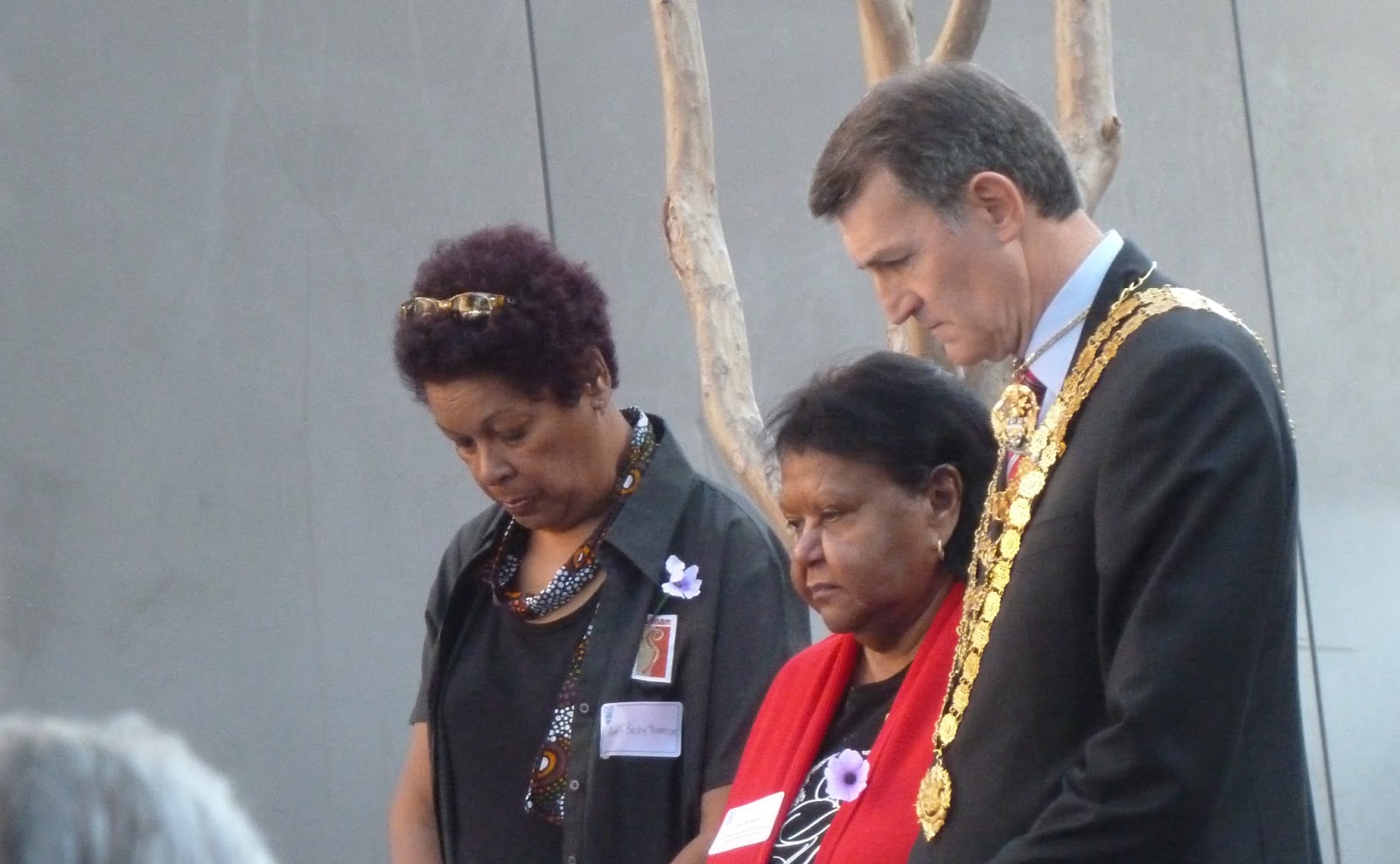
It was a glorious late-autumn day in Brisbane as we gathered to commemorate National Sorry Day in King George Square. It was a solemn and moving affair. What on earth was I doing there, you might ask. I was there in solidarity, I suppose, with a people sorely wronged in the past and still waiting for their chance at a fair go.
* The report was produced by the National Inquiry into the Separation of Aboriginal and Torres Strait Islander Children from Their Families, established by federal Attorney-General Michael Lavarch (Labor) in 1995
** http://www.recognise.org.au
These children become known as the 'Stolen Generations'. The children were raised in institutions or fostered by non-Indigenous families. Few were allowed visits from their families; most were so far away as to make that impossible. Such removal was official government policy until 1969, although the practice didn't stop then. In fact, it is alleged that these days far more Aboriginal children are removed from their homes than during the Stolen Generations, except that now they're described as being in 'out of home care'.
Some victims never recovered from the trauma of losing their family and the isolation from their culture and the all-important connection to country. Long-lost family members are still being reunited by means of organisations such as Link-Up Queensland which, as well as helping people search for and reunite with their relatives, provides counselling for those suffering from the trauma of separation.
The following day, the 27th, is also a significant day, being the anniversary of the referendum in 1967 in which Australians voted to include Aboriginal peoples and Torres Strait Islanders in the census and to empower the Australian government to legislate on behalf of those peoples. It took a number of years, however, for the government to pass laws for the benefit of Aboriginal people. Gough Whitlam established the Department of Aboriginal Affairs in 1972, and in 1975 he gave the Gurindji people of the Northern Territory the title deeds to part of their traditional lands.
The 27th marks the start of National Reconciliation Week, a time to celebrate shared culture, history and achievement towards reconciling the peoples of Australia. Each year there is a theme, and for 2016 it is Our History, Our Story, Our Future. June 3 marks the end of that week and is the date of the famous Mabo decision in the High Court in 1992 that upheld the native title rights of Aboriginal peoples and Torres Strait Islanders over their lands post British colonisation. Eddie Mabo from the Murray Islands in the Torres Strait had challenged two assumptions under Australian law: that Indigenous peoples had no concept of land ownership before colonisers arrived in 1788, making the continent and its islands terra nullius, land belonging to no one; and that British sovereignty gave ownership of the land to the Crown and abolished any rights that might have existed previously.
The journey towards Reconciliation between Indigenous and non-Indigenous Australians continues. Link-Up counsellors are still busy soothing the pain of the Stolen Generations, and not all the Bringing Them Home recommendations have been realised. Debate rages about precisely where Reconciliation should go from here, and opinions are divided. Recognition of Aboriginal and Torres Strait Island peoples in Australia's constitution** is one of the thornier issues still requiring national debate.
A formal apology for past mistreatment was made by Prime Minister Kevin Rudd in 2008 (below, the plaque in King George Square, Brisbane: click on image to read).
It included a proposal for a commission to close the gap between Indigenous and non-Indigenous Australians in terms of educational achievement, health equality and life expectancy, and economic opportunity. That gap is still considerable. I quote from journalist Stan Grant's speech as part of an Intelligence Squared debate in October 2015.
My people die young in this country. We die ten years younger than average Australians, and we are far from free. We are fewer than three per cent of the Australian population and yet we are 25 per cent, a quarter, of those Australians locked up in our prisons, and if you are a juvenile, it is worse, it is 50 per cent. An Indigenous child is more likely to be locked up in prison than they are to finish high school.If you are tempted to conclude that Indigenous people should 'move on' from, or 'get over' two centuries of mistreatment and disadvantage, then read Stan Grant's book published earlier this year, Talking to My Country. It makes for sobering reading, but you will be enlightened about how it feels to be an Indigenous person – even an enormously successful one – in Australia in 2016.
It is not my intention to insult my host country, but many Australians have a lot to learn about Indigenous culture and experience. I have learned a huge amount, especially from other recent publications. Lesley and Tammy Williams's Not Just Black and White tells of Lesley being sent away from home by the Queensland government to work as a domestic servant, aged 15. This was in the 1960s. Her wages were kept in trust by the government even though she didn't know she had earned them until years later. Her nine-year battle to claim back her 'savings' presented an almost bigger challenge than being separated from her family. Her enormous courage resulted in a more than $55 million reparation package for Indigenous workers in Queensland.
The case for greater attention to 'Our History' is made starkly by Bruce Pascoe in Dark Emu Black Seeds, recent winner of a NSW Premier's Literary Award. Pascoe systematically destroys the myth of a continent populated by hunter-gathering roamers prior to colonisation. Based on evidence from explorers, drovers and early settlers, he describes the construction of permanent dwellings, dams, wells and storage facilities; the cultivation of grain, the baking of bread, and the transformation of unpalatable plants into everyday staples; large-scale fishing methods; conservation, economics and spirituality. He has to conclude that deliberate and concerted denial of experience combined with wilful destruction and massacre was employed to justify the seizure of a land from its rightful occupants. The obliteration of facts has been perpetuated. 'Such is the tenacity of the Australian delusion', Pascoe says, 'it encourages an impoverished national debate.'
It was a glorious late-autumn day in Brisbane as we gathered to commemorate National Sorry Day in King George Square. It was a solemn and moving affair. What on earth was I doing there, you might ask. I was there in solidarity, I suppose, with a people sorely wronged in the past and still waiting for their chance at a fair go.
* The report was produced by the National Inquiry into the Separation of Aboriginal and Torres Strait Islander Children from Their Families, established by federal Attorney-General Michael Lavarch (Labor) in 1995
** http://www.recognise.org.au
May 20, 2016
Words matter
My supper last night was interrupted by an automatic telephone survey about how I was intending to vote in the upcoming election and how important were certain issues. I don't mind surveys but I do mind careless wording.
I was given a list of topics – jobs, tax, health… and so on. I waited for 'climate change', but it didn't come up; environment did.
When the word 'environment' is used as an umbrella term, what do you think it means? How green is your suburb; how many lovely old Queenslanders on their spacious shady blocks are being replaced by multiple indistinguishable tight-fitting units; how clean is the water in your local creek; when did you last see a koala in South East Queensland; do you live within a kilometre of uncovered coal-trains; have the mangroves on the Bay disappeared for another marina; do you approve of fracking to extract coal seam gas; do you think the proposed Galilee coal mines should be allowed to obliterate remnant vegetation and ecosystems; how do you feel about such large areas of the Great Barrier Reef being bleached to death?
Oh, hang on, the bleaching is a result of the warmer, more acidic ocean, right? And climate change can be mitigated by not exploiting any more fossil fuel resources, and not clearing land of trees.
And then there's the loss of regional biodiversity throughout your state. Is that because of hotter droughts or habitat loss during development? Biodiversity is not a user-friendly word, we environmental activists are taught. People's eyes glaze over when they hear it; they start to think about what they'd like to eat for dinner; and many of them don't know precisely what it means, nor are inclined to find out.
Politicians of whatever colour know that Australia must live up to its international obligations to reduce carbon emissions globally, but at the same time many of them, and probably the majority of the people they represent, believe that action on climate change remains in the too-difficult box. They don't want to reduce their number of gadgets, cars and flights/year. The economy must transition to renewables, ah but some people get headaches from those wind turbines, and solar subsidies mean higher energy bills for everyone; and other myths.
When Aussie pollies list their priorities in slick, sound-bitey slogans, they tend to stick to must-have-otherwise-I'll-never-be-elected policies: the economy, jobs, education and health; the big four. Those politicians must be brave, however, and include the most pressing issue of all, action on climate change. There's no point in having a job in a landscape that's burnt to a frazzle and won't support food crops. Hand in hand with action on climate change goes transition to renewable energy. And specific environmental issues such as conservation of threatened species must be talked about too because everything is interconnected. If you destroy wetlands so you've got more berths for your boats, migratory shorebirds won't visit and there'll be less vegetation to check high tides when sea levels rise. If you cover more hinterland with concrete not only will there be less koala habitat but the impact of flash-flooding during intensifying storms will be more devastating.
If your candidates only list the obvious, ask them about the protection of dwindling water resources and endangered wildlife; how they intend to persuade Australians to reduce their high per capita carbon emissions; and will they make solar panels and insulation compulsory on new builds in the Sunshine State. Put them on the spot; a hot spot. If they waffle on about 'environment', ask them to clarify their position on 'climate change'. The careful choice of words is key to easier important conversations.
May 13, 2016
Queensland the archaic state
It's hard to believe but I have lived in Queensland for more than six years and only realised on Monday that abortion is illegal here. I was profoundly shocked: I felt peculiar, as if I'd suddenly been transported to a third-world state.
There was a protracted discussion in the UK decades ago about the viability of a foetus, and the stage of a pregnancy beyond which only a massive risk of death to the mother meant abortion was an option. The private member's bill introduced to the Queensland Parliament this week by Independent MP Rob Pyne still requires those details to be ironed out during debate on the floor of the house. At this stage Mr Pyne seeks simply to update a law from 1899 that criminalises abortion: 'What a woman decides to do with her body, in consultation with her doctor, does not belong in the criminal code.' Quite.
Recently, a 12-year-old girl had to appear in the Supreme Court to gain permission to have a termination. This is bordering on the inhumane.
The ACT, Victoria and Tasmania have all decriminalised abortion, but surely nationwide consistency necessitates federal jurisdiction.
The two main political parties are likely to allow their MPs a conscience vote. There will undoubtedly be a wide spectrum of opinions, from pro-choicers to typical detractors, old white men on the religious far right.
One caller to ABC Brisbane, perhaps belonging to the latter group, expressed concern that young women would use abortion as a form of birth control if the rules were relaxed. This is deeply insulting to countless women who have faced the agonising choice to continue with a pregnancy or abort, and illustrates the fact that some men with an urge to pontificate on the subject should pause for substantial thought before opening their mouths.
A few days later we learned that Brisbane's private members' club Tattersall's, bastion of tradition, 'heritage and unparalleled elegance', has offered honorary memberships to a number of male members of Queensland's government and Opposition. I am proud that Queensland currently boasts a female Premier and Deputy Premier, and 50 per cent of Annastacia Palaszczuk's Cabinet are women, but none are eligible, unless they are the partners of male members or are invited by male members.
Bizarrely, the LNP held their International Women's Day festivities at the Club last year.
I can scarcely believe I am writing about such an anachronistic indulgence. I understand men use clubs such as Tattersall's to network and do business. It is therefore all the more insulting that female members of the state government are exempt. Are they not worthy, membership being 'limited to gentlemen' but not gentle ladies? Tattersall's has a long connection to the racing industry, but Racing Minister Grace Grace was also snubbed.
The calls to talkback radio were predictable. Australian women are expected to 'just get on with it' when it comes to discrimination, otherwise they're accused of that most despised misdemeanour – whingeing. Men and women callers alike made the point that it's OK if women want to belong to all-women fitness clubs for example (for reasons other than the desire for female company, I suspect), and similarly for men to have men-only gatherings. This misses the point, however. Tattersall's didn't have to issue the invitations, drawing attention to their selectivity. As it is, they added arrogance and insensitivity to insult.
By the by, I wonder if Tattersall's issue Partner Cards to same-sex couples?
All in all, not a great week for women's confidence about their rights or equality in Queensland.
December 13, 2015
We'll all remember Paris
![]() |
| Polar bears in Paris (credit: Matt Dunham/AP) |
The key difference between exam results day and the finale of the Paris climate conference is that pass marks soon become less meaningful as time passes; whereas the lesser or greater degree of commitment to defined and necessary actions agreed at the Conference of the Parties will be of increasing significance in a warming world over the next couple of decades. Exactly how we will remember Paris is the point.
While I am pleased about delegates' positivism about their achievements, it's highly unlikely I would ever have been happy with the outcome. I do, however, acknowledge that it could have been far less satisfactory. For two weeks, the attention of the world has been focused on climate change, all the more so because the leaders of the world's greatest powers took it seriously. And renewable energy will get a bigger profile as a result; witness Malcolm Turnbull's reversal today of That Idiot Abbott's ban on government funding of wind power.
There are big buts, however. 'Parties aim to reach global peaking of greenhouse gas emissions as soon as possible, recognising that peaking will take longer for developing country Parties…' is disappointingly woolly, and no more than an aspirational statement.
There's no statement of intent to leave all coal reserves in the ground. That means no new mines, anywhere, from this day forward. Coal isn't mentioned at all in the agreement, in fact. Nor oil. There is no directive that says further fossil fuel exploitation must cease. Now.
There's nothing about protecting the oceans, from death by oxygen depletion, acidification or overfishing. And no suggestion of curbing the vast emissions from animal agriculture. Or details of how to accommodate large numbers of climate refugees forced to move by overpopulation, harvest failures, dust-bowlification, rising sea levels, and so on.
Worst of all, the biggest issue didn't even get a look-in at COP21. System change. Was it even on the agenda of a fringe meeting, bearing in mind that the world's largest corporations and industrial lobbyists funded the whole shebang and packed it out? Business as usual is simply not compatible with big enough action on climate change. Alternatives to capitalism have always been in the too-difficult box, however, and no one took along the key with them to Paris.
It's admirable that everyone agreed that a 2-degree rise in global temps was too high and a maximum of 1.5 degrees should be the target. But the pledges (Intended Nationally Defined Contributions, or INDCs) to curb emissions made by countries before they got to Paris would see temperatures rise by 2.7 degrees, and don't forget that Earth has already warmed by one degree. So, the hard work starts once delegates are back home and left to their own devices. That's why there's going to be a 'stock-taking' of emissions achievements every five years. The INDCs, though recognised by the Paris agreement, are not legally binding, so a review mechanism is essential to ramp up pledges so that the target temperature is met. It could be argued that, given the degree of warming already, five-year gaps in monitoring are too long. And where are the fines (with proceeds to the climate aid fund) for laggards?
In addition, mechanisms were put in place recognising 'the importance of averting, minimising and addressing loss and damage associated with the adverse effects of climate change'. And to make finance available for developing countries to adapt to climate change and make the transition to clean energy. In case you think these points are obvious and must have been relatively easy to insert into the agreement, bear in mind that Saudi Arabia, a 'developing country' apparently, lobbied for financial aid beyond the point at which the bottom drops out of the oil market completely.
In years to come, perhaps people will ask, 'Where were you when the climate change talks in Paris changed the course of the world?' I'd like to think so. I'd also like to think my awareness of an accelerating sea change is more than wishful thinking. It's not where I am right now, on the bottom right edge of the planetary map, but it's out there. It was in Paris, but among the 10,000 who filled the streets, post-COP, and created red lines of danger o'er which we step by not doing enough soon enough. There are reasons to be cheerful, as long as you relish the prospect of the challenge facing everyone in future. Ostensibly not much has changed, but maybe it's too early to see that everything has.
Goodnight.
December 2, 2015
Oh, the disappointment
I have marched through Brisbane several times before: for greater protection of the Great Barrier Reef (August 2013); for improved carbon emissions policies (November 2013); and I marched in March (2014) with disparate disgruntled groups protesting about Abbott's bad governance and broken promises.
On each occasion, I expected to see bands of marchers converging by ferry and bus, streaming up from North Quay or the Cultural Centre, wearing their aptly sloganed tees and hoisting scathingly witty placards. I believed they'd be spilling out of Queens Park into nearby streets before I'd even got there.
This never happens, of course. I take photos of clever signs and cute kids and Greens speakers and support bands, and try to make it look as if the CBD is bursting with ordinary folk rather than campaigners. With rising anger followed by debilitating disappointment in my heart, I return home to learn that Brisbane's 4000 or 5000, at best, pale into insignificance against Sydney's and Melbourne's tens of thousands more. I'm sure you'll tell me in your defence, Brisbane, that they are much larger cities. Percentages give the game away, however.
But last Saturday's People's Climate March was going to be different, right? I had attended the planning meetings, distributed the flyers, pinned up the posters, bought the T-shirts in advance, and posted the countdown to action on Facebook and Twitter. This would be the biggy. Drought-declared Queenslanders had pulled their heads out of the spreading sands in time to send their pathetic, lily-livered leaders in Paris a strong message: if you don't act now, the devastating consequences of beyond-the-tipping-point climate change will soon be felt.
I cannot fault the enthusiasm of the many dedicated environmental protectors I have come to know who gave up weekends and evenings and days after days, to brainstorm and organise, create and paint, door-knock and chat and cajole and maybe even lambast a bit. But I do believe that rather more energy should have been expended engaging consumers on the high street than colour co-ordinating like-minds and their protest paraphernalia.
I acknowledge that across Australia that weekend more people marched for climate change than had ever done before. In Sydney there were 45,000, and Melbourne between 40,000 and 60,000, depending on whose figures you trust – and both were fantastic turn-outs. Even in Hobart, there were 4000. Here in Brisbane, in a so-called New World City of 2.3 million, there were 5000 (ABC) or 10,000 (event organisers). I know, however much I would love to believe otherwise, that there were nothing like 10,000. Five thousand would be 0.2 per cent of the population of this city. In fact, it was less than that, because coach loads came from Ipswich, the Darling Downs, the Gold and Sunny Coasts, and further afield in Southeast Queensland.
Really, Brisbanites, it was nowhere near good enough. Complacency and the blind hope that you can hang on to your hedonistic lifestyle, whingeing about the rising costs of electricity and how tough you're doing it, but not engaging with effective methods of curtailing this state's, this nation's, love affair with inappropriate development, is no longer the least bit excusable. It is within your power to bring about a transformation; but only if you have the determination to do so. You are naïve if you think parliaments will do it presently.
An inspirational lady and dear friend worked tirelessly on the climate march preparation as well as her usual conservation projects, despite a huge personal struggle of her own these past months. I know she will drag me to my feet from a heap of despond upon the floor. And I will most likely not make plans to move to a city that cares bigtime, as was my inclination on Sunday. There is so much more work to do here than I believed a week ago.
This woman's T-shirt got my best-in-show vote. (She bought it in Sydney.)
October 19, 2015
Not in Kevin's Corner
| Grazier Bruce Currie talks to the ABC outside the Magistrates Court |
All objections to proposed mega mines in the Galilee, and mines anywhere else for that matter, come down to irreversible groundwater impacts. It was the same in the Alpha case of 2013 and the Carmichael case in April this year, and it is the same in the battle for the Liverpool Plains of New South Wales. Will farmers' bores dry up once the mine is operational; will spring systems cease to be; and will the Great Artesian Basin (GAB), arguably Australia's most crucially important water source, be compromised beyond recovery.
Water is unquestionably the nation's most valuable resource. This continent has an arid climate in more regions than not, and, since climate is changing, drought will become more severe and prolonged. There is currently what has been described as a Godzilla El Niño developing, which will exacerbate the drought already being endured by many farming communities across Queensland and other states.
Other key matters in this case are ecology, economics and cumulative impact assessment.
Appearing in Court are the North Queensland Conservation Council (NQCC) and the Coast and Country Association of Queensland (CCAQ), the latter represented by the Environmental Defenders Office (EDO), along with Bruce and Annette Currie, beef farmers from near Jericho who are once again bravely representing themselves.
Kevin's Corner mine is projected to produce 30 million tonnes of thermal coal a year for 30 years. It is situated in the south Galilee Basin, 360 kilometres southwest of Mackay. The project will have both open-cut and underground operations.
As Damian Clothier (for GVK Hancock) began his opening statement, familiar names, acronyms and issues cropped up: the Rewan Formation and Dunda Beds; disputes between expert hydrogeologists about folding, faulting and recharge; aquifer parameters and groundwater modelling; monitoring bores and trigger levels; EISs, SEISs and MES; the Co-ordinator General's conditions and the Precautionary Principle.
Member Cochrane has a very different style from the judges in previous cases I've attended in the Land Court. He frequently interjected with questions, or required clarification or elaboration. He shared his thoughts with counsel and other representatives: are cumulative impact assessments (CIAs) beyond his remit? Where is the security for landowners (with regard to unpredicted impacts on water)? Modelling is only as good as the extent to which its assumptions are based on reality. Isn't everything he's going to hear from expert witnesses speculative? (Mr Clothier preferred the word predictive.) Could Mrs Tubman (for NQCC) give him an example of a social cumulative impact?
Before Dr McGrath of the EDO began his opening statement, he raised possibly the most intriguing matter of the day, and a conundrum. References had been made earlier by Mr Clothier to how Hancock's lack of a water licence permitting, for example, any impact on the GAB, would protect landowners against an unpredicted loss of water from their artesian bores, and thus necessitate a halt to mining if it occurred. Dr McGrath pointed out that changes to the Water Act introduced by the Newman government (the contentious Water Reform and Other Legislation Amendment Act) due to take effect by default from 6 December this year unless the current Queensland government repeals them (as promised prior to its election last January), mean that mining companies will no longer be required to obtain water licences in order to extract large quantities of water for their projects. This has huge implications for the handing down of Member Cochrane's recommendations in conclusion to this case.
The day's proceedings culminated with Ms Tubman's opening statement and main concern – the failure of GVK Hancock to provide a CIA as specified in the SEIS for Kevin's Corner.
We start half an hour earlier than usual in the morning…
Labels:
Environment,
Life in Australia,
Politics,
Social comment
July 22, 2015
Message to Adani
It is bad enough that the Carmichael mega mine will industrialise pastoral land in the Galilee Basin; decimate the last remaining populations of Waxy Cabbage Palms and Black-throated Finches; run dry a unique spring system in an arid region; carve up floodplains and paddocks with its rail link to Abbot Point coal port; increase bulk carrier traffic through the precious, endangered Reef; and be responsible for enough carbon emissions to rank among the world's top ten emitters. But neither has the project's Indian proponent, Adani, adequately considered the native title rights of the Traditional Owners of regions affected.
Some of those Traditional Owners (TOs) came to Brisbane last week*, to deliver the pledges of thousands of Australians who are concerned about the development of the Galilee for a whole host of reasons but are united as Reef Defenders and protectors of country. Juru elder Aunty Carol Prior led the TOs, and she asked to deliver the pledges personally up to Adani's office. She was not allowed into the building at 10 Eagle Street, however, let alone up to the office. An Adani representative came down, instead. He was William Haseler, Adani's counsel. He explained that the CEO was out of state and that he would accept the pledges on the company's behalf. I recognised this man from the Carmichael case in the Land Court earlier in the year: he was there part of most days.
Aunty Carol explained that the mine's infrastructure would impact on four different tribal lands.
Other Traditional Owners, the Birri, performed traditional dances. In one, they symbolically cleaned the land; later, they performed the Eagle Dance: they were in Eagle Street.
Some of those Traditional Owners (TOs) came to Brisbane last week*, to deliver the pledges of thousands of Australians who are concerned about the development of the Galilee for a whole host of reasons but are united as Reef Defenders and protectors of country. Juru elder Aunty Carol Prior led the TOs, and she asked to deliver the pledges personally up to Adani's office. She was not allowed into the building at 10 Eagle Street, however, let alone up to the office. An Adani representative came down, instead. He was William Haseler, Adani's counsel. He explained that the CEO was out of state and that he would accept the pledges on the company's behalf. I recognised this man from the Carmichael case in the Land Court earlier in the year: he was there part of most days.
Aunty Carol explained that the mine's infrastructure would impact on four different tribal lands.
In some areas, it goes right through sacred sites, sacred waterholes. And in my country it's going through 30 metres away from a rock art that's thousands of years old. Our concern is that the dust will destroy that rock art.
| Traditional Owners approach Adani HQ |
| Bill Haseler didn't invite Aunty Carol in |
I was introduced to Aunty Carol by a mutual friend. She gave me a hug: I was by now quite moved by the event. I am frequently angered by Australia's treatment of its indigenous peoples, past and present. Seeing these Traditional Owners out of context in Brisbane's alien CBD reinforced my belief that they should not have to lobby for their land rights.
One sign seemed to sum up the mood during this successful, strong yet peaceful protest. It said simply: 'Hey, Adani, we won't stop until you do.'
* The Wangan and Jagalingou Traditional Owners, whose land would be directly affected by the Carmichael mine excavation, have a Native Title claim to much of the Galilee Basin. They have submitted a Defence-of-Country Declaration to the Queensland government, opposing the mine, having failed to negotiate an Indigenous Land Use Agreement (ILUA) with Adani. In May they appealed to the Federal Court, challenging Australia's National Native Title Tribunal's decision that the government of Queensland can issue a mining lease for the mine. Wangan and Jagalingou elder Adrian Burragubba has expressed an intention to take the case to the High Court if necessary.
May 23, 2015
They who dare
One of many beneficial consequences of The Guardian's arrival in Oz has been increased exposure to the thoughts of George Monbiot. He writes about the environment, social injustice and other things that make him angry. Sometimes that's politics. He tackles subjects that most people are only too glad to brush under carpets: ones in the 'too difficult' box; those that require you to take a long hard look at the way you live. On occasion, you need to be strong of heart and mind to read Monbiot.
Yesterday, stupidly, I read this just before going to bed. I felt extremely depressed. Australia used to have megafauna, you know?http://www.theguardian.com/environment/georgemonbiot/2015/may/22/attacks-on-the-last-elephants-and-rhinos-threaten-entire-ecosystems
Then this morning I read this: http://www.theguardian.com/
commentisfree/2015/may/19/chicken-welfare-human-health-meat. Now I feel I should give up chicken. In the UK I could avoid the obvious burns on the flesh of factory farmed offerings by buying organic, but in Australia organic chicken isn't easy to find. Butchers look blank when I ask for it. It's available in larger Woolworths, but can you be sure of its origin? I only buy eggs off companies that offer me webcam footage of happy chooks in paddocks.
There are lots of food products my friend and I reject. I have never knowingly bought Nestlé products since my youngest daughter came home from school more than a decade ago and asked me not to after she'd learned about the baby milk scandal*. I'd loved KitKat since childhood but I haven't eaten one since. The company still ranks high on the morally indefensible ladder. Recently they admitted they would happily bottle more water in seriously drought-ridden California if permitted**.
In the UK, I never bought Israeli food produce, and often had to forgo citrus fruits, sweet peppers and other veggies for weeks in winter when they weren't available in Europe. But we survived without any of these things, having put our minds to it.
These days, we won't eat fish unless we know it is on our list of sustainably fished varieties. Five and a half years ago when we moved here, and asked at the fish counter of an upmarket deli in New Farm if they knew where their fish was sourced, they told us we were the first to have asked that question. The best-value prawns ever – from a farmers' market in the same suburb – were sacrificed as soon as we learned they were bottom-trawled in the Gulf of Carpentaria.
George makes you rethink all sorts of things you may have condoned for years without question: eating meat, overfishing, eating chicken, nature conservation methods, spoiling soil, consuming more stuff, subsidising large landowners, subsidising fossil fuels, offsetting biodiversity, climate change delaying tactics, tolerating bank scams, overpopulating, building more roads, using plastic bags, over-packaging, fracking ignorance, sitting idly by…
This week we learned that some frickin' idiot shooter from Texas paid $350,000 to 'hunt' and kill a black rhino in Namibia, as part of a supposed conservation fundraiser. Disbelief and despair combined in the imagined joy of shooting Corey Knowlton, the perpetrator of this unspeakable crime. I feel as if the-world's-gone-mad moments are becoming much more frequent than they used to be. Is that a symptom of getting older? Or a natural fearful reaction as we hurtle, seemingly powerless, towards the inevitable devastation of the planet?
Increasingly I have to conclude that politicians are not going to do what is necessary until a large-scale catastrophe hits their voters. We must take our heads out from beneath the pillow and change things, starting with our lifestyle, before setting more ambitious targets.
I leave you, naturally, with George's words:
It's not blind spots we suffer from. We have vision spots, tiny illuminated patches of perception, around which everything else is blanked out. How often have I seen environmentalists gather to bemoan the state of the world, then repair to a restaurant in which they gorge on beef or salmon? The Guardian and Observer urge us to go green, then publish recipes for fish whose capture rips apart the life of the sea.It's so hard to get it right. So much to learn, in so little time. But so many places you can start.
* http://www.theguardian.com/sustainable-business/nestle-baby-milk-scandal-food-industry-standards
** http://thinkprogress.org/climate/2015/05/15/3659415/drought-isnt-nestles-problem/
December 13, 2014
#auspol
Tweets using the understated hashtag #auspol trended the most on Twitter in Australia during 2014. Which just goes to show that, despite masses of disillusionment, disinterest and downright cynicism among Aussies about their pollies, in certain circles politics is still a hot topic. Having decried Twitter for years, I find it useful, now I'm on it, for several reasons, but especially for venting during a week such as the last one, which was a truly extraordinary newsweek.
Jeff Seeney channels King Canute (#climateactionnow)
The Deputy Premier of Queensland has ordered Moreton Bay Council to remove all mention of 'theoretical' climate-change-related sea level rises from their regional planning documents. This must be the most obvious denial of climate change in a while. Usually, LNP anti-science disinformers shroud their scepticism in woolly, action-evading witterings. While there is nothing to indicate that steadily increasing human-generated carbon emissions are not having an impact on the climate, there is a whole stash of evidence suggesting the opposite. So beware, those of you planning your dream home on the Bay: you will have to do your own research about the risks of ever-higher tidal reaches in future.
You might like to consult a draft CSIRO discussion paper*, details of which were revealed by the ABC this week. It warns about the high costs of damage done by extreme weather events. Its concern is that poor – or perhaps head-in-the-sand – planning will leave Australia increasingly exposed to bushfires, inland flooding and coastal inundation in a warming world.
The New South Wales government is not guided solely by dogma rather than science, however. There is a Climate Change Research Centre at the University of New South Wales, and they have collaborated with the NSW and Australian Capitol Territory governments in detailed climate modelling**. Parts of northwest New South Wales – places such as Bourke and Moree, where we were in August – are expected to experience as many as 40 more days a year of temperatures reaching 35 degrees, by 2070.
Australia is Fossil of the Day, again and again and again… (#idiotabbott)
Following on from its G20 embarrassment, Australia garnered yet more international opprobrium in Lima at the COP20 climate change talks. Awarded by the Climate Action Network (CAN) – consisting of about 800 international environmental and climate justice organisations – the Fossil is given to those countries considered to have done most to block the progress of negotiations. This coincided with the Climate Change Performance Index 2014† rating Australia the worst-performing country on a list comparing the 58 nations that together are responsible for 90 per cent of energy-related carbon dioxide emissions.
The Sydney Morning Herald revealed that 'Six out of ten of [sic] Australians think Tony Abbott's Direct Action policy has left the country with an inadequate response to the problem of global warming, according to the latest Fairfax Ipsos poll.' This preceded a new analysis†† by the Climate Action Tracker (CAT) claiming that Australia's current programme for future emissions will come nowhere near enabling the pledge it made in Copenhagen to cut five per cent of its 2000 level of emissions by 2020.
The branding of the Queensland Police Service (#hereweJohagain)
Above-average temperatures in southeast Queensland have produced serious storms in the last couple of weeks. But nothing like as ferocious as the outrage let loose on social media once the cat was out of the bag about Queensland police cars bearing the logo of big mining company Santos.
They may well have been part of an Outback road safety campaign, and there may have been only two police vehicles involved, and other commercial partners as well as the company putting essential water supplies at risk in the Channel Country of Far West Queensland, but Minister for Police Jack Dempsey completely missed the point as he defended the indefensible, hugely perturbing issue for anyone with half a brain. So, if you get pulled over on the Bulloo Developmental Road by a police car that may be principally engaged in Outback road safety but isn't going to ignore motorists infringing traffic laws, what do you think when you see Santos emblazoned on the vehicle? I know what I'd think. That the police might be influenced by the interests of their sponsors, that's what.
Imagine: 'Officer, I was just stopped at the side of the road taking a photograph (of a gas well, for my travel blog). Oh, I see you have the name of the gas company on your car…Are you the state police or do you work for the company…?'
Political hypocrisy knows no bounds (#liesandhypocrisy)
I vividly remember the extent of the Opposition's indignation and vitriolic criticism of Julia Gillard's introduction of carbon pricing, having famously announced prior to the 2010 federal election that there would be no carbon tax on her watch. Expediency soon ruled the day and she had to make deals with minority parties and independents in order to govern.
I also well remember Tony Abbott selling himself in the lead-up to last year's election: no broken promises; grown-up government, and a list of policies safe in LNP hands. His assertion that there would be no cuts to the ABC was the tripwire in his case. He has finally had to eat humble pie, although at first he had downgraded the ABC promise compared with repealing the carbon tax and stopping the boats. Cutting funding to the much-loved and highly valued ABC was necessary for balancing the budget, the final component of Abbott's retrospective big three promises. Expediency struck again, but it cuts both ways. Either it is acceptable for politicians, regardless of their political colour, to change their minds and policies as befitting altered circumstances, or it is not.
The damage has been done, however. Abbot simply cannot be trusted. He misjudged the popular support for the ABC and no amount of grovelling can redeem him now. He had no mandate to slash their funds, just as he had no mandate to take his climate change denialism to the extent of rendering Australia an international embarrassment, first at the G20 and now in Lima. So hopefully he's #onetermtony.
Not enough has been made of his gross hypocrisy, however. I don't suppose it will be by a massively right-leaning press (top). But this week he has added to the charges while defending his chief of staff, Peta Credlin. There is much disquiet in Canberra about the extent of her powers. I have noticed her sitting with him in places you would not expect, from Parliament to the United Nations, which is disconcerting. Abbott has criticised her critics by attributing their motivation to sexism. Do you remember how he reviled Gillard for playing 'the gender card'?
The beauty of hashtags is that, used wisely, they can be concise and incisive, witty and amusing. A Twitter 'storm' certainly makes the people's feelings felt. Sometimes, however, hashtags are dropped in far too liberally, in a #childlike fashion. Then they become #simple #irritating and a complete #wasteoftime.
As for the nature of the news this week, observe the writing on the wall. #youhavebeenwarned.
* http://www.businessspectator.com.au/news/2014/12/10/policy-politics/csiro-warns-1-trillion-natural-disasters-exposure?utm_source=exact
** http://www.abc.net.au/news/2014-12-06/nsw-climate-change-predictions-show-rising-temperatures/5947406
† https://germanwatch.org/en/7677 and http://www.theguardian.com/environment/2014/dec/08/australia-named-worst-performing-industrial-country-on-climate-change
†† http://climateactiontracker.org/publications/pressreleases/181/Australia-Emissions-set-to-soar-by-2020.html
December 9, 2014
Your planet or your lifestyle?
The other day I read a piece in an online magazine written by a woman whose life, she claims, has been ruined by coal seam gas. She and her family live in the Darling Downs west of Brisbane. There are several gas wells on her property, and many more within a couple of kilometres. On her land and all around is gas infrastructure – holding ponds, vents, pipelines, compressor stations, roads. The family's health has steadily declined, but she cannot prove it is because of the gas.
She signed an agreement with QCG (Queensland Gas Company) for the first well nearly ten years ago. She alleges thereafter she was bullied into accepting more. She can't sell up because she would never again be able to afford such a big house (10 bedrooms), and it's where she and her husband run their business.
I have heard a lot about the ill-effects of living in a gas field. Your family gets sick, physically and psychologically; there is constant disturbance of one kind or another; the financial reward is not commensurate with the inconvenience; there is little recourse to government at any level; and the comeback is virtually non-existent. I have no doubt it presents a grim outlook.
My sympathy for this woman was short-lived, however. She has 11 children, eight of whom are still living at home. She bought this property so they could roam free, riding their motorbikes, going fishing, etc. If I were to meet this woman I would have to ask, before I enquired about her daughter's headaches or her son's nosebleeds, whatever had possessed her to produce so many children. Does she not believe in birth control? Does she not understand how to use it? Is she on a personal mission to populate this largely empty continent? Does she not consider it morally reprehensible to blatantly disregard global population pressures?
Australia's birthrate is currently fewer than two babies per woman, below replacement level. This means a contracting workforce to support an ageing population. Women have more options than ever with regard to controlling reproduction and realising ambition in the workplace: many of them are choosing to have fewer children. Large numbers of immigrants, however, helped Australia's population to top 23 million in 2013.
Like many industrialised countries, Australia experienced a baby boom following World War 2 and the fertility rate increased to about 3.5. Then the contraceptive pill in the 1960s brought about a decline that continued gradually until the turn of the century: it was as low as 1.73 in 2001. In 2002 came the 'baby bonus', a tax rebate for first-time mums. This may have been attractive to younger, lower-paid women, but it is uncertain exactly how much impact it had on the birth rate, which increased to 1.93 by 2008, after which it began to fall again. In 2004, Peter Costello, Treasurer in John Howard's government, famously encouraged Australians to have at least three children – 'one for mum, one for dad, and one for the country'. But who listened to him?
Well, someone in the Darling Downs seems to have done. She perhaps wasn't aware that, if everyone on earth lived life like an Australian, more than three planets' worth of resources would be required to produce the jet skis and boats and household gadgets and monster 4WD trucks and airconditioners and clothes driers and patio heaters and leaf blowers and home entertainment systems and smart phones and gaming consoles, and so on.
Let's assume her children don't follow her example, and produce a modest two or three children each. Within 15-20 years she could have 25-30 grandchildren. Let's hope most of them are solar-power generating vegetarians with an environmental conscience, for the planet's and their children's sake.
I have noticed a reverence here for women who produce lots of babies. On talkback radio, blogging parents and Aussie battlers alike proudly boast they've got four or five children or whatever, and are almost congratulated or at least accorded a lot of respect, as if they're doing it for a higher cause than themselves.
And let's not forget the shameful treatment received by this country's first female leader at the hands of the Murdoch media and the Opposition that included being chided for her childlessness.
I wonder a lot about our priorities. Do you?
June 3, 2014
How the audience laughed
Did you watch Q&A last night?
Did you notice the overly right-wing representation on the panel? The ABC must be trying to convince its many critics in government that it doesn't have a left-leaning bias. The Tweedledum and Tweedledee of Liberal policy Senator Cory Bernardi and advertiser and Australian Financial Review columnist Rowan Dean batted the overused party lines across the table and shared the shouting down of anyone who appeared to disagree. There was businesswoman and ex-Lord Mayor of Sydney (and wife of Liberal MP Malcolm Turnbull)) Lucy Turnbull, the voice of reason; and American theoretical physicist Lawrence Krauss, who loudly held his own in the face of what he clearly thought an extraordinary undermining of science in Australia, in both the recent budget and the climate science debate. The only 'leftie' on the panel was Shadow Health Minister Catherine King, who managed to maintain her smile throughout the programme, probably because the Bernardi-Dean team's performance was so derisible.
There was a question specifically for Cory Bernardi from a science researcher, regarding the Senator's welcoming of the abolition in the budget of the Australian Renewable Energy Agency, and the Government's continued commitment to getting rid of both the Climate Change Authority and the Clean Energy Finance Corporation. She assumed that if Senator Bernardi learned from his car mechanic, dentist or plumber that there was something wrong with his car, teeth or pipes, that he would listen and take action. She asked why, therefore, would he ignore climate change experts from all over the world who are urging that the climate is changing and that we must act now to reduce carbon dioxide emissions.
The audience clapped the questioner enthusiastically. Cory Bernardi began by explaining, with his smirky face on, that he had paused for 'the expected applause', showing thinly disguised contempt for his listeners. So, when he then declared that, of course the climate is changing, it's been changing for millennia, there was loud and hearty laughter, followed by endorsement of Laurence Krauss's well-deserved put-down:
I was greatly encouraged by the audience's laughter. More and more Australians are recognising that the government they elected only a few months ago is swimming against an ever-stronger global tide – not to mention looking increasingly stupid.
Did you notice the overly right-wing representation on the panel? The ABC must be trying to convince its many critics in government that it doesn't have a left-leaning bias. The Tweedledum and Tweedledee of Liberal policy Senator Cory Bernardi and advertiser and Australian Financial Review columnist Rowan Dean batted the overused party lines across the table and shared the shouting down of anyone who appeared to disagree. There was businesswoman and ex-Lord Mayor of Sydney (and wife of Liberal MP Malcolm Turnbull)) Lucy Turnbull, the voice of reason; and American theoretical physicist Lawrence Krauss, who loudly held his own in the face of what he clearly thought an extraordinary undermining of science in Australia, in both the recent budget and the climate science debate. The only 'leftie' on the panel was Shadow Health Minister Catherine King, who managed to maintain her smile throughout the programme, probably because the Bernardi-Dean team's performance was so derisible.
There was a question specifically for Cory Bernardi from a science researcher, regarding the Senator's welcoming of the abolition in the budget of the Australian Renewable Energy Agency, and the Government's continued commitment to getting rid of both the Climate Change Authority and the Clean Energy Finance Corporation. She assumed that if Senator Bernardi learned from his car mechanic, dentist or plumber that there was something wrong with his car, teeth or pipes, that he would listen and take action. She asked why, therefore, would he ignore climate change experts from all over the world who are urging that the climate is changing and that we must act now to reduce carbon dioxide emissions.
The audience clapped the questioner enthusiastically. Cory Bernardi began by explaining, with his smirky face on, that he had paused for 'the expected applause', showing thinly disguised contempt for his listeners. So, when he then declared that, of course the climate is changing, it's been changing for millennia, there was loud and hearty laughter, followed by endorsement of Laurence Krauss's well-deserved put-down:
You know... what would be really refreshing is if... people like you actually tried to base your policies on empirical evidence instead of beliefs. It would be so refreshing.As Bernardi couldn't help revealing his true denialist colours, disputing the figures that prove a warming world, Krauss taught him a basic lesson:
It's fundamental physics. You put carbon dioxide into the atmosphere, you add heat to the Earth. It's just physics. It's not politics.Few in the audience may have known of Bernardi's strong Roman Catholic beliefs, or of his visit to the US in 2009 to seek tuition from America's leading climate change deniers and the right-wing Tea Party. He probably thinks his god will guide us when frequent extreme weather events threaten food production, coastal cities, the health of millions, and societal structure. There is no doubt, however, that the audience was closer than the senator from South Australia to identifying the most pressing issue facing Australia now and in the foreseeable future. They can see clearly, free of the patronage of rich business. Bernardi does them a disservice by not encouraging the party leader he helped bring to power to change course on emissions and renewables.
I was greatly encouraged by the audience's laughter. More and more Australians are recognising that the government they elected only a few months ago is swimming against an ever-stronger global tide – not to mention looking increasingly stupid.
May 27, 2014
Environmentalists' impact statements
Environmental protectors the world over last week celebrated the success of the Bentley blockade as defined by the suspension of natural gas company Metgasco's licence to drill by the New South Wales government for failing to consult adequately with the local community (see The Bentley effect, May 2014). A day later came an announcement from Metgasco, that drilling of their Rosella well would 'not be proceeding in the near term' after they had learned that the police resources 'necessary to provide a safe and lawful environment for drilling to proceed' had been reallocated. They were cancelling the drilling rig and other service contracts 'to minimise costs'.
The NSW government had considered it necessary to use – reports varied but essentially – 800 regular police, possibly including riot units, to disperse potentially thousands of extremely well organised and absolutely non-violent protectors. An equally efficient social media back-up network would have broadcast to the world in minutes the kind of image that would not have improved Australia's already sullied global reputation. The ABC have an interesting take on the cancellation of Operation Stapler*.
Possibly the best news at the end of the week came from Deutsche Bank's AGM in Frankfurt. The bank will not be considering investment in port expansion at Abbot Point while there is no consensus between the Australian Federal Government and UNESCO about the risk of further development damaging the fragile ecosystem of the Great Barrier Reef. Deutsche Bank's announcement followed intense lobbying by environmental groups and their supporters' networks worldwide.
The day after that, HSBC at its AGM, described the likelihood of its further financing of projects close to the GBR as 'extraordinarily unlikely'. Activists were less successful in persuading French Bank Société Générale not to get on board with Gina Rinehart and GVK, although Crédit Agricole preceded Deutsche Bank in announcing ESG (environmental, social and governance) risks in its investment management.
Queensland Resources Council** Chief Executive Michael Roche provided a rather churlish addendum to the jubilation at Deutsche Bank's decision.
In 2012, Crédit Suisse calculated that the resources industry was at the greatest risk from negative share price valuation on the ASX (Australian Securities Exchange) as a result of environmental, social and governance impacts. A new study involving the University of Queensland – and reported by Mining Australia† – has shown that 'company-community conflict' is now costing miners billions of dollars. Conflict can be translated into business costs and has become a major component of project costings. Dr Daniel Franks of UQ's Centre for Social Responsibility in Mining explains:
This month, ABC Rural reported that the Minerals Council of Australia estimates 10,000 lost jobs in coal mining in the last two years, during which time prices for thermal and coking coal (used in steel manufacture) have fallen by between 50 and 70 per cent. In the meantime, the Queensland government has approved Adani's proposal for Australia's largest mine ever – Carmichael in the Galilee Basin. The stats are enough to make your eyes water: the mine will measure 25 kilometres by 12, or 28,000 hectares; it will produce 120 million tonnes of carbon every year, four times New Zealand's fossil fuel emissions; it will use 12 billion litres of water a year; and its development will put at risk 60 'at risk' species. Do investors in this monster really want to lose their shirts?
During the transition from a fossil-fueled, growth-obsessed economy to a sustainable, renewable-energy-powered, climate-focused action plan, there will be many different takes on what is happening and what should happen, depending on where the protagonist is standing. A research company working for the Minerals Council has just advised that professional investors are 'resistant to anti-coal rhetoric and still wedded to their standard data-based analysis of coal as an asset class'. They conclude that coal's current under-performance is not being influenced by the divestment campaign but is cyclical. Heard that before?
Their figures – reported in the Australian Financial Review – are open to different interpretations. Having surveyed 1000 Australians, the research company found 67 per cent were unaware of the divestment campaign; 13 per cent were aware but didn't plan any action; 17 might act in the future; and 4 per cent were planning to divest. Apart from the fact that the numbers don't add up to 100, they show that 21 per cent of interviewees are either divesting or considering it. Not a bad start to the campaign, you could argue, especially if you consider that the likes of Stanford University and Deutsche Bank have joined the 'anti-coal collective'.
Today would have been the 107th birthday of Rachel Carson, an American marine biologist and conservationist who, with the publication of her book Silent Spring, in 1962, inspired a global grassroots interest in environmentalism. Carson's impact was summed up two decades later by environmental engineer and academic H Patricia Hynes:
The NSW government had considered it necessary to use – reports varied but essentially – 800 regular police, possibly including riot units, to disperse potentially thousands of extremely well organised and absolutely non-violent protectors. An equally efficient social media back-up network would have broadcast to the world in minutes the kind of image that would not have improved Australia's already sullied global reputation. The ABC have an interesting take on the cancellation of Operation Stapler*.
Possibly the best news at the end of the week came from Deutsche Bank's AGM in Frankfurt. The bank will not be considering investment in port expansion at Abbot Point while there is no consensus between the Australian Federal Government and UNESCO about the risk of further development damaging the fragile ecosystem of the Great Barrier Reef. Deutsche Bank's announcement followed intense lobbying by environmental groups and their supporters' networks worldwide.
The day after that, HSBC at its AGM, described the likelihood of its further financing of projects close to the GBR as 'extraordinarily unlikely'. Activists were less successful in persuading French Bank Société Générale not to get on board with Gina Rinehart and GVK, although Crédit Agricole preceded Deutsche Bank in announcing ESG (environmental, social and governance) risks in its investment management.
Queensland Resources Council** Chief Executive Michael Roche provided a rather churlish addendum to the jubilation at Deutsche Bank's decision.
The anti-mining activists seem to have a lot of money to travel the world to put lies and distortions in front of institutions. I would like to think the activist groups, with all this money to be swanning around Paris, Frankfurt and London... would put their member's [sic] hard-earned donations into proper research to eradicate the real threats to the Reef such as the Crown-of-Thorns Starfish.Mr Roche's comments are typical of the increasingly knee-jerk and not-always-accurate reaction of mining companies, their lobbyists and investors as the writing on the wall for coal becomes ever more luminous.
In 2012, Crédit Suisse calculated that the resources industry was at the greatest risk from negative share price valuation on the ASX (Australian Securities Exchange) as a result of environmental, social and governance impacts. A new study involving the University of Queensland – and reported by Mining Australia† – has shown that 'company-community conflict' is now costing miners billions of dollars. Conflict can be translated into business costs and has become a major component of project costings. Dr Daniel Franks of UQ's Centre for Social Responsibility in Mining explains:
There is a popular misconception that local communities are powerless in the face of large corporations and governments. Our findings show that community mobilisation can be very effective at raising the costs to companies.Delaying tactics are currently a powerful tool in the hands of environmental activists trying to stall the approvals of mega mines in the Galilee Basin, for example, or halt the start-up of projects already green-lit such as at Maules Creek. For a major mining project with a huge capital expenditure, the study shows that up to US$20 million a week may be lost.
This month, ABC Rural reported that the Minerals Council of Australia estimates 10,000 lost jobs in coal mining in the last two years, during which time prices for thermal and coking coal (used in steel manufacture) have fallen by between 50 and 70 per cent. In the meantime, the Queensland government has approved Adani's proposal for Australia's largest mine ever – Carmichael in the Galilee Basin. The stats are enough to make your eyes water: the mine will measure 25 kilometres by 12, or 28,000 hectares; it will produce 120 million tonnes of carbon every year, four times New Zealand's fossil fuel emissions; it will use 12 billion litres of water a year; and its development will put at risk 60 'at risk' species. Do investors in this monster really want to lose their shirts?
During the transition from a fossil-fueled, growth-obsessed economy to a sustainable, renewable-energy-powered, climate-focused action plan, there will be many different takes on what is happening and what should happen, depending on where the protagonist is standing. A research company working for the Minerals Council has just advised that professional investors are 'resistant to anti-coal rhetoric and still wedded to their standard data-based analysis of coal as an asset class'. They conclude that coal's current under-performance is not being influenced by the divestment campaign but is cyclical. Heard that before?
Their figures – reported in the Australian Financial Review – are open to different interpretations. Having surveyed 1000 Australians, the research company found 67 per cent were unaware of the divestment campaign; 13 per cent were aware but didn't plan any action; 17 might act in the future; and 4 per cent were planning to divest. Apart from the fact that the numbers don't add up to 100, they show that 21 per cent of interviewees are either divesting or considering it. Not a bad start to the campaign, you could argue, especially if you consider that the likes of Stanford University and Deutsche Bank have joined the 'anti-coal collective'.
Today would have been the 107th birthday of Rachel Carson, an American marine biologist and conservationist who, with the publication of her book Silent Spring, in 1962, inspired a global grassroots interest in environmentalism. Carson's impact was summed up two decades later by environmental engineer and academic H Patricia Hynes:
Silent Spring altered the balance of power in the world. No one since would be able to sell pollution as the necessary underside of progress so easily or uncritically.* http://www.abc.net.au/news/2014-05-27/metgasco-casualties/5479900
** an NGO representing the interests of companies engaged in the exploration, mining and processing of minerals
January 23, 2014
Teach your children
A few months ago I asked Brisbane City Council if they would plant a tree outside our house. There always used to be one, on the nature strip, but it did not survive the renovations. Council approved my request and, early one Sunday morning late in November, they planted a Tuckeroo sapling that I'd promised we would care for, by mulching and watering.
Little Tree, as it has come to be known, has flourished. A couple of weeks ago, my neighbours were seeing off some visitors who were parked alongside Little Tree. The children were loitering: their mother obviously wasn't saying goodbye fast enough, and the boy starting pulling Little Tree over by its leaves and letting go, so it sprang back. His sister pulled a couple of leaves off to pass the time. Ordinarily, I would have asked them to stop, but our neighbours are strange and I wished to avoid confrontation.
Earlier this week, while walking in a local park, I watched in dismay as a young woman let two fast, powerful dogs chase two Masked Lapwings across the football pitch – twice. The park is not a dog off-leash area.
These incidents got me thinking about how we raise children with regard to the natural world. It's not rocket science, but I am frequently surprised that what I consider to be obvious, obviously isn't.
* There's a good reason for 'Don't feed the wildlife' signs – our food doesn't suit most animals – so don't do it. And don't set the precedent: 'Let's go and feed the ducks, roos, etc...'.
* Respect all living things. A bat is just as worthy as a koala, just not as cute... or as good at earning tourist dollars.
* Take home ALL your rubbish and belongings after picnicking, camping, swimming, fishing, sailing, sunbaking etc. Leave only your footprints, not your broken thongs.
* You don't have to have two dogs or more: one's just fine (working dogs in the bush being the exception). Multiple dogs in the city is not clever nor good for your carbon footprint†. Adopt a Phillip Island penguin instead*.
* Always keep your dog on a lead if there is any wildlife nearby, or the possibility that there might be. And keep your dog quiet, especially at night: if it's a yapper, bring it in from the yard.
* Go quietly. If you're walking in the bush or along the beach, remember that other people may be listening to birdsong, waves breaking or simply the silence. You'll never see animals if you crash about.
* If you're driving off road, respect the land and those who work and use it: leave gates as you find them; always watch out for animals, not just at dawn and dusk; never disturb seabirds resting on the shoreline; and don't even think about circle-turning on the sand or carving your name in wood or rock. Leaving your mark is not smart, it's dumb...
Above all, set an example of wonderment and celebration in biodiversity and landscape. Teach your children to see clearly, and to explore what they see; to value it and to question those who would exploit it for the gain of a few at the expense of the many. With a bit of luck we'll produce committed guardians of a planet under siege.
A few weeks ago I read a piece in a magazine OneEarth, an online forum for thought and opinion about the environment. It is a long piece but I recommend you read it. It's the story of three people who paddled 92 miles down the Kobuk River through the boreal forest in arctic Alaska, and is an inspiring celebration of raw experience in a wild, wonderful place. A place that will be obliterated by mining and roads if the governor of Alaska has his way. In the face of madness, the writer concludes:
It's not so much that we are trying the save the beauty and efficacy of the natural world; rather, it saves us.† http://theconversation.com/what-about-your-carbon-pawprint-9878
* https://penguinfoundation.org.au/donation/?newForm=1
** http://www.onearth.org/articles/2013/12/alaska-kobuk-valley-open-pit-mines
July 10, 2013
Sexism cont'd
It seems only yesterday that I was writing about Julia Gillard's outburst in the Australian parliament when three years of daily sexist jibes and, yes, misogynistic horror stuff circulating among redneck backbenchers finally conspired to make her speak her mind. When she lost her job a couple of weeks ago many women in Australia – and some modern men, I'm sure – hung their heads in dejection while reflecting on how unready this nation is to appreciate the attributes women can bring to high office.
I worked in publishing houses in London for many years. There were always many more women on the staff than men, but that disproportion was never reflected at board level. Perhaps over that time I became inured to underlying sexism such as this. It is comparatively easy to rail against some of the more obvious daily examples, but sometimes, for sanity's sake, you have to put them out of mind. What a pleasant surprise it was in the Outback when, on chatting to a couple we'd just met, I was asked what I did for a living. It was the woman who asked me, natch.
So, from sexism in politics and the workplace to sexism in sport.
We have just endured Wimbledon. Don't get me wrong, I love tennis, and stayed up to watch Andy Murray win his second Grand Slam title in 12 months. I would have liked to watch the women's final too, especially as there were 'new' faces, but I didn't fancy two days of sleep deprivation. People still don't seem to know much about this year's champion, Marion Bartoli, even though she was a Wimbledon finalist in 2007. She hasn't got long blonde hair, you see, or slim bronzed legs up to her armpits. I actually can't bear to watch some of those candidates: Maria Sharapova may be beautiful but the excessive volume of her grunting renders watching her unenjoyable. Anna Kornikova was gorgeous, too, and acquired 'hottest female athlete' and lots of similar labels, but how many people remember that a WTA singles title eluded her?
Watching Wimbledon has several other irritations. I didn't mind seeing Andy Murray's girlfriend in her nice green Victorian Beckham frock as she took her place in the players' box. But I didn't want to witness her reaction to every point, and I didn't want to miss replays of key shots in order to marvel at her big hair or whatever it was that repeatedly attracted the cameramen. Neither do I give a toss whether or not Murray is going to propose to her now he's achieved his Wimbledon goal. One of the worst blunders of the tournament was silly-old-sod commentator John Inverdale's comment that Bartoli was 'never going to be a looker' while discussing her tennis technique. There were complaints about his sexist comments during Wimbledon back in 2009, too, so obviously he's a bit of a slow learner. The BBC apologised but still allowed him to commentate on the men's final the next day.
Since the weekend it has been pointed out ad nauseam that Murray is the first man to be Wimbledon champion since Fred Perry in 1936. I assumed the media were talking about the men's title even when the headlines replaced 'man' with 'Briton'. But what that change did, of course – and let's give them the benefit of the doubt – was to inadvertently overlook the four British women who have won the title in the years between Perry and Murray. Shame on them, and me.
Meanwhile, sexism is alive and kicking in Oz, despite the Gillard debate dying down. Now we have the latest porno, sorry, promo for surf retailer Roxy in the run-up to the World Women's Championship Tour of Surfing. There are lots of pert-butt shots and much sensual panning up and down long tanned limbs but no surfing footage whatsoever. All the model does is paddle out rather awkwardly. Women's surfing here has been battling gender inequality for years. As with tennis, people prefer to watch the men, in the water that is. The sexualisation of female athletes – beach volleyball probably takes the biscuit – in order to garner bigger audiences and more customers is peculiarly disquieting.
I'm sure I'll be called all manner of things for banging on about this subject again. Bitter and twisted, whingeing, etc, etc. Hey, I should just get on with it, shouldn't I, as a woman in Australia? And that's exactly what I'm going to do, highlighting sexism whenever I can.
Subscribe to:
Posts (Atom)