Showing posts with label Wildlife. Show all posts

December 15, 2013

'13 images (wildlife)

Jan Soggy roo on North Coast, NSW
Feb Sulphur-crested room mate, Hamilton Is
Mar Monitor Lizard playing hard to get
Apr Bit o' stick in Binna Burra
May Turtle channelling ET (Botanic Gardens)
Jun Echidna in the Outback
Jul Sydney Seagull
Aug Pellie posse in the Port
Sep Blue-face-off with Kookaburras
Oct Now you see me, soon you won't
Nov Yoga at Swan Lake
Dec Balancing act in Byron (Little Black Cormorants)
Best in show Lorikeets in a bit of a hole


October 5, 2013

So long, koalas

Have you ever known anyone not respond positively to a koala? Smiling or laughing or aahing, reaching for the camera? All visitors want to see koalas, without exception. Along with roos, koalas are the essence of Australia to the rest of the world.

September was Save the Koala month. You may not have known; I didn't. I didn't know until I read about the Queensland government sacking its only two specialist koala ecologists. For the first time since 1971, according to the Courier Mail, there isn't a dedicated koala ecologist in the Department of the Environment (and Heritage Protection). Great timing, boys.

Minister Andrew Powell assures us the ecologists' work will go on. And over the next four years $22.5 million will be spent on 'Koala habitat acquisition" and $800,000 on 'koala rescue and rehabilitation grants', which is not much. What precisely does 'habitat acquisition' mean? That koala habitat will be protected from the developers in perpetuity? Trees won't be cleared for yet more houses in the Gold Coast hinterland? Don't, absolutely don't, mention translocation to me (see 'Koalas declared extinct in Australia", August 2012).

This week also saw the release of research by the University of Sydney that indicates koalas will be severely impacted by heatwaves following further climate change. The study tracked 40 koalas over three years in northwest New South Wales and found that they used certain eucalypt species for feeding at night and then moved to a more shade-giving variety during the heat of the day. The composition of eucalypt woodland has been found to change with increasing temperatures: a quarter of the koalas tracked in this study perished during a heatwave in 2009. The suggestion by the researchers is that the supply of suitable trees will need to be managed in order to ensure the survival of koalas. This as well as preventing the loss of habitat area and protecting koalas from the attendant risks of development such as dogs and traffic.

Save the Koala Month is an annual fundraising and awareness campaign by the Australian Koala Foundation. You can help them plant trees: go to https://www.savethekoala.com/plant-a-tree/plant-form. I don't think we can rely on the Queensland government, do you?

* Climate-mediated habitat selection in an arboreal folivore by Mathew S Crowther et al. To read the abstract, go to http://onlinelibrary.wiley.com/doi/10.1111/j.1600-0587.2013.00413.x/abstract


August 21, 2012

'Koalas declared extinct in Australia'

'Yesterday the Federal Environment Minister, Anna Rose, reported to a silent Parliament in Canberra that, since there have been no koala sightings in the wild for the last 18 years, her Department had reluctantly revised the animal's conservation status to EW – extinct in the wild. She added that numbers in wildlife sanctuaries in Queensland and Victoria had failed to recover significantly in the last five years, and that breeding and translocation programmes had been largely unsuccessful.'
Did you see Four Corners: Koala Crunch Time last night? If you did, how long do you think it will be before you're reading something like the above on the ABC or in The Age? Twenty years? Fifty years? What did you think as you watched the programme? It can't have come as a complete surprise to you to learn of diving koala populations, in Southeast Queensland in particular, where there is an insatiable demand, still, for development, and apparently at any cost.

I last wrote about koalas nearly a year ago (see Koala alert, September 2011). I've been back to Noosa National Park several times since I last saw a koala in the wild, in February 2011. By August of that year, the park information office said they hadn't seen any koalas for a couple of months. There was better news a couple of weeks ago, a year on, although we didn't spot any on our walk to Hell's Gates. Our visitors had to content themselves with the Lone Pine Koala Sanctuary at Fig Tree Pocket in Brisbane, which never fails to impress, but you can't beat seeing a koala sitting in a gum tree in the bush.

Last night's programme started in Coomera, at the northern end of, and inland from, the Gold Coast. Here a rural/rural residential area has been transformed into a new 'satellite growth suburb'. In 2006-07, the Gold Coast City Council estimated there were 500 koalas in the koala habitat of East Coomera, about 3640 hectares, and acknowledged that the proposed development would pose a serious threat to them. The Council's conservation project currently involves the 'translocation' of about 200 animals to a reserve in nearby Pimpana.

Coomera is just part of the story of the catastrophic fall in koala numbers in Southeast Queensland. Federal Environment Minister Tony Burke put the koalas of Queensland, New South Wales and the Australian Capital Territory on the endangered species list back in April of this year following a recommendation by the Threatened Species Scientific Committee. They had calculated that between 1990 and 2010 the number of koalas in New South Wales had reduced by a third, and in Queensland by as much as 43 per cent. The Koala Coast Koala Population Report for the Queensland Government made even grimmer reading: between 1999 and 2010 koala numbers plummeted from 6000 to 2000. While in the Mulga Lands bioregion straddling the QLD-NSW border further inland, the population crashed by 85 per cent between 1995 and 2009.

You surely don't need any more evidence? My own experience – no koalas seen in Burleigh Head National Park in at least two years – suggests to me that Queensland, and other eastern states, face a very stark choice. If, my Australian friends, you want to save your cutest iconic symbol, you have to stop the destruction of its habitat. NOW. Endless development – and the clearing of land for mining and infrastructure is, obviously, just as devastating – means more roads, more koalas killed and injured by traffic, and more pet dogs attacking and maiming them. It also means starvation and greater susceptibility to stress and disease.

You have to ask yourselves, does the Gold Coast really need to spread further inland into a satellite suburb? And at what cost? You can't continue to delude yourselves that you can protect wildlife while building endless residential developments and leisure facilities and shopping malls and roads. Let your government at all levels know that the time for prevarication and kowtowing to developers has to end. You can't build here because these gum trees are protected in a koala reserve. And no, we can't move them out of the way. Go and build someplace else. Sorry we said a few years back that it was OK: in fact, it's not, so here are a few thousand dollars compensation for your trouble. Governments CAN do this if it is the will of the people.

Watching Koala Crunch Time made me very angry; possibly angrier than I've been since I got here. And deeply upset. See for yourselves at http://www.abc.net.au/4corners/stories/2012/08/16/
3569231.htm.

John Callaghan, Koala Conservation Manager for the Gold Coast City Council, looked distraught as he released 'Nita' back into a tree, a huge tracking collar around her neck. She cried pitifully as she climbed the tree and I thought he would cry, too. If ever there was a man whose heart was not in his work, it was this one. I'd never heard a koala make a sound like that and I hope I never hear it again.

I am reminded of the 'tragic tale of the Tasmanian Tiger'*. Will we ever learn?

* See Tasmania: the beautiful and damned, May 2012
This post was last edited on 2 October 2012


June 18, 2012

6 pelicans 6

A pelican is a majestic sight, whether idling on water or perched on a lamp post. Last week I was cycling home along the river keeping an eye on a fishing boat making slow progress downstream. At a discreet distance behind it was a stately pelican, an opportunist biding his time.
Behind it was another fishing vessel, accompanied by more bird activity. Not only was there an egret aboard the second boat, but also lots of seagulls behind it and a gang of five pelicans. I have only ever seen pairs of pelicans on the Brisbane River before.
The Australian Pelican is a large bird, but in pelican world it's a pretty average size. Its distinctive pale pink beak and throat pouch, however, is huge by pelican standards: males' are larger (naturally). The bill is sensitive which helps to locate fish in murky water, and the pouch is used as a sort of fishing net, to scoop up food and water – it can hold up to 13 litres. After emptying the water out, by drawing the pouch to its breast, the pelican uses its beak to manoeuvre prey until the head is pointing down the gullet. The pelican then jerks its head to swallow.


Most Aussie pellies weigh between 4.5kg and 7.5kg, although heavyweights can reach a whopping 13kg. Wingspan ranges from 2.3 metres to 2.7 metres (7.5ft to almost 9ft). All in all, they never look as if they're going to achieve flight when they are taking off, rather like swans. According to my bird book*, they soar and circle in thermals to a great height (commonly 1000 metres) and then glide for long distances with only occasional slow flapping. The book describes them when not in flight as fishing or 'loafing', which is a nice idea.


Although pelicans are found throughout Australia – in freshwater lakes and waterways, swamps, rivers, estuaries, marine wetlands and islands off the coast – I'm always impressed when I see one. I especially like the fact that you see them quite often on the busy Brisbane River. The gang was fairly close to the demolition of the Cutters Landing Wharf but remained unperturbed.


Because I love them so much, here are some taken earlier (on our travels).


* Field Guide to Australian Birds by Michael Morcombe

May 17, 2012

Croc or dog?

Yesterday I heard a story about a 'rogue saltie' being shot on an island off the Northern Territory because it was 'acting menacingly' near a beach. Rangers had been notified by police a couple of weeks previously that a large crocodile had taken a dog and was threatening others. Yesterday morning, rangers were on the beach and shot a 3.5-metre croc as it snapped a dog's leg. When they opened up its stomach, shock horror, they found dog parts.

They obviously shot the culprit, right? But were they sure when they pulled the trigger?

In any case, that'll learn the other crocs. 'Don't you go after those dogs on the beach,' they'll warn each other, 'you'll get shot.'

I don't get it. When an idiot goes swimming off a beach where a Great White has been spotted days ago or there's a great big notice saying Beware of Shark, and he's attacked and dies, people set out to search for and kill the shark. What does that achieve apart from exacting some sort of specious revenge? How many such hunts succeed in locating a shark at all, and how can they be sure they've identified the killer? How does this prevent other sharks from attacking swimmers?

The slaughtering of Tasmanian Tigers to extinction began with the largely misguided belief of early European settlers that these predators were slaughtering huge numbers of stock. It was too late by the time they realised, 'Oops, lots of other predators (such as wild dogs, Tasmanian Devils, and Wedge-tailed Eagles, not to mention Aborigines and itinerants) are taking our lambs as well as the Tiger.' Large tracts of land were unsuitable for sheep rearing and one mistake compounded another. These days we think we know better than we did then, but in fact we're still on a steep learning curve as far as ecosystem management is concerned.

Wouldn't it be better if people just didn't go swimming until the shark had moved on? Use the pool for a while instead? And keep dogs in the yard rather than letting them roam the beach? Actually, there are far, far too many dogs in Australia. The Aussies are more dog crazy than the Poms, which I didn't think was possible. Brisbane is dog city. Couples have a matching pair. They go out to work, leaving the animals to bark in the yard all day. Then they take them to the dog-off-leash areas where they all bark some more – the dogs, that is. As habitation encroaches on wild areas, domestic animals pose an increasing threat to wildlife. I'm tempted to say, we could well afford to lose a few dogs to crocs, but I'd probably be shot, too; or pilloried at least. 

On Fraser Island, dingoes that attack tourists are put down. If humans are stupid enough to leave their food debris lying around, let their children wander off, or try to attract a dingo's attention for a photograph, when the signs make the risks perfectly clear, there will be dilemma and conflict. But killing an offending dingo will not prevent stupidity and its consequences in the future. There are too many people on Fraser Island and they've messed it up. Dingoes were there long before backpackers or off-roaders or fisher people. Leave them be and reduce visitor numbers accordingly.

Let the animals alone. Reassess your position in the wilderness. Re-evaluate your expectations. Modify your behaviour. Back off.


March 28, 2012

Bat-manic days

There is a magnificent Weeping Fig just outside the apartment, on the river side. It's tall and spreading and so leafy it's almost impenetrable visually. I know it's stood here since before 1946 – and I suspect long before that, but I'm waiting for more information from Brisbane City Council.

Since we've lived here, however, we've been a tad disappointed by the relative lack of bird life in the tree. I suppose we were hoping for our own natural aviary on the doorstep. There are plenty of Noisy Miners and especially-noisy Ravens and sometimes Currawongs, Butcherbirds and Lorikeets. At dusk bats cross the river and swoop all around the north shore. Some of them land in our Fig; others move on to more highly favoured spots. They're quite large and we often hear wings beating, particularly if they fly between the Fig and the balcony.

This last month, however, has been a very different story. We got back from Tasmania to find the Fig covered with small red fruit. And suddenly there was never-ending action, day and night. There were many more bats in evidence: our Fig had become a major feeding tree. They arrived earlier than usual – some by 5 o'clock, when it was still quite light – to get stuck into the feeding frenzy. As more and more arrived, there was an increasing chance of them choosing places already bagged. The ensuing screeching and squabbling was an extraordinary noise. I was reminded of a small plastic squeaking toy my toddler son used to take everywhere with him. Squeaky Squirrel we called it. Cross bats sound just like Squeaky Squirrel did. The bats' breeding season is March and April, however, so maybe not all the noise was the result of food fights.
It was hours before the mayhem died down. And even when we thought all was quiet, there'd be a sudden flurry of violent leaf disturbance and shrieking. My friend confirmed one day when he was awake earlier than usual that the bats headed back across the river before daybreak, at about 5am. By the time I awoke there were different visitors already harvesting the new day's fruit crop – Figbirds, unsurprisingly. In Australia, you don't get a name like that without good reason.

Figbirds clamber about in tree tops, a bit like parrots my bird book opines. They also eat insects and nectar. The juveniles and females have impressive streaked 'underparts', while the males have a striking red eye surround.

Now, all the fruit has been eaten and tree life returns to normal. The fig-fruit feeding frenzy is over, for another year I guess.

But back to bats. Those in our Fig are flying foxes, either Grey-headed or Black: both reside in Brisbane. Bats live in colonies in 'camps'. There is a camp just a little way upstream from us, in Norman Creek. Both varieties hang there. If you want to learn about flying foxes in Brisbane, study at
http://www.brisbane.qld.gov.au/2010%20Library/2009%20PDF%20and%20Docs/4.Environment%20and%20Waste/4.7%20Wildlife/environment_and_waste_flying_foxes_CAS_2010_d4.pdf
What isn't in here isn't worth knowing, and you can easily dip in for specific bits of information.

My friend and I like bats. When we first arrived in this city, we enjoyed watching them glide across the river each evening and settle in Centenary Park in Fortitude Valley in front of the apartment block we lived in temporarily.

They get a very bad press in Australia, however. Some people just don't like bats, finding them a bit creepy and believing them to be harbingers of doom and all sorts. Very large colonies in urban areas and parks can wreak havoc, badly affecting trees and being noisy and smelly into the bargain. They are also known to carry serious disease, although the risk is often greatly exaggerated. I don't usually recommend reading The Australian, but this piece from last October on 'the pariah of Australian wildlife' is a fascinating account of the history and present-day outpourings of bat-antipathy in this nation.
http://www.theaustralian.com.au/news/features/man-v-bats/story-e6frg8h6-1226158915886

October 8, 2011

Red Squirrels and Hairy-nosed Wombats

What's that expression? When a door closes a window opens?

A couple of weeks ago The Guardian reported* on the continuing demise of the Red Squirrel, especially in England and Wales. The UK, like Australia, has suffered from the introduction of animals that outstayed their welcome. The Grey Squirrel came from the US in the late 19th century: it's bigger and feistier than the indigenous Red, which is now found only in isolated pockets of the British Isles.

Greys damage the bark of broadleaved trees, bully birds out of suburban gardens, and carry squirrel pox virus, identified in 2005. There are thought to be more than 3 million of them. By contrast, the more timid Reds have dwindled by more than 50 per cent in 50 years (exact figures are not known but may be as low as 120,000).

The Common Dormouse isn't faring too well either. Nor the Harvest Mouse, Mountain Hare, Water Vole, Scottish Wildcat and the humble hedgehog. There were 30 million hedgehogs in the 1950s: now there are about 1.5 million.

But otters and bats are doing better as a result of biodiversity action plans. Otters now enjoy cleaner rivers following the banning of sheep-dip chemicals in the late 1990s. Brown Hares, Polecats and Greater and Lesser Horseshoe Bats are also increasing in number.

On the other side of the planet, the Northern Hairy-nosed Wombat of Northern Queensland is among the world's most endangered animals. There are fewer of them than Giant Pandas or Sumatran Tigers. NHN Wombats are shy, nocturnal creatures. They have lost their territory to cattle, sheep and rabbits, and fall prey to wild dogs and drought. Numbers fell to 35 in 1983. Under a state government protection programme, however, their numbers have been increasing – from 115 to 138 between 2007 and 2009.

Their last natural stronghold was in Epping Forest. That's near Emerald, not northeast London; the town sits on the Tropic of Capricorn 275 kilometres west of Rockhampton. Then came plans to establish a second colony, in southwestern Queensland, just in case the one in Epping was wiped out by an extreme event. With sponsorship from the mining company Xstrata (Emerald is located in a huge mining region), a suitable site was found and developed at Yarran Downs near St George. A predator-proof fence surrounded the Richard Underwood Nature Reserve, and DERM (Department of Environment and Resource Management) rangers dug 'starter' burrows for the translocated animals and cleared the area of undesirable weeds. During 2009 and 2010, 15 wombats were moved. Wombat monitoring and fire, weed and predator management are ongoing.

In March and April this year came news of the birth of two joeys at the second colony.

Habitat destruction – whether it be the result of logging, mining, farming or urban development – plays a significant role in the demise of fauna and flora the world over, and especially so here in Australia. Perhaps it takes the occupants of a big country longer to appreciate the toll taken by extensive resource development.

The relocation of just a few NHN Wombats took a huge amount of time and effort. Many other animals need help to survive now, or they will do very soon, including koalas, bandicoots, possums, Tasmanian Devils, quokkas, quolls, dugongs, turtles, dolphins and sharks – to name but very few** of the most exotic. Even Rainbow Lorikeet numbers are dropping on the Gold Coast.

More biodiversity conservation programmes are imperative.


* State of Britain's Mammals 2011, by Oxford University's Wildlife Conservation Unit for the People's Trust for Endangered Species

** For lists of those at risk from climate change see www.cana.net.au/bush/aus_animals.htm

Image courtesy of DERM


October 5, 2011

New south whales


I'd been whale-watching before (see A whale of a time, September 2010), off Moreton Island. I'd seen Humpbacks: they gave me goosebumps, such was their power to enthrall.

A few days ago, however, I went whale-watching on a much smaller boat, out from Brunswick Heads into Byron Bay and beyond, and this time the experience was... well... awesome. You run out of words on such occasions. Spellbinding; captivating; engaging; mesmerizing; wondrous; gobsmacking: whales are all of these and more. I was reduced to feeble 'oh-my-god' exclamations bordering on incoherence.

Before we could start looking for clues of whale activity, we had to negotiate Brunswick's white-water bar. The tidal Brunswick River has a narrow mouth, where a bar has formed from sand drifting along the coast. This reduces the depth of the water considerably (to a metre at times), and waves break over a hundred-metre stretch. Taking a boat through this water is not recommended unless you are familiar with the wave patterns, and swells and winds are light. Ideally, you cross a bar on an incoming tide when the waves are running with the tide.

Our boatman had to inform the coastguard of his intention to cross the bar, and then study the wave patterns on this particular day and observe any lulls in wave activity. He headed for the deepest parts of the channel, while at the same time manoeuvring around breaking waves. Once you decide to go, you have to keep going, maintaining a constant speed that will lift the bow over a wave, then bearing away along its back.

Everyone has to wear a lifejacket (by law) while crossing a bar. And hang on. I'd love to be able to show you a view of the oncoming waves bearing down on our 8.5-metre Cougar Cat, but this was a white knuckle ride. No hands for cameras.

As we boarded in Brunswick Heads Boat Harbour there were thunder rumblings, and the coastguard warned of a storm in the Bay. Luckily, my desire to see whales was greater than my fear of lightning. Our boatman correctly judged that the bad weather was moving away from us, but added that the winds had been veering wildly all day and he couldn't be sure what would happen. Once the heavy clouds had moved on, however, the sea became calmer and whale-spotting easier.

We must have sailed for half an hour before getting anywhere near a whale. Fortunately, they are curious creatures. Once we'd approached some, they invited a couple of their mates over and, for about 30 to 45 glorious minutes, eight or nine whales kept us company as we moved very slowly in the direction of their southward migration.

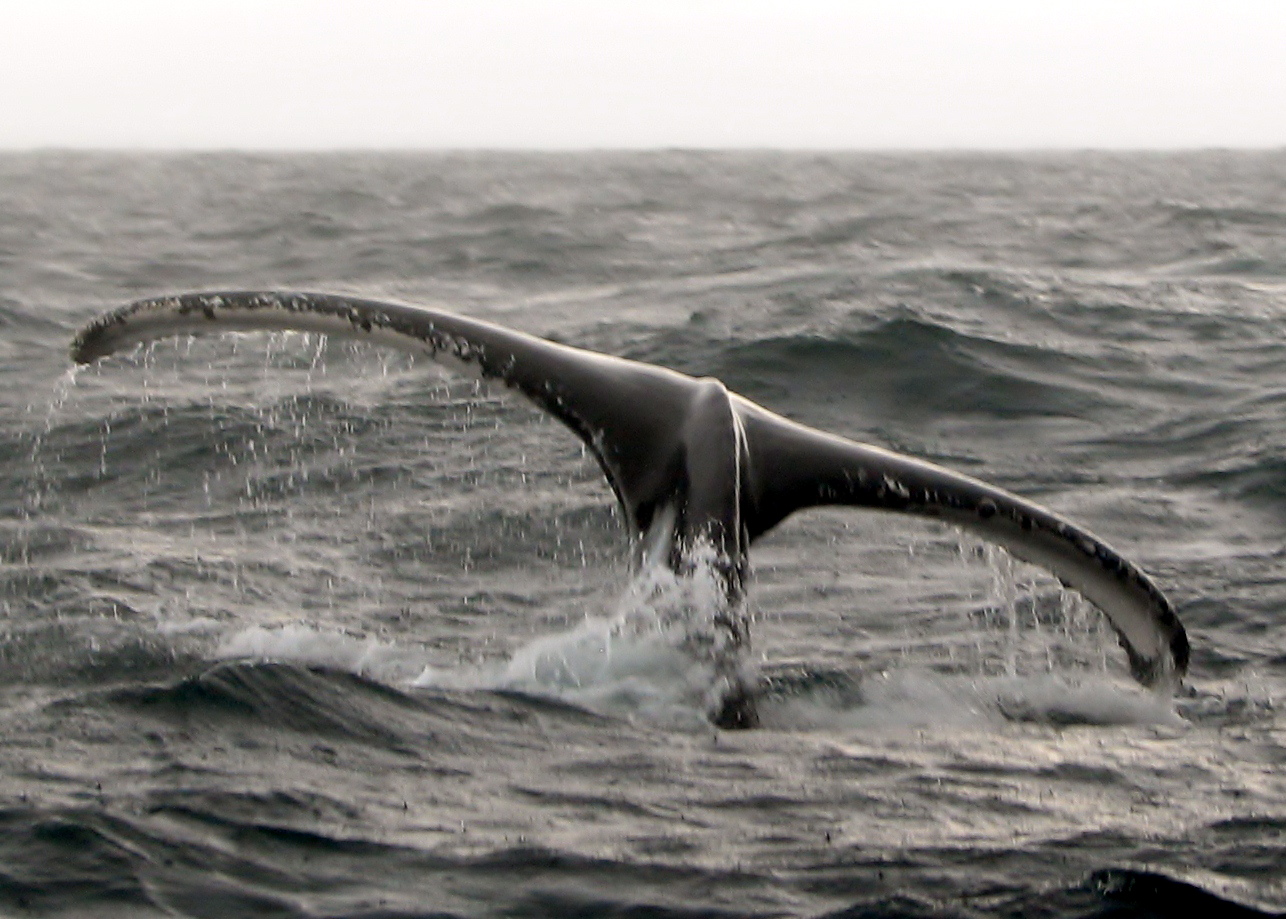
Having stared, wonder-struck, for a while, you think you must try to capture these moments – for Facebook mates in Europe at the very least – and, while hanging on with one hand, you stab at your camera, producing a series of grey frames, perhaps with a trace of spout or post-breaching spray in a big seascape, but few bits of whale. Between the lot of us (12), hundreds of useless shots must have been taken during the three hours we were out in the Bay. My friend was more patient than I – and the best of these photographs are his. I gave up to gaze, again, but he was determined to catch a tail fluke in all its glory and some breaching action.

The whales came so close to the boat, we could have almost touched them. They passed under the boat, then circled round to pass by again. A couple of times one turned on its back, flashing a white tum. This is what whales do when they're relaxed, we were told. And once, one showed it's beady eye above the surface and had a good look at us. That's quite rare, we were told. But I didn't need further embellishment; this trip was special enough already.


Our boatman had told the coastguard when we would return to harbour, and, eventually and reluctantly, we had to leave our friends. Some whales had been spotted further inshore, so we did a loop towards Byron's beaches before heading back to Brunswick Heads.


Sure enough, a female and her two-year-old calf (our crew guesstimated) were having fun. The calf breached repeatedly, to whoops of joy from everyone on board every time.

The awesomeness has stayed with me. A couple of days after our trip, we were walking the cliff path from Broken Head. We looked out to sea for a long time, searching for telltale signs of whale activity. I felt very close to them, still. Before sleep that night, I wondered where they all were. Do whales sleep? They must do, but how?*

By the time whaling ceased off the east coast of Australia in 1963 (1962 in Byron), the Humpback population had been reduced to little more than 100, less than five per cent of pre-whaling stock. Last year, it was estimated that 14,000 whales migrated the 10,000 kilometres from Antarctica to the subtropical waters off Northern Queensland, and the recovery rate is expected to be maintained at about ten per cent a year. This year six Southern Right Whales** have also been spotted, four more than last year.

Our adventure was with Blue Bay Whale Watching (www.bluebaywhalewatching.com.au). They do diving and snorkelling tours, too. They were recommended to me by someone I chatted to, a local, up on Cape Byron in August as we watched whales from afar. He was not wrong. I have no doubt it was the best $80 ($55 for a child) I've ever spent. Ever.

There is no more beautiful thing than several Humpbacks' synchronised arcing. Right in front of you.


* Whales sort of half-sleep, or doze. They are not 'conscious breathers', which means they have to decide to surface to breathe while they're underwater, otherwise they'll drown. So they only switch off half their brain, while the other half monitors breathing, potential predators and, if the whale is female, the safety of calves.

** Southern Right Whales and Blue Whales were hunted almost to extinction by Australian whalers, who then turned their attention to the Humpback


September 23, 2011

Koala alert

Conservation groups have long campaigned for the national protection of this much-loved Australian icon, one that's worth as much as $1 billion a year to the national economy through tourism. Deborah Tabart, Chief Executive Officer of the Australian Koala Foundation (www.savethekoala.com), told the ABC this week that there are no more than 85,000 koalas left in Australia, possibly as few as 45,000. It is estimated that there may have been 10 million at white settlement.

The main threats to koalas today are habitat loss, urban development (principally in the form of traffic accidents and dog attacks), logging, drought, bushfires and disease (especially clamydia). Koalas should be on the watch list.

A Parliamentary committee recently unanimously recommended 19 measures to protect them. These include protection under national law; better national monitoring; habitat mapping of critical areas; and identification of priority spots for koala conservation. These recommendations are likely to become law by the end of the year. 'It's been two hundred years coming,' says Tabart.

• Koalas are not found in Western Australia, Northern Territory or Tasmania. They were wiped out in South Australia during the early 20th century. A hundred years later the state was repopulated with Victorian koalas, but they are still rare, with the exception of Kangaroo Island. Today koalas are considered 'vulnerable' in southeast Queensland and parts of New South Wales. They are probably thriving best in Victoria.
• Queensland koalas are smaller than those found elsewhere and have lighter grey fur, which is also thinner and not as long, presumably because it's hotter here.
• Koalas are not bears, but were labelled as such by European settlers.
• They are arboreal herbivores and native to this continent. Their nearest relative is the wombat. They are marsupials, which means they give birth to relatively undeveloped young, for a mammal. After it's born, a joey crawls into its mother's pouch and stays there, suckling, for about six months. Once it ventures beyond the pouch, a young joey stays with its mother until it is about a year old.
• There is no collective noun for koalas because they are fairly solitary animals. They do share territory, however, where they are referred to as koala 'populations' or 'colonies'.
• Koalas famously eat eucalyptus leaves (mostly), but, contrary to popular myth, they don't get high on them. They prefer some gum trees to others, but none of them are particularly nutritious. The leaves – a koala eats about 500g of them a day – take a lot of chewing and contain toxins. A koala spends more than half its waking hours – which aren't that many, between three and five – eating. It sleeps or sits in a sort of torpor the rest of the time. Like a sloth, a koala has a very low metabolic rate. It gets most of the moisture it needs from the eucalyptus leaves so it drinks very little. A young joey acquires the microbes that enable its digestive system to deal with eucalyptus leaves from its mother.
• Millions of years ago, koalas lived in rainforest. Then the climate cooled and rainforest was replaced by eucaplyt forest in many regions. Koalas may have adapted to eating eucalyptus because there was no competition for this 'food'.
• A female koala has one baby a year (twins are very rare), and her reproductive life lasts about 12 years. Gestation is 35 days.
• Koalas walk on all fours on the ground.
• When vast numbers of koalas were culled at the start of the 20th century, there was a public outcry, which perhaps marked the start of environmental campaigning to protect Australian wildlife.


August 30, 2011

Family and other animals

When asked prior to their visit what they wanted to see when they came to Australia, the Manchester chapter were quite clear: animals; especially Australian exotica and creatures of the deep. So a lot of the trip-planning featured wildlife: Girraween for roos; Byron for the reef around Julian rocks and whales off the Cape; Noosa for koalas (in theory); and the Gold Coast for Currumbin Wildlife Sanctuary.

Sometimes the best-laid plans come to nought; other times, critters oblige when you least expect them to; on yet other occasions you find the familiar surprisingly enchanting (below, donkeys and pal at the ever-lovely Coolabine Ridge Eco Sanctuary near Mapleton)...


...or you come across what you're least expecting at the time, such as a young Cormorant wing-drying in the heart of Brisbane's CBD, or an Osprey (we think) on a lamppost in the centre of Caloundra.


What is certain is that in Australia, there will always be animals of interest at some point along the way, wherever you go.

First up was Girraween; Girraween Environmental Lodge to be precise, where my friend and I stayed on our first visit to Queensland's Granite Belt, back in October 2010 (see Great Granite), and where many kangaroos call home. We happily returned to this haven of peace well away from it all; the Manchester chapter loved their cabin as well as the locals.

One of the first roos we came across, while walking to Whale Rock, looked as if he was going to bound straight at us. There was a bit of a standoff – who was going to hold their nerve the longest? – before he veered off through the bushes on a short detour and then returned to the path behind us.

There were lots of others to be studied, especially in the early morning and at twilight. They let us approach quite close, even if there were joeys about. Their blending into the landscape was as remarkable as ever.


But perhaps the most astonishing candidate at Girraween, spotted by my friend's eagle eye as we walked down from the summit of Castle Rock in the National Park, was a quite extraordinary stick insect. It was more twiggy than a twig.

And these cast remains had been left behind on tree trunks by whichever insects had outgrown them. I had never spotted these before, on all my many walks through bush and forest, but there were many once I started looking for them. Assuming they were alive, we approached with caution – you never know in Oz – and then felt silly on discovering they were lifeless remains.


The Manchester chapter had headed up to Cairns, principally for the diving on the Great Barrier Reef, within days of arriving in Brisbane on this, their first visit to Australia. They enjoyed, but didn't rave about, their Reef experiences in Northern Queensland. But the diving in Byron Bay, now that was a different kettle of cuttlefish. The best ever, I was told. Tropical and temperate waters mix along this section of the Australian east coast, increasing the variety of marine life, and Julian Rocks, out in the Bay, provide shelter and ample food supplies for many species.

The Byron Bay Dive Centre is well organised, supportive and informative, my brother-in-law reported. They run dinghies off the town beach for the 10-minute journey to the Rocks, during which large dolphin pods and Humpbacks often appear within metres of the boat. Other delights included Green Turtles, Grey Reef Sharks and schools of large pelagic hunters such as Mullaway. Here are some of the best of the beasts*.


You can't visit Byron, of course, without bumping into old friends...

...and over a beer on our west-facing balcony one evening, we counted bats on their twilight passage from the direction of the setting sun. More than 1,500 in 15-20 minutes, we estimated, having counted how many flew over in a minute, several times.

On the way to Byron, we stopped off at the Gold Coast, and Currumbin Wildlife Sanctuary. World famous yet struggling to survive financially, this place needs our support. But I was disappointed. It felt more like a zoo than a sanctuary, with some animals in small cages or enclosures complete with that resigned expression animals acquire in such surroundings. Several compartments in certain areas seemed to be empty or depleted.

Tasmanian Devil
Australian Dingo
Maybe they were tired. This Echidna just kept pacing the same circuit over and over.

You can get really up close and personal with the roos. You can pat them and hug them and feed them and, if you're from a certain part of the globe, make V for victory signs as you pose with them for your friends' snaps. What I really couldn't bear was little kids feeding the joeys. That can't be a good idea, can it?

And the saltie's enclosure seemed only slightly bigger than he was, although admittedly he didn't move far from the effects of his overhead heater.


The koalas looked the most content. They were as cute as a million buttons.


Even more irresistible than a koala doing a spot of DIY is a koala with a baby.


Undoubtedly the best bits of a koala are its ears and back-of-head.

The Free Flight Bird Show at Currumbin is impressive, but it was difficult to be impressed and take photographs at the same time. So I can't show you a proud Pelican strutting across the 'arena'; a Bush Stone-curlew's nervous dash; or the swooping Wedge-tailed Eagle and smart, head-skimming Cockatoos. The birds of prey weren't exactly 'free', of course; they were restrained when on their trainers' arms. I don't wish to sound churlish, but by that time I was bothered about animals not doing things naturally.

We should have visited the Wildlife Hospital Precinct to see animals being helped rather than used for entertainment. (I know the entertainment earns the income.) Our time was limited, however, and we had to make choices. If we'd had younger children with us, they would doubtless have loved the Green Challenge Adventure Parc (tree-top rope courses) or the Wild Island adventure playground or Superbee Honeyworld (a bee show!) or the Wild Night Adventure (Aboriginal dance and nocturnal wildlife).


There were no animals to speak of during our last excursion with the Manchester chapter – to the Glasshouse Mountains, the Three Ms (Maleny, Montville and Mapleton), Noosa and Coloundra – except the donkeys and horses above. There should have been koalas-in-the-wild in Noosa National Park. But things have changed since February and our last visit. Koalas haven't been spotted in these parts for a while, reported the Park information centre; not since a large male died a few months ago. It's thought the females may have moved on in search of a new one.

There weren't any koalas in the National Park for decades, following extensive culling (for fur) in the early 20th century. Then, in the 1960s, the word was koalas were under threat from development down Brisbane way. Someone from Noosa Parks Association went down in his ute, loaded it up with koalas and brought them up to Noosa, where they've been ever since. (So much for great sensitivity to habitat change, I was told.)

They migrate between the headland Park and areas further south. (With more and more development come more roads for koalas to cross and more dogs to worry, if not maim or kill, koalas.) Sightings vary as a result of these migrations. And some people believe it's harder to see koalas in trees now than it was during the drought years because the vegetation has flourished since rainy 2010.

Whatever the reason, we didn't spot any, even in their favourite trees – Grey Gums and Eucalyptus robusta.

The day before the Manchester chapter left for Sydney was the Ekka (see The Ekka, August 2011), an experience on many levels for European visitors. The animal extravaganza ranged from my little pony to venomous vipers, which we hadn't encountered previously on our travels, and provided a fitting end to an introduction to Queensland.


Here's a silly list we compiled one day while waiting for a CityCat, based very loosely on 'The 12 Days of Christmas' and some children's book or other, in honour of Australia's wondrous wildlife.

One Wombat
Two Platypuses
Three Tree Frogs
Four Flying Foxes
Five Friar Birds
Six Salties
Seven Basking Sharks
Eight Echidnas
Nine Noisy Miners
Ten Turtles


Carpet Python (top snake) and Common Death Adder (bottom snake)

*Girraween National Park (above) and underwater photographs (Spotted Boxfish, Grey Reef Shark and Green Turtle) courtesy of Jim Grainger

This post was last updated on 8 October 2011