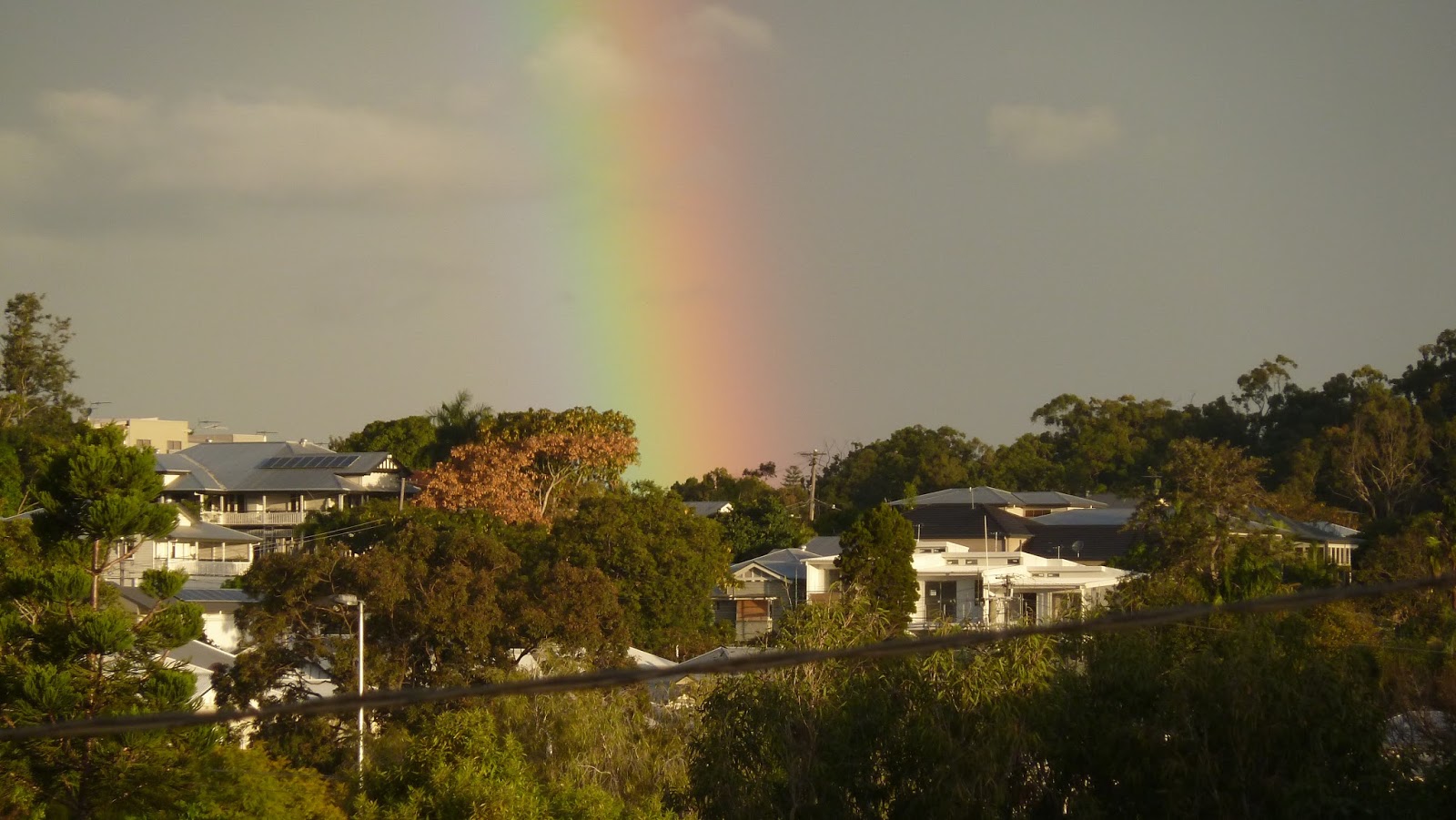
July 15, 2015

Watch on weather: big chill

Some of us knew it was going to get seriously cold long before Jenny the Weather Lady or BOM (Bureau of Meteorology) gave us the details.

Higgins Storm Chasing's Facebook posts are best-known for their notifications of tropical cyclonic events in the summer, but in fact they monitor all kinds of weather phenomena. And the freeze eastern Australia is currently experiencing is certainly phenomenal.

On 6 July HSC* posted these images. A big chill was spreading north from the cruel Southern Ocean and would reach Queensland the following week. Even tropical Queensland. It looked as if orange Bundy was the place to be. But subsequent days' isotherms revealed that I'd have to go to Weipa, right up in the Pointy Bit, to escape the blues.
The extreme blue straddles the state's southern border. As the weekend approached, chillier nights were heralded by biting southerly winds. 'Wind chill factor' became common parlance in weather forecasts. Clear night skies meant any warmth from sunny days was dissipated by sundown. 

I scanned the skies for signs of the storm's approach. 
Unsettled weather
Uniform mistiness
Pink early-morning light
A second icy low was following the first.
So, more than a week later, there's no let-up. BOM forecasts cold nights until at least this weekend.

It dropped to 6 degrees at 04:00 this morning where I live: BOM records 5 for Brisbane. It hasn't reached double figures yet and it's 08:15. The ABC is telling me (at 09:00) it's up to 11, which is only two degrees below average, they claim. Frost is being reported from various parts of Queensland: the Darling Downs had -3, and zero temps reached as far north as Hughenden, where we'll be in a month's time. There's been lots of snow in the southern states, and some not that much further south of here. There were flurries in the Granite Belt, which is 1000 metres above sea level; and blizzards in northern New South Wales just down the New England Highway from the Granites. There was even a report of a tornado at Burrumbuttock, NSW. (I have not made up that name.)

Australians get very excited about snow, and think nothing of driving for hours to see it. There have been some beautiful frost and snow pictures posted, proper wintery scenes, from almost the length of eastern Australia. Just wish I could record a snow-in-Queensland shot myself.

These temps are not record-breaking. I have little recollection of this, even from 12 months ago, but my diary entry for 12 July 2014 records the same lowest temperature as today. It was reported as the coldest July morning in Brisbane for 103 years.
* http://www.bsch.com.au/index.shtml

Post script 17 July 07:50: there have been the heaviest snow falls in the Granite Belt for 30 years – 8cm overnight – but most of it is expected to have gone by 10:00. The lowest temp in Brisbane was 6.8 at 06:30. This is the best pic of the cold snap so far, taken near Stanthorpe.
PPS Midday 17 July: it was still snowing in Stanthorpe at 10:00. Later, ABC Radio's weatherman reported that Friday (17th) was the sixth consecutive day Brisbane temps failed to reach 20 degrees
This post was last edited on 18 July 2015


July 10, 2015

Another mining disaster waiting to happen

Coming soon… to your neck of the woods?
It's come to something if Barnaby Joyce – is that the Chattanooga choo-choo?* – declares 'the world has gone mad'. He was reacting to his Coalition government's approval of a big coal mine amidst some of Australia's finest agricultural land – in Joyce's constituency of New England in New South Wales (which is a crazy bit of naming, if you ask me). Some of us reached the same conclusion a while back.

If you read The Australian Institute's submission** to the Planning Assessment Commission on Shenhua's Watermark coal project in 2014, you'll see the same points as those made by the plaintiff in Brisbane's Land Court in April and May this year during the case against Adani's Carmichael mine in Queensland's Galilee Basin. That the input-output modelling used gives a biased impression of the economic benefits of the mine by underestimating operating costs and overestimating coal prices, job opportunities and state royalties. That the risks to agriculture and biodiversity extend beyond the mine site. Old data was used for agricultural impact assessment in Watermark's EIS, particularly in relation to groundwater and irrigation, and thermal coal market prices have shifted considerably since, the wrong way for Shenhua.

Not to mention the contribution of more coal burning to global carbon emissions and hence climate change. Politicians from both major political parties are disingenuous about this: the coal will not be burned on these shores so it's not adding to Australia's emissions total. If the Chinese didn't buy their coal from Australia, they'd get it from somewhere else. If it's Indian mining companies exploiting Aussie coal, then it's all in the cause of supplying the subcontinent's poorest communities with electricity. Noble, right?

Barnaby Joyce belongs to the National Party, who are in coalition with the Liberals. He is also Minister for Agriculture in Tony Abbott's Cabinet. He must be feeling the heat of farmers' outrage right now. Traditionally, the Nationals look after country folk; conservatively tending battlers on land that's been in their family for generations, stoically dealing with drought and flood and locust and invasive exotic weed and feral goat and worse, without complaint. It is not their way to expect, or ask for, help from governments in state capitals or Canberra. You only know when they've given their all and beyond when, one morning, they put starving cattle out of their misery before turning the gun on themselves. The mortgage company takes possession and sells the land to a Chinese buyer who's adding to hundreds of thousands of hectares already acquired across the country.

Some time in the next few decades, when climate extremes threaten key grain harvests in other parts of the world, Australia might have supplied nations in need of food for large populations, as well as catering for its own. Yet current politicians claim they lack funds, and are certainly without foresight or motivation, to prevent this sell-out or resist the lure of royalties promised by Asian mining giants.

Disaster capitalism may seem a long way off – in Greece in particular at the moment – but in fact it's alive and well among those who peddle the politics of fear – of credit-rating agencies or religious extremists.

If the National Party deserts the famers of the Liverpool plains then the party should be done for. But who do these poor people vote for instead? There's little to choose between the LNP and Labor when it comes to foreign investment in mining, and many Aussies appear to have an inbuilt aversion to Greens.

The proposed mine is, inevitably, dividing local communities†. There may be just as many who are fighting the mine as there are who do not want them to. Solutions are few on the ground where everyone wants to protect their children's children's future in the best way they see fit.

For the Agriculture Minister to claim he did all he could to prevent a decision made by the so-called Minister for the Environment in his own government is the cruelest deception. If ministers cannot about-turn current decision-making, and overturn that of previous governments – as Queensland's Environment Minister claimed a couple of weeks ago – then who can? Papa Francisco?

All parties, preferably together, must address, in detail rather than airy-fairy precursors to policy documents, how to create alternative, clean green jobs in small rural communities that hoped a big mine might keep their children at home even if it destroyed the landscape and everything in it. And air and water quality; peace and tranquility; tourism. (Watermark will be open cut.)

Did you know there's a Regional Renewable Energy Program†† in
New South Wales? And I came across this in my research online – http://www.climateinstitute.org.au/verve/_resources/cleanenergyjobssnapshot_queensland.pdf. I believe this was produced in 2011.

I suspect Barnaby Joyce doesn't really think the world's gone crazy, and I don't believe he fought against the approval of the Watermark mine. As more and more citizens find their voices against the sacrifice of land and biodiversity to increasingly unviable and undesirable fossil fuel exploitation, more politicians will feel obliged to exclaim largely empty words of dismay at the loss of cropping land, ecosystems and animal species, as they have about the plight of the Great Barrier Reef. Next we'll hear about plans for strategic regional land use policy aimed at restoring a balance between mining and agriculture – yet more fiddling while bushland burns.

I doubt that as we get closer to the climate conference in Paris in November, Tony Abbott's government will suddenly start making encouraging noises about emissions targets, having recently slashed the RET. The conveniently dropped budget deficit drama – the nation's debt has increased under Abbott – has been replaced by different smoke-and-mirror policies. Not even the international embarrassment of sticking Australia back out on a far-side planetary limb will dampen his ardour for coal, it seems.

Even the return to politics of New England's former MP, Independent Tony Windsor, is unlikely to halt the Shenhua abomination, although constituents would be better served, as they once were, by this honourable man. Perhaps if there were an early Federal election… or a further dramatic fall in coal prices… In any case, get ready to raise your voices, citizens, and drown out the ditherers and denialists, the pretenders and prevaricators.

The background to the Watermark project can be found at http://www.abc.net.au/news/2015-07-09/shenhua-watermark-coal-explainer/6607142
* I will forever associate Barnaby Joyce with The Andrews Sisters' version of the Glen Miller classic thanks to Shaun Micallef https://www.youtube.com/watch?v=V_cflUkj9iE
** http://www.tai.org.au/content/submission-report-proposed-watermark-coal-project
† http://www.theguardian.com/environment/2015/feb/26/battle-for-liverpool-plains-chinese-coal-project-tears-at-fabric-of-rural-nsw
†† http://www.environment.nsw.gov.au/communities/clean-energy.htm
This post was last edited on 11 July 2015

July 4, 2015

Watch on weather: cyclone in July?

BOM
You may have missed this news, since the Queensland coast was never at risk of devastation, but it is remarkable nonetheless. The other night, while watching Jenny the Weather Lady on the seven o'clock news, we were jolted to attention by the mention of a possible cyclone developing over the Solomon Islands in the southwest Pacific. Hurricanes hardly ever happen in this part of world in July: actually, they've never happened in July in the zone monitored by the weather watchers of Queensland by means of satellite imagery (top). 

Tropical cyclones – otherwise known as hurricanes or typhoons, depending on where you are on the planet – have an official season here, from 1 November until 10 April; that is, the southern hemisphere summer, more or less. Only once has Queensland recorded a really late cyclone, at the end of May/early June in 1972 – TC Ida. There was, however, a July cyclone off Western Australia in 1996.

Some media have reported Raquel as an early tropical cyclone, but is that accurate? It is closer in time to the end of the last cyclone season than the start of the next one.

Tropical Cyclone Raquel was tracked by the Bureau of Meteorology, but it never posed a threat to the coast of Far North Queensland, 2000 kilometres away. A cyclone warning was posted, however. The storm became a category 1 system early on Wednesday morning, and was expected to intensify into a category 2 by Thursday as it moved slowly southwest towards the Solomons, before weakening to a tropical low by late yesterday. A sister storm formed north of the equator – and was therefore a typhoon (named Chan-Hom) – threatening Guam. Unfortunately no one at BOM commented on how unusual this twinning was.

An El Niño has been brewing in the central and eastern equatorial regions of the Pacific for a few months. Cyclone Raquel's development may be connected to the warmer sea surface temperatures associated with an El Niño, but this is only speculation since BOM have no data for cyclones in July. TC Ida coincided with an El Niño event, too.

El Niño is not good news for farmers already struggling with rainfall deficits in parts of every state and territory in Australia. (Click on map below to see detail.) Queensland registered its warmest first half of a year ever – and didn't we know it – with record-breaking temperatures in several towns in the state's north and west.
Meanwhile, on the other side of the planet, London's Heathrow Airport hit its highest July temperature on record (since the 1870s) this week – 36.7 degrees. Ball boys collapsed at Wimbledon's tennis championship, and the Brits marvelled as they always do when tarmac softens and ice lolly shops sell out. Western Europe's current heatwave follows similar record-breaking events in India and Pakistan, the Pacific northwest of North America and parts of South America.

It seems that the Great Barrier Reef is not the only place in Australia where tourism is at great risk from climate change. There is little natural snowfall on the southern states' alpine slopes as we go into July and families head off for some early skiing in the last week of school holidays. Dependence on snow-making, even in a gadget-happy nation, is always a bit of a taboo subject among skiing fanatics, however. And you'll hear as few complaints about snow machines' carbon footprint as you do about multiple car and dog ownership.

Post script: read the latest on a series of unseasonal storms in the western Pacific at http://mobile.abc.net.au/news/2015-07-04/chaotic-unseasonal-storms-strike-marshall-islands-and-guam/6595124


June 30, 2015

Outback 3 Route revisions

I get bees in my bonnet about place names. Fixated, you could say. Once, the names were the stuff of Californian folk rock or movies: Ventura Highway, Zabriskie Point. Then I moved to Europe: Saint-Germain-des-Prés, the Bridge of Sighs (Ponte dei Sospiri) and the plain of Lasithi.

In Australia, I will not rest until I have visited Esperance, Broken Hill and the Bungle Bungles.

Camooweal, a small town in northwest Queensland, more than 2000 kilometres from Brisbane and almost on the Northern Territory border, wasn't on any list until I heard a song entitled Luck, by Busby Marou. I guarantee, after a couple of plays, you'll get in your car and hit the road. 'From Camooweal to Katherine, from Lambert to The Kimberleys…'

At first, Camooweal didn't feature in the Outback trip that begins in a month's time – Brisbane to Adelaide, Alice Springs and the Red Centre, northwest Queensland not visited previously, and back to Bris. We were intending to cut across to Mount Isa via Urandangi from the eastern end of the Plenty Highway, which traverses almost half the width of the Northern Territory from the Stuart Highway north of Alice. Last weekend, however, my friend noticed the Camooweal Caves National Park, and that was it. Detour ahead.
This trip came about because, months ago, he noticed a Great Southern Rail advert for The Ghan which featured a second's glimpse of cars being transported on the train. Prior to that, we were going to New Zealand. I only need the seed of an idea.

This morning I have been booking the Post Office Hotel Motel in Camooweal, shunting our reservations along the Flinders Highway on a day, and reducing two nights in Hughenden to one. Two previous Outback adventures involved changes en route – forced by bad weather or choosing to escape bad accommodation – so this still represents forward planning. The trip is longer but it is the fact that we are travelling further afield, more remotely, and with fewer accommodation options that presented a more time-consuming challenge. Even choosing dates involved checking school and public holidays in three states and a territory.

Diverting to Camooweal opened up another possible route across the remote ranges of the Territory between the Simpson Desert and the Barkly Tableland. The Sandover Highway branches off the Plenty not far from its start and crosses into Queensland north of Urandangi. I have studied drivers' accounts of the northernmost of the two options, which isn't called Sandover for nothing. And it is more vulnerable to disruption after a downpour. The Plenty is graded regularly – there's more traffic passing – and the landscape is more varied. I am inclined to stick with Plan A for this stage. And Gemtree might have zircon shops!
This may be the fourth major road trip, but every time extra items are required. Biggies this time included a second spare wheel – we already had a second spare tyre – a tent, and self-inflating camp mattresses! Plus bits and bobs.
Twenty-nine sleeps…

This post was last edited on 1 July 2015


June 28, 2015

Enviro round-up: June

The Reef
Queensland's Environment Minister, Dr Steven Miles, left for Bonn on Friday, to hear UNESCO's World Heritage Committee's final – as opposed to draft – decision about whether or not the Great Barrier Reef is 'in danger'. I don't imagine he would be going unless he knew the right decision awaited him, do you? I don't know if Federal Environment Minister Greg Hunt is going too, but if so, I hope they don't crow about the result like they did a month ago. In truth, the hard slog to restore the Reef is ahead of them (see Grief about the Reef, June 2015).

Promises, promises
So far, I'm underwhelmed by the still-fairly-new Queensland government. I have tried to be patient, but here we are, approaching July, and important policy, pledged during their election campaign as part of a de-Newmanisation process, has not yet come before Parliament. They don't appear to have been in session much since Premier Annastacia Palusczcuk was sworn in, but I know nothing of Parliamentary scheduling. In any case, policy implementation is largely on hold pending the Budget (14 July), which hangs like the sword of Damocles above state departments, key industries such as construction and NGOs alike.

Almost as disappointing as Minister Anthony Lynham seeking expressions of interest in oil and gas exploration in Queensland's Channel Country (see Dear Premier, June 2015), was the fact that this week he was calling for 'suitably qualified companies to undertake the dredging works and construct the dredged material containment ponds required to expand the Port of Abbot Point'*. The ponds will be situated on unused industrial land adjoining the existing coal terminal. This plan replaces that of the Newman government who were going dump dredge spoil in the Caley Valley Wetlands once they knew they couldn't get rid of it at sea.

Bye-bye Adani?
But hang on… why is the port being expanded if Adani are going to pull the plug on their massive Carmichael mine? This week's big news was broken by The Guardian** on Thursday (see top of page), but soon backed up by mining industry and other media outlets. Whether you think this was posturing on the part of Adani, or an attempt to bully the Queensland government into speeding up approvals, it matters little. Similar reports in the Times of India and a subsequent 4 per cent loss in the value of Adani Enterprises shares was surely never what the company intended.

Pope power
An even bigger surprise, however, was Papa Francisco doing a great job as climate action advocate. In his first papal document, or encyclical, on the environment, the Pope didn't hold back on calling a halt to the degradation of the planet, the 'throwaway' culture, and weak, self-interested governance. He demanded the replacement of fossil-fuel-based technology and the greater responsibility towards those in abject poverty. He immediately placed himself among the leaders on the road to Paris in November.

No response from Tony Abbott and his catholic Cabinet members yet: they've been too busy diminishing Australia's Renewable Energy Target. Denialists the world over have criticised the Pope for stepping beyond his religious remit, but many millions more have been impressed. Laudato Si, indeed. He's probably the most progressive-thinking pope I've ever known, and he's earned himself even more Brownie points since, by suggesting a fixed date for Easter. Its jigging about in the calendar from year to year has always irritated me. As my friend commented the other day: 'We are all catholics now'!

No-fly zone
Few days go by without disturbing stories about the effects of a changing climate. The California drought continues; Alaska has hundreds of wild fires, and tarmac is melting in Oregon; northern France is expecting temperatures in the mid-30s next week. One report in particular has troubled me. It was about migratory species of bird that haven't left Fraser Island to breed in the Siberian summer as they normally would. There is speculation the birds have not been able to fatten themselves up in preparation for such an arduous journey. There may no longer be enough pilchards; or perhaps the birds have been disturbed by too many 4WDs careening along the beach. Equally worrying is the fact that birds that normally fly north from Australia's southern states to winter on Fraser haven't arrived this year.

Bimblebox update
The Bimblebox Alliance is hard at work raising the profile of Protected Areas that aren't really. This includes writing letters to the Department of Environment and Heritage Protection and popping up at gatherings frequented by Minister Steven Miles to ask awkward questions.

The landscape conservation arm of the Department has conducted research† in conjunction with James Cook University to identify which habitats might best survive in a warming world. Climate-resistant pockets were found in elevated areas and valleys along the eastern ranges of the state, but also in mulga country much further west. These parcels of land are being termed 'refugia'. With limited funds available for conservation, the Minister said:
We could probably find the money to buy more properties but we need the money to manage it properly and deal with pests and fire and weeds. Nature Refuges will be incredibly important at helping us meet our goal of preserving land across the state. We can't achieve the amount of natural estate that we want to just with national parks so we need to work with private landholders.
With so much of the state covered by mining exploration permits – 80 per cent or more – the Minister needs to legislate to protect those landowners already signed up to the Nature Refuges Program††, and reassure anyone who might like to help conserve Queensland's refugia in the future but knows at the moment their efforts would be afforded no protection against would-be mining magnates, logging or those with certain land-title rights.
Bimblebox Nature Refuge

June 19, 2015

Grief about the Reef

Marine scientists know that corals don't like sediment, which suffocates them. Crown of Thorns larvae, on the other hand, thrive on it. These are two good reasons why no more capital* dredge spoil should be dumped in the Great Barrier Reef. The public know dumping is a no-no, and have told their political representatives as much. Queenslanders voted loudly for protection of the Great Barrier Reef in the state election in January, and the beneficiaries of that, Queensland Labor, are on the case. But no politicians are prepared to stick their necks out as far as is necessary to ensure the Reef's survival. That requires tackling global climate change as well as local dumping of spoil.

The end of May saw UNESCO's World Heritage Committee's draft decision with regard to the state of conservation of the Great Barrier Reef World Heritage Area**. The Abbott government had been lobbying member countries of the Committee for months, spending $100,000 of taxpayers' money in the process***. The Commonwealth and State governments released a joint statement† following the Committee's announcement that the GBR would not be listed 'in danger'. Greg Hunt went a little overboard when he spoke to The Australian, describing it as a 'huge tick of approval' for his government's efforts to save the Reef. Not everyone agrees, of course, that the Committee is satisfied with what's being done, or that Hunt will go down in history as the saviour of Australia's greatest natural treasure.

Australia is by no means off the hook. The Committee's decision has to be upheld at the 39th Session of the Committee in Bonn at the end of June, but that is largely a formality. The Australian government is required to rigorously implement all its commitments, which means their inclusion in legislation, a solid investment framework, and the delivery of its anticipated results. By the end of 2016, Australia must report how it is going to implement its Reef 2050 Long-Term Sustainability Plan, which 'responds to the World Heritage Committee's recommendation that Australia develop a long-term plan for sustainable development to protect the Outstanding Universal Value of the Reef'. Already the Commonwealth and State governments have together produced a Reef 2050 Plan – Implementation Strategy††. As yet it runs to a mere 40 pages, which contain commendable aims and an integrated monitoring and reporting progamme, but I wish there was less on governance structure and committee terms of reference, and more on detailed action plans. Hopefully a lot of work will be done on those during the next 18 months.

There is a further, five-year reporting requirement. By 2019, Australia must prove to the Committee that its targets are being met. This means scientists will be required to confirm hard on-ground evidence that the Plan is working.

It beggars belief that Australia needed to be told to implement serious measures to preserve the GBR; that it didn't fully appreciate its international responsibility. Unfortunately, there is nothing about climate change in the Plan, so it doesn't begin to address the larger-scale risks to the Reef of a warming ocean that are likely to be exacerbated during the lifetime of the Plan unless all nations, especially feet-draggers such as this one, reduce their carbon emissions significantly.

The Environmental Defenders Office in Brisbane regularly delivers free legal information seminars for the public, focusing on topical subjects. Last week's 'Law Jam' was all about protecting the Reef, and was held at QUT's Law School. The EDO's Andrew Kwan outlined all the Reef-related court battles his colleagues have been and are currently involved in. WWF Australia's GBR Coastal Campaign Manager, Louise Matthiesson, explained the World Heritage Committee's recommendation and its implications. Dr Selina Ward, Reef scientist at the University of Queensland, told us that 50.7 per cent of the GBR's coral has died in the last 27 years: 24 per cent as a result of tropical cyclone damage; 21 per cent by Crown of Thorns outbreaks; and 5 per cent because of bleaching. In 1998, 16 per cent of the world coral died in one large bleaching event. She was in no doubt that climate change poses the greatest threat to the Reef. Fiercer cyclones will cause more damage and increased erosion; calcification will decrease with the increased acidification of water absorbing more atmospheric carbon dioxide; and warmer water = heat-stressed algae that supply coral with food = coral death (bleaching).

The GBR is most certainly in danger. But Dr Ward believes there is enough healthy coral left to turn around the Reef's decline.

Steven Miles, Queensland's Environment Minister, was the EDO's final speaker. He is personable and much more confident than when I last heard him speak, at the National Parks Association of Queensland a few weeks ago. He is proud of the Queensland government's contribution to the sustainability plan that persuaded UNESCO not to designate the Reef at risk. Such a decision would have meant that people lost hope, he argued. He listed the new Great Barrier Reef Water Science Task Force's credentials in response to a question from the audience.

During his speech he opined that climate change legislation was the domain of the Commonwealth government, on the world stage. I took issue with that. I suggested that there was much the state could do to mitigate climate change, but there was one key decision that not only would have an immediate impact on emissions but would render his government's plan for Reef conservation much more likely to succeed. Namely, to halt the development of the Galilee Basin's massive coal deposits.

Needless to say, he didn't agree with me. He acknowledged supporters of the Keep It In The Ground Campaign, but claimed that the majority of Queenslanders were not with them or me.

A significant number of Queenslanders do not know where the Galilee Basin is. They have no concept of the staggering amounts of coal this area could produce if proponents were given the go-ahead, or the timescale for production. Rehabilitation of massive pits does not concern them as much as revenue for hospitals or road building. As they see it, mining = jobs. Simple. They know nothing of transition to a clean energy economy or how to enable it. Nor are they likely to be enlightened unless they actively seek out information. They could start with http://bze.org.au/about, and more specifically http://media.bze.org.au/ZCA2020_Stationary_Energy_Report_v1.pdf.

It's a long time since I last wrote about the Reef (Great Barrier Reef: the final warning? October 2012). In the meantime I have marched on its behalf; attended talks and rallies; signed petitions; and wrung my hands in sheer frustration at the tinkering around the edges of the issue. I find myself increasingly believing that only extreme measures can save it. Every week hundreds of large vessels leave many locations along the Queensland coast, each boat transporting hundreds of tourists to pontoons off which they dive or snorkel, many for the first time, their flippers breaking off pieces of coral as they thrash around. I would severely limit such activities: most people would be restricted to observing shallow-water coral reefs from glass-bottomed boats – and watching natural history programmes. I would halt all port expansion. And tankers and bulk carriers would have to travel around the Reef, not through it. I would replace sugar cane with macadamia nuts or citrus trees or whatever. We don't need 1500 kilometres of cane-growing down Australia's eastern coast. Go and watch That Sugar Film. I would fund local and state government engagement with communities about renewable energy projects, and sustainable farming, fishing and tourism. There would be little debate about zip lines and much about enlarging national parks and genuinely protecting areas of high conservation value.

This week came news of research from James Cook University about young Clown Fish being poisoned by sediment†††. So, we won't be able to find Nemo on the inner Reef for much longer? How much more of a wake-up call does anyone need?

* capital dredging is necessary for the creation of a new port or berth; maintenance dredging keeps an existing waterway or channel navigable 
** the World Heritage Area does not coincide with the Great Barrier Reef Marine Park. The differences between the two are defined at http://www.gbrmpa.gov.au/about-the-reef/heritage/great-barrier-reef-world-heritage-area/differences-between-the-marine-park-and-the-world-heritage-area2
*** http://www.smh.com.au/federal-politics/political-news/abbott-government-spends-100000-on-travel-to-lobby-against-unesco-reef-listing-20150511-ggyydi.html
† http://www.environment.gov.au/minister/hunt/2015/mr20150529.html
†† http://www.environment.gov.au/system/files/resources/32cb8925-03ee-40e7-9b27-4b3848d3b5f5/files/reef-2050-plan-implementation-strategy.pdf
††† http://www.independent.co.uk/news/world/australasia/sediment-from-human-activity-increases-disease-levels-in-the-great-barrier-reefs-fish-new-study-finds-10327261.html


June 18, 2015

Watch on weather: fog

It's hard to watch anything in Brisbane this morning, in thick fog. Humidity is at 98 per cent and everything is dripping, totally soaked, following days of showers or heavy dull grey. Towels have been damp for days. (We don't have a tumble drier because for most of the year warm sunshine and breezes are perfectly adequate.)

There is no city; there are no hills. Lorikeets sit relatively silent and not quite so Rainbow: they fly at far too high a speed to do so without fog lights.
No CBD
No distant hills
Grounded Lorikeets
The rain and grey had become oppressive by yesterday, and was affecting mood. Out west, they were also getting rain: ABC news showed a downpour at Alpha, almost halfway between Emerald and Longreach. This was good news for farmers but not enough to break the drought. At sundown in the South East there was a fleeting hint of the sunshine forecast for today.
The fog took time to clear: first some hazy blue patches; then a few building details and high-rise tops appearing and fading; before, finally, the city skyline was visible below remnant fog patches.
The sun has shone ever since, and tonight's sunset is virtually cloudless with a splendid crescent Moon. Has normal winter service been restored?
This post was last edited on 20 June 2015