May 12, 2014

And so to Bimblebox...

Thursday on the Galilee Road Trip. Just after sun-up. A beautiful morning in the bush. Grabbing a (hot) shower before most other campers. Galahs for company. And today was the day I would finally get to Bimblebox.
Breakfast and packing up with a spring in my step. Into Jericho to fuel up. Indulge me: I loved Jericho.
There was nothing on at the drive-in so we enjoyed an impromptu pavement disco – in increasingly warm sunshine. Well, some of us did. With thanks to Mackay Conservation Group for their musical contributions on this trip. Somewhere there's a video...
There is art in Jericho's street, including fine murals. A slight concern about this character, however.
More than 1000 kilometres northwest of Brisbane and 500 west of Rocky, Jericho is a small town getting smaller. Someone else had up sticks just last week. Parents are increasingly home-schooling their sons and daughters, so numbers are falling at the school. Shopkeepers are doing it tough: as increased costs of bringing in supplies raise prices, people can no longer afford to buy, the shopkeeper can't afford to restock, so the people don't shop there any more. I heard that the cafe once enticing grey nomads and other travellers to stop in the town is now in competition with a tearoom in the tourist information office. Who made that decision in Barcaldine?

How do you stop the young leaving town in search of better prospects? There are townsfolk who believe that the Galilee mines would breathe new life into Jericho and Alpha, and they are alarmed at talk of falling commodity prices and stranded assets. (Some of them had joined us to listen to a talk about this the previous evening – more in a later post). If you argue against exploitation of the Galilee's coal deposits, then your list of alternatives to fossil fuel development has to extend beyond renewable energy sources to different economic activities for already struggling communities.

I wasn't concentrating on the route from Jericho. We turned off the Capricorn Highway sooner than I expected; I think it was at Beta, 20 minutes or so east of Jericho? There was a lot more dust. Then a left turn by the Glen Innes sign. And, finally, Bimblebox. The convoy seemed to be rolling on through the gate, but I pleaded for a photo op. Two years I'd been waiting to get here: I had to record the moment. The bus door opened for consultations and I leapt out. 
We reached camp well before lunchtime. We were to spend two nights at Bimblebox, which felt like luxury compared with our schedule up to that point. Time to relax, even contemplate. Stand and stare. Listen to the silence. The donga* was for cooking and eating, and small study/discussion groups. Alternatively, gatherings took place in the 'field'. After dark we debated around a campfire while above us a thousand million diamonds glinted. How could you fail to be inspired?
We made ourselves useful by doing much-needed weeding, but alas, not enough. We were looking for Seca Stylo. Now graziers like seca because it makes their cattle grow fatter and means they can graze cattle more densely. But it tends to push out native grasses and, being a legume, also acidifies the soil. Bimblebox is not heavily grazed enough to keep it in check, hence the weeding campaign. We had to take out small plants, and leave them to die, but bag up and remove larger, flowering plants so they wouldn't seed and spread this environmental weed, a native of the Caribbean and South America but naturalised in northern Australia.

There was a trip round the property that provided a real ye-har moment – sitting on hay bales on the back of a ute. And birdwatching with an expert, for those prepared to get up early enough.
And – a real treat – landowner and campaigner Paola Cassoni supplemented our provisions with Italian home-cooking, in the middle of the Australian bush. Even instruction on how to make gnocchi. She must be mad to have agreed to 40 opinionated conservationists descending on her haven of tranquility in the Desert Uplands. But there are no bounds to her efforts to inform people of the fate of this Nature Refuge in the hands of an oversized and overbearing investment billionaire who doesn't care for six regional ecosystems in his way.

Our ye-har tour revealed a rich diversity of vegetation – far removed from Clive Palmer's insulting description of Bimblebox as a degraded cattle station. We could see what the neighbouring, cleared property looked like beyond the boundary.
Milky Dam
Spike rush (sedge family)
Silver-leaf Ironbark and Kurrajong
'Decommissioned' itchy grub nest
Sedge
Pigweed
Bimblebox/Box Tree
Heathland ecosystem
Australian Bustard
Few-and-far-between cattle – at dusk
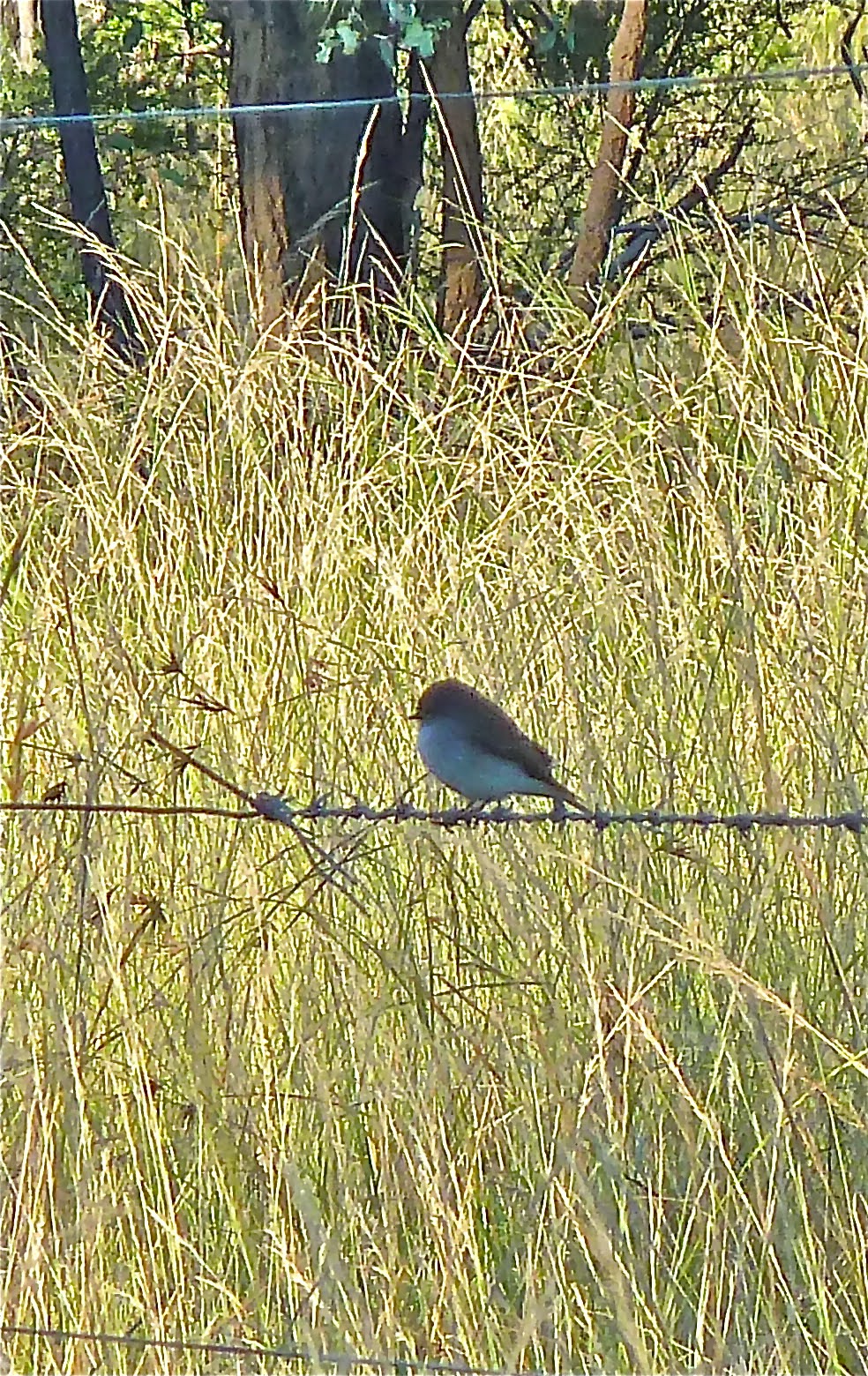
Early-morning bird-watching revealed the following: Little Friarbird, Red-browed Pardelote, Striated Pardelote, White-plumed Honeyeater, Pied Butcherbird, Spiny-cheeked Honeyeater, Royal Spoonbill (in flight), Weebil, Buff-rumped Thornbill, Striped Honeyeater, Raven, Black-faced Cuckoo-shrike, Pale-headed Rosella and Collared Sparrowhawk. For a number of reasons – not least of which was trying to keep up with the fount of all birding knowledge – I only managed to photograph adequately a Jacky Winter, warming up on a wire.
More than 150 species of bird have been logged at Bimblebox since 2003, many of them of conservation significance, and some endangered. There are mammals of conservation significance, and many species of reptile, amphibian and invertebrate. You can read more about the fauna and flora in Bimblebox: A Nature Refuge Under Siege, edited by Maureen Cooper (http://bimblebox.org/book/).

Did I mention how beautiful Bimblebox was? How the sun catches the canopy in the early morning, and the soil matches the pink sky. The Ironbark thickets. And the backlighting at sundown.
My favourite explorer Ludwig Leichhardt passed through the northeastly reaches of the the Desert Uplands in April 1845. He noticed extensively burned Ironbark forest, and observed Aboriginals burning grassland. The region was white-settled in the late 1800s: sheep were reared at first but they weren't really suited to the area. (Barcaldine became known for the shearers' strike of 1891, one of Australia's earliest examples of industrial action.) In fact, much of the Uplands was only used for drought relief by graziers who also held land blocks in the more productive Mitchell Grass Downs. A gradual transition to cattle began. The railway brought development in the region from the 1880s, especially when bores were able to tap into shallow sandstone aquifers, longer-distance fencing was possible and large-scale mechanical land clearance became the norm. More recently, Buffel grass has enabled graziers to upgrade pasture.

In 2000 the present owners purchased the Glen Innes property – which came with a clearing permit – to ensure that it was never cleared. Two years later, the Bimblebox Nature Refuge Agreement was signed with the Queensland State Government. It promised protection in perpetuity. 
More than 95 per cent had never been cleared; nor had it been extensively grazed by previous owners. The state government contributed two-thirds of the price of the property in order to protect the conservation values of this intact ecosystem. The Nature Refuge's guardians had to provide a land management plan, and they continue to report on progress to the federal government every two years. Research into the compatibility of cattle grazing and nature conservation is ongoing at Bimblebox, and has ranged from developing (stock) carrying capacity models for the Desert Uplands, to understanding vegetation change in grazed woodlands, and the use of fire in maintaining open eucalypt woodland. Years of hard graft by the owners and their helpers have eradicated many invasive species. 

Back in 2002, no one envisaged the likes of Waratah Coal – acquired by Clive Palmer in 2008 – baying at the gate in the knowledge of valuable coal seams beneath the Galilee's 'pretty droughty sort of desert' landscape. Waratah's Environmental Impact Statement in 2011 confirmed the worst news for Bimblebox; half of it to disappear in an open pit and half to be literally undermined by a longwall operation. The battle for Bimblebox had to be raised to a whole new level†. One hundred and ten Nature Refuges are currently at risk from (coal) mining leases in Queensland. It would appear 'perpetuity' has been redefined.

The last few months have seen increasing activism among environmental protectors. Governments are just not listening to their concerns: for the conservation of biodiversity; for the preservation of Australia's remarkable landscapes, the security of prime agricultural land. I always believed if the call came one day to make a stand at the gate I insisted on photographing in April that I would answer it. My recent pilgrimage to Bimblebox – for it truly was a spiritual experience – only served to render that commitment a certainty. And I know I won't be alone. 

If you enjoyed reading this – and the other Galilee Road Trip posts – please share with friends and connections. One of our principal aims in making this journey was to spread the word about the Galilee Basin.
Nobbi Dragon
* a makeshift or temporary dwelling, often used on remote work sites or as low-cost tourist accommodation 

With thanks to all those who helped identify plant and animal species
This post was last edited on 15 May 2014

May 8, 2014

Galilee Road Trip: farm hopping... and hoping

It was with some reluctance we left lovely Springwood Station and got on the road again... to Springsure... the Gregory Highway to Emerald... and the Capricorn Highway to a point 17 km beyond Anakie, where we took a dirt road north. Another 15-20 km further on was Withersfield, where John and Diana Graham graze Brangus cattle organically on 48,600 hectares. They have lived there since 1973. We were also to meet up with our Mackay contingent.

We had to find a place in the middle of nowhere in the dark: we didn't spot a ruined house supposed to be a marker. Again, we arrived late, tired... and dusty. We put up the tents with some illumination from vehicle headlights. Wise campers sported head lamps: it's hard to erect a tent and a stretcher bed with one hand while your other holds a torch.

We headed over to the homestead for supper. John and Diana have built their house from local stone and it's a very very very fine house. The chunks of sandstone (I think) make for thick solid walls that keep the family warm in winter and cool in summer. The stonework reminded me of farm houses in the dales of Northern England.
It was late by the time John began to talk to us. Withersfield is not at risk from mining, but he supports neighbouring landholders who are affected and resisting. One he mentioned is the by-all-accounts beautiful Degulla Station, 100 km north of Alpha close by the Belyando River. There had once been a plan to include this property on our itinerary... but the reality of Outback travel is that dirt roads and distances tend to downsize your must-see list.

It was too late in the day to take notes, so I just listened. He had two clumps of grass as props, and proceeded to explain how his grazing animals help keep carbon in the soil. He spoke of his cows with an empathy gleaned from decades of care, including low stress stockhandling methods and paddock rotation to avoid overgrazing and nutrient depletion. He almost flitted from subject to subject, as relevancies occurred to him – drought, rough terrain, demand for organic beef, WWOOFers (Willing Workers On Organic Farms) – and his style was mesmeric after a while. I didn't want him to stop. This was, after all, what I was here for. But our dusty campsite eventually beckoned.

The contribution of grazing animals to soil carbon sequestration is a contentious subject. Some see grazing animals as destroyers of soil, vegetation and landscape. But others believe in the principle of 'rational grazing' (aka mob grazing, rotational grazing, short duration grazing, et al), originated by a French biochemist and small farmer, AndrĂ© Voisin, who spent some time simply watching his animals graze. He wrote a book called Grass Productivity in the 1950s. Voisin's ideas were picked up by a South African, Allan Savory, 20 years later. Essentially, it's more about animals grazing at the right time in the growth cycle of the plants they're eating than the number of animals grazing. If cows spend too long grazing in one place, or return to it too quickly, then overgrazing results. Their trampling also has benefits: hooves break up the soil and press dead vegetation and seeds into the aerated surface layer. Confining cows to one area at a time and then moving them on means their dung improves soil fertility while they're away in the next paddock.

So, overgrazed, degraded land means cattle have been mismanaged, not overstocked, the theory goes.

The next morning in the sunshine Withersfield looked completely different. A sizeable solar array on the outhouses was impressive (top of page). Everywhere looked dry. Dust followed us up the hill and away.
Next stop was Jericho, 130 kilometres west along the Capricorn Highway. Once through the beautiful Drummond Range, the road was straight and the plains flat. It was golden grassed country peppered with isolated trees. We had a bakery stop at Alpha, with its pleasant wide main drag.
In Jericho we uncoupled the trailer from the bus and left it in yet another showground where we were going to spend the night. And then it was 78 km up north to Speculation, home of Bruce and Annette Currie, and 2000 'breeders' on 25,000 hectares. Along the track the convoy had to spread out, the dust clouds were so thick. Not only does it tickle your back-of-throat and eyes, it gets into your bags and gear.
We were now well and truly in the Desert Uplands, 75,000 square kilometres of biogeographical region in Queensland's Outback and the middle of the state. It extends, roughly, from Hughenden and the Flinders Highway in the north to Blackall and the Carnarvon Range in the south, and from Barcaldine to the Belyando River west to east. It is described as 'desert' because of its red sandy soils, semi-arid climate and tussocky grasses. These include Spinifex, Mitchell and Buffel (an introduced species); while common trees are Desert Oak, Gidyea, Ironbark, Yellow Jacket, Box and Wattle.

The region consists of sand and clay plains and sandstone ridges. Speculation has a number of farm ponds but relies mainly on two bores taking water from the Clematis Sandstone of the Great Artesian Basin. The area's primary industry is cattle grazing: it used to be sheep. Dry land farming here would necessitate considerable inputs such as fertiliser and weed control. The Curries try to operate as sustainably as possible, but production has to be profitable, Bruce adds.

Our tour of the property included a 650-kg bullock named Wag, who liked having his back tickled, cute but skittish goats, and a Maremma sheepdog. Maremmas are large white dogs that resemble feral woolly Retrievers. They are bred to bond with and protect (but not herd) sheep, or any vulnerable flock species for that matter – cows, goats, chooks, even alpacas. They are fairly aloof, independently minded creatures, and live with the flock, not a family. As pups, Maremmas spend three months penned with the flock, and then are allowed into a paddock with them. Fascinating.
I was pleased to see the Curries in their proper context. I first met them in the Land Court in Brisbane last September (see Farmers vs Big Coal, September 2013). It cost them a lot of money and time and angst to take action against Hancock's Alpha Mine, the operation of which will more than likely affect their groundwater supplies. Their property is within the drawdown zone of the mine. They were rewarded a few weeks ago with a recommendation by Member Smith (whose decision is not binding, unfortunately) that the Minister in the Queensland state government with responsibility for the Mining Resources Act, and the Minister responsible for the Environmental Protection Act, reject Hancock's mining lease application. And should they choose not to reject it, that Hancock obtain water licences 'such that all concerns pursuant to the precautionary principle are resolved'. That is, essentially, all fears about impact on groundwater should be allayed. In addition, the Environment Minister should ensure water monitoring devices are installed on possibly affected properties, and make-good agreements are in place before mining commences.

As Bruce has always maintained, 'If the mines are so confident they are not going to impact on our groundwater, why is it so difficult to get a make-good agreement?'

The world now awaits the Ministers' responses. They are imminent. Hence the hoping.

In the meantime, the Queensland government has today approved the fourth mine of nine in the Galilee, the Carmichael.
Our visit to Speculation over, we returned to Jericho to establish camp before nightfall. Someone reported one of the loos was leaking. Thanks to the experience of our birdwatcher extraordinaire (and wildlife expert generally), the problem was soon solved: green tree frogs in the cistern.
A few of us escaped to the pub in Jericho for supper. Special treats: drinks in glasses; proper plates and knives and forks; tables and chairs; people not covered in dust, in a normal building. We had to be back at camp for 7.30, ready to learn all about stranded assets and meet more locals. Busy days.

If you enjoyed reading this – and there are several Galilee Road Trip posts still to come – please share with friends and connections. One of our principal aims in making this journey was to spread the word about the Galilee Basin.