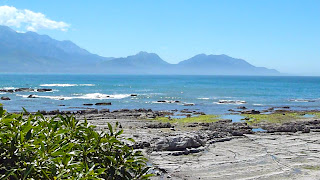
Whatever else you do in Kaikoura, walk the Peninsula Walk. You'll see weirdly spectacular limestone coastal scenery, New Zealand Fur Seals, thousands of noisy members of seabird colonies and high-peaked mountains backdropping dairy pastures that could be mistaken for Swiss alpine meadows. Look a little way out to sea and visualise a deep, deep canyon cutting a twilight zone, teeming with sea life. In South Bay you can even imagine you're on a photo shoot for a Pink Floyd album. And you'll get a great feel for this faintly desolate yet mesmerising stretch of coast.
You can start walking from the car park on West End in town, along The Esplanade, Avoca Street and Fyffe Quay to Kean Point, but in places there's only the roadside verge to walk on. Alternatively, you can drive and park at the Point to start the serious bit of the Walk. There's a steep climb up to a viewpoint but it's easy walking thereafter: allow a good half-day for the 11.7 kilometres. You're advised to wear warm, windproof clothing, but we were caught out by sun that was at least 10 degrees hotter than we'd been expecting. I also hadn't appreciated the heightened risk of sun damage here, since the ozone hole over Antarctica extends as far as New Zealand. Hats and sun block are a must: I didn't have either and got a Rudolf nose to prove it.
At Kean Point there's an extensive tidal mudstone platform that is a seal haul-out zone. The seals nearest the car park are more than likely to be males, but there are females further out on the platform and they have recently started to breed there. You may see wading birds such as oystercatchers on the platform; there are rock pools to investigate; and you can snorkel or dive off the platform in possibly the clearest water I'd ever seen – until a couple of days later while fossicking in Woodside Creek on the way to Blenheim.

From the viewpoint you can also see the site of a Maori fortification called a pa, which consisted of a series of defensive terraces. Continuing along the cliffs to Whalers Bay (so called for obvious reasons), there is a 360-degree view – of ocean, coast and mountains.
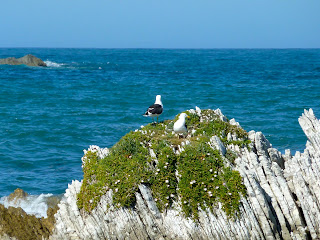
Along the Peninsula's crenulated shoreline, Whalers Bay is perhaps the most pleasing. The largest of its eroded limestone sculptures is the Sugarloaf, which you're requested not to climb (thus exacerbating the erosion), but people do. Another good reason not to make the detour that traces the old whalers' route from their lookout on the cliffs to the shore is so as not to disturb the South Island's largest colony of Red-billed Gulls, aka 'Bird City'. You wouldn't want to mess with this, would you?
Folded strata attest to an eventful geological past in these parts. Sit and stare and take it all in before continuing to South Bay.
You'll pass a predator-proofed enclosure that's been established in recent years as a new breeding ground for Hutton's Shearwaters. Yet another of Kaikoura's wildlife treasures, the Shearwaters are endangered endemic seabirds that used to breed throughout the Kaikoura Ranges. They were believed to be extinct, but then eight colonies were rediscovered in the 1960s. Now just two remain, in the Seaward Range. With nests between 1,200 and 1,800 meters up, these are among the loftiest seabirds in the world.
The Hutton's Shearwater Charitable Trust* and its volunteers brought some 300 chicks down the mountain to artificial burrows in the new Peninsula colony between 2005 and 2008. They hand-reared the chicks in the hope that they would imprint the site before migrating across the Tasman Sea to winter off Western Australia. Shearwaters return to the New Zealand mountains in August to breed, and chicks hatch in December. The Trust report that at least a dozen adults returned this summer to the Peninsula's colony, which is great news. They sent me this.
The Hutton's Shearwater Charitable Trust
During the breeding season large flocks of Shearwaters feed during the day off the coast of Kaikoura. On our first day we were lucky enough to see them just by the mouth of the Hapuku River (see Happy New Zealand, January 2012). It's not often you see such large numbers of birds.
By this time I was having to shield my Rudolph nose with the Kaikoura Peninsula Walk brochure. Photography was tricky, but the peculiar mudstone shapes and bird perches were irresistible.


It was extremely difficult to spot birds such as Pied Stilts foraging on the rock platform. Impossible, in fact, unless they moved. Or you had binoculars.

At the end of this section of the Walk there are three pouhenua. One of these striking Maori carvings depicts the demigod Maui fishing North Island out of the ocean.
Then it's time to head in the direction of South Bay's marina and follow signs back to Kaikoura town centre via the South Bay Track and Tom's Track to The Esplanade.
It was still quite hot and it seemed a long way back to the car at Point Kean, although there was a splendid avenue of Norfolk Island Pines, Black-backed Gulls on dramatically tilted rocks and yet more stunning views.
We rewarded ourselves with an early crayfish supper from a van parked on Armers Beach. This, we had been told, was the best way of enjoying the seafood that gives Kaikoura its name (roughly translated, 'crayfish dinner'), and that costs a small fortune in restaurants. It's a small lobster, is what it is.
I could live quite happily without eating seafood: I love prawns (but I'm not allowed to eat them because they're bottom-trawled**) and mussels when they're cooked the Basque way†, but everything else, well, I can take it or leave it. And I can happily leave crayfish, even though it's very big in KK. It was OK, don't get me wrong, and I loved the idea of eating it sitting by the sea. But all I could really taste was garlic. Chewy garlic. Sorry.
The Walk was thoroughly enjoyable, however.
** This fishing method churns up sediment (restricting light, encouraging algal blooms and redistributing pollutants); damages seabed ecosystems; and kills other sea creatures
† Caldo de almejas