When asked prior to their visit what they wanted to see when they came to Australia, the Manchester chapter were quite clear: animals; especially Australian exotica and creatures of the deep. So a lot of the trip-planning featured wildlife: Girraween for roos; Byron for the reef around Julian rocks and whales off the Cape; Noosa for koalas (in theory); and the Gold Coast for Currumbin Wildlife Sanctuary.
Sometimes the best-laid plans come to nought; other times, critters oblige when you least expect them to; on yet other occasions you find the familiar surprisingly enchanting (below, donkeys and pal at the ever-lovely Coolabine Ridge Eco Sanctuary near Mapleton)...


...or you come across what you're least expecting at the time, such as a young Cormorant wing-drying in the heart of Brisbane's CBD, or an Osprey (we think) on a lamppost in the centre of Caloundra.


What is certain is that in Australia, there will always be animals of interest at some point along the way, wherever you go.
First up was Girraween; Girraween Environmental Lodge to be precise, where my friend and I stayed on our first visit to Queensland's Granite Belt, back in October 2010 (see Great Granite), and where many kangaroos call home. We happily returned to this haven of peace well away from it all; the Manchester chapter loved their cabin as well as the locals.
One of the first roos we came across, while walking to Whale Rock, looked as if he was going to bound straight at us. There was a bit of a standoff – who was going to hold their nerve the longest? – before he veered off through the bushes on a short detour and then returned to the path behind us.
There were lots of others to be studied, especially in the early morning and at twilight. They let us approach quite close, even if there were joeys about. Their blending into the landscape was as remarkable as ever.

But perhaps the most astonishing candidate at Girraween, spotted by my friend's eagle eye as we walked down from the summit of Castle Rock in the National Park, was a quite extraordinary stick insect. It was more twiggy than a twig.
And these cast remains had been left behind on tree trunks by whichever insects had outgrown them. I had never spotted these before, on all my many walks through bush and forest, but there were many once I started looking for them. Assuming they were alive, we approached with caution – you never know in Oz – and then felt silly on discovering they were lifeless remains.
The Manchester chapter had headed up to Cairns, principally for the diving on the Great Barrier Reef, within days of arriving in Brisbane on this, their first visit to Australia. They enjoyed, but didn't rave about, their Reef experiences in Northern Queensland. But the diving in Byron Bay, now that was a different kettle of cuttlefish. The best ever, I was told. Tropical and temperate waters mix along this section of the Australian east coast, increasing the variety of marine life, and Julian Rocks, out in the Bay, provide shelter and ample food supplies for many species.
The Byron Bay Dive Centre is well organised, supportive and informative, my brother-in-law reported. They run dinghies off the town beach for the 10-minute journey to the Rocks, during which large dolphin pods and Humpbacks often appear within metres of the boat. Other delights included Green Turtles, Grey Reef Sharks and schools of large pelagic hunters such as Mullaway. Here are some of the best of the beasts*.
You can't visit Byron, of course, without bumping into old friends...
...and over a beer on our west-facing balcony one evening, we counted bats on their twilight passage from the direction of the setting sun. More than 1,500 in 15-20 minutes, we estimated, having counted how many flew over in a minute, several times.
On the way to Byron, we stopped off at the Gold Coast, and Currumbin Wildlife Sanctuary. World famous yet struggling to survive financially, this place needs our support. But I was disappointed. It felt more like a zoo than a sanctuary, with some animals in small cages or enclosures complete with that resigned expression animals acquire in such surroundings. Several compartments in certain areas seemed to be empty or depleted.
Tasmanian Devil
Australian Dingo
Maybe they were tired. This Echidna just kept pacing the same circuit over and over.
You can get really up close and personal with the roos. You can pat them and hug them and feed them and, if you're from a certain part of the globe, make V for victory signs as you pose with them for your friends' snaps. What I really couldn't bear was little kids feeding the joeys. That can't be a good idea, can it?
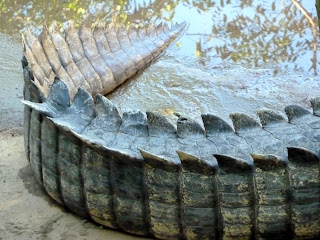
And the saltie's enclosure seemed only slightly bigger than he was, although admittedly he didn't move far from the effects of his overhead heater.
The koalas looked the most content. They were as cute as a million buttons.
Even more irresistible than a koala doing a spot of DIY is a koala with a baby.
Undoubtedly the best bits of a koala are its ears and back-of-head.
The Free Flight Bird Show at Currumbin is impressive, but it was difficult to be impressed and take photographs at the same time. So I can't show you a proud Pelican strutting across the 'arena'; a Bush Stone-curlew's nervous dash; or the swooping Wedge-tailed Eagle and smart, head-skimming Cockatoos. The birds of prey weren't exactly 'free', of course; they were restrained when on their trainers' arms. I don't wish to sound churlish, but by that time I was bothered about animals not doing things naturally.
We should have visited the Wildlife Hospital Precinct to see animals being helped rather than used for entertainment. (I know the entertainment earns the income.) Our time was limited, however, and we had to make choices. If we'd had younger children with us, they would doubtless have loved the Green Challenge Adventure Parc (tree-top rope courses) or the Wild Island adventure playground or Superbee Honeyworld (a bee show!) or the Wild Night Adventure (Aboriginal dance and nocturnal wildlife).


There were no animals to speak of during our last excursion with the Manchester chapter – to the Glasshouse Mountains, the Three Ms (Maleny, Montville and Mapleton), Noosa and Coloundra – except the donkeys and horses above. There should have been koalas-in-the-wild in Noosa National Park. But things have changed since February and our last visit. Koalas haven't been spotted in these parts for a while, reported the Park information centre; not since a large male died a few months ago. It's thought the females may have moved on in search of a new one.
There weren't any koalas in the National Park for decades, following extensive culling (for fur) in the early 20th century. Then, in the 1960s, the word was koalas were under threat from development down Brisbane way. Someone from Noosa Parks Association went down in his ute, loaded it up with koalas and brought them up to Noosa, where they've been ever since. (So much for great sensitivity to habitat change, I was told.)
They migrate between the headland Park and areas further south. (With more and more development come more roads for koalas to cross and more dogs to worry, if not maim or kill, koalas.) Sightings vary as a result of these migrations. And some people believe it's harder to see koalas in trees now than it was during the drought years because the vegetation has flourished since rainy 2010.
Whatever the reason, we didn't spot any, even in their favourite trees – Grey Gums and Eucalyptus robusta.
The day before the Manchester chapter left for Sydney was the Ekka (see The Ekka, August 2011), an experience on many levels for European visitors. The animal extravaganza ranged from my little pony to venomous vipers, which we hadn't encountered previously on our travels, and provided a fitting end to an introduction to Queensland.
Here's a silly list we compiled one day while waiting for a CityCat, based very loosely on 'The 12 Days of Christmas' and some children's book or other, in honour of Australia's wondrous wildlife.
One Wombat
Two Platypuses
Three Tree Frogs
Four Flying Foxes
Five Friar Birds
Six Salties
Seven Basking Sharks
Eight Echidnas
Nine Noisy Miners
Ten Turtles
Carpet Python (top snake) and Common Death Adder (bottom snake)
*Girraween National Park (above) and underwater photographs (Spotted Boxfish, Grey Reef Shark and Green Turtle) courtesy of Jim Grainger
This post was last updated on 8 October 2011

 Many runners in Brisbane run the Bridge to Brisbane. This year, almost 42,000 people took part, on a glorious morning.