March 15, 2016

San Francisco Days

Day 2 of our California road trip was spent relaxing in San Francisco after a much-needed long night's sleep.

The previous day, Friday, we landed in Los Angeles at 06:30, five hours earlier than we'd left Brisbane, after a 13-hour flight and barely half-an-hour's rest in the previous 30+. Months earlier, we had stupidly made the decision to drive from Los Angeles to San Francisco on busy, flat and straight Route 5 through the fruit trees and more fruit trees of the San Joaquin Valley. We left LA in the morning rush-hour, and our arrival in SanFran coincided with the Friday-evening commute. It was most certainly a drive too far for people too long without sleep.
Crossing San Francisco-Oakland Bay Bridge 
Our house was on Grand View Avenue (and there was), on the border of Twin Peaks and Noe Valley. The following misty morning, we walked down for breakfast on 24th Street, at the French bakery. We fancied a decent croissant and proper coffee, having not yet acquired the taste for American. The fire brigade popped in for coffee, too, leaving their extremely long vehicle double-parked on the corner.
All around there was colour, blossom and the city's famous and delightfully distinctive houses. There was no end to the photographic possibilities. But how I cursed the strung-out power cables. Just like home. 
 
It was market day so Noe Valley was bustling. We wandered up and down 24th Street, several times. There was a phenomenal chocolate shop, where we spent a lot of time and not an inconsiderable amount of money.
San Francisco is a hilly city. Later, we walked up and down Castro Street to The Castro itself, where there was colour of a different variety. We caught a trolleybus back, however.
Our first night we ate tapas at Contigo kitchen and cava, on Castro Street in Noe Valley. It's Spanish and Catalan with a Michelin 'Bib Gourmand' and a philosophy driven by sustainability as well as a big love of Barcelona. We chose boquerones (white anchovies) and croqueta de jamón serrano, followed by pork, lamb and jamón albondigas (meatballs), coca (flatbread) of wild nettles, jamón and manchego, and wild mushroom and spinach canalones. We chatted to Andrew and Denise on the next table, locals who often dine at Contigo. We described the Australian Outback, which they have thought of visiting; and they suggested we would love the Alaskan wilderness. I'm sure we would. 

They assured us California was solidly Democrat, always had been, always would be, which was oddly comforting; normal service amidst the Trump trainwreck. There had been young and eager canvassers on 24th Street earlier. Like everyone we talked to in the city, they welcomed us to their state and were happy to chat even though we weren't potential voters. We stated our preference for their party in any case.

For us, there were two absolute must-dos in SanFran: the Golden Gate Bridge and a cable car ride. Back in Bris, I'm having a little trouble with vehicle terminology: street cars, trams, trolley buses, cable cars? I have many pictures, and very pretty they are, too. But which is which? 
Tram (streetcar, in American)
Different kind of tram
And another
Cable car
Trolley bus
We took the California Line cable car from one end of the line to the other. It climbed steeply, and quickly. Its speed was almost disconcerting at times, given that passengers hang off the sides, because that's what you do. We laughed about the fact that such a thing would never be allowed in Australia. Far too dangerous. In San Francisco, however, you can fall off beneath the wheels of a vehicle alongside and kill yourself; it's up to you, not the nanny state.
Spot the Golden Gate Bridge
First glimpses of the Bridge from afar were tantalisingly beautiful. Up close, it was quite remarkable.

Constructed between 1933 and 1937, the Golden Gate was the first really large suspension bridge in the world. Its span of 4200 feet ranked it the world's longest until 1959. It was designed by Irving Morrow to withstand wind speeds of up to 100 mph (swinging by as much as 27 feet in strong gusts), and has only been closed three times because of weather conditions.
View from Telegraph Hill
 
The Bridge needs to be able to move in response to an earthquake, too. Two retrofits have attempted to protect it: the structure has been strengthened in places to resist the force of a quake, and it has also been fitted with seismic isolators, which deform during a quake, softening the impact of tremors. Isolators were invented in New Zealand in the 1970s, and commonly take the form of a cylinder consisting of layers of steel and rubber bonded together. There may be a hole in the middle of the cylinder with a lead plug to facilitate the dissipation of energy.

You can drive across the Golden Gate Bridge, of course, but you won't be able to look at it properly in traffic. You can walk across, but this takes time. We only had three days to 'do' San Francisco, so we cycled, my friend and I on a tandem. I would recommend this if you're a gal and you fancy a bit of help up the long hill from sea level to Bridge height. We hired from Sports Basement in the Presidio and not far from the bottom of that hill. But be warned, there was a lengthy queue to register and be allocated a bike; and running repairs were required halfway up. There were five of us, on three bikes, and two of them had chain problems. You can hire for three hours or a full day. Avoid weekends.

There are places you can pull into on the Bridge, for a rest, take a photo of the beautiful coastline beyond, or to turn around. Another warning is necessary, about the ultra-serious cyclists who give no truck to the slow or less experienced. One wonders why they choose a route that is bound to be fraught with idiots or aimless wanderers.

There's a gift shop at both the Warming Hut Cafe at the bottom of the hill climb and at the Welcome Centre at the southern end of the Bridge. They have good stuff, such as books about the Bridge, waterproof pocket guides to the birds of California, stylish hoodies, realistic rivets, pens and notebooks, and this, which will long remain a souvenir favourite. We never got to see the Bridge looming out of mist, you see.
Our tram travels took us along Fisherman's Wharf, which was horribly crowded, and tacky. We didn't linger and walked quickly away from the waterfront to the 'Zig Zag Street', as we called it. This was a disappointment, too, being clogged with cars and impossible to photograph without silly tourists and vehicles. Lombard Street's tight curves – which have a speed limit of 5 mph – might be fun if you can get them to yourself in the early morning. There's certainly a good view from the top.
Looking to Telegraph Hill and Coit Tower
We walked up and down Lombard Street, and then up to Coit Tower, where the queue was too long and time too short. We decided the view from Telegraph Hill was good enough without an extra 210 feet of Tower; and then walked down to Washington Square, where we chilled in the stylish Park Tavern; I procured a black Guido Delgado Fedora from Goorin Bros; and we people-watched in the Park, while pretending not to notice black dudes in vintage convertibles or Hummers cruising round the Square to loud funky accompaniment.
San Francisco Bay from Telegraph Hill
Saints Peter and Paul Church, Washington Square
We returned to Fisherman's Wharf that evening to eat at Scoma's, which had been recommended by friends who'd visited recently. This seafood classic dates from 1965, and it was a real treat. They describe how, 'Each morning local fishermen bring their catch to Scoma's pier. Our chef then selects the very best for our pier to plate menu.' I chose Scoma's famous clam chowder to start, followed by wild salmon with black rice, accompanied by a California Viognier. I hadn't enjoyed fish food as much in a long time.

On our last evening in SanFran we ate at Foreign Cinema in Mission district. This is a super-cool joint combining 'food, wine, cocktails, film, and art gallery into one harmonious ambience'. It has featured in the San Francisco Chronicle's Top 100 Restaurants for 16 consecutive years. I kicked off with A Poet's Blood cocktail, before ordering a salmon and prawn starter, pork chop main, and salted caramel pud. I was intrigued by the chop's description on the menu – Heritage pork chop, Umbrian farro (wheat grain), nettle, hen-of-the-woods, poached tart cherries, balsamica. This was the first time I'd come across 'hen-of-the-woods', which is a mushroom that clusters at the base of trees, particularly oaks. You live and learn. 

Finally, I had to visit Haight Ashbury, for American comfort food at the unpretentious Pork Store Cafe, before we hit the road south. Originally a sausage butcher's established by Czech immigrants in 1916, Pork Store has become something of a breakfast institution in SF. Our waitress patiently explained 'grits' and 'biscuits', and suggested we share a large plate of hash browns in addition to our individual orders. 
 
It was a bit early for most of The Haight to be awake and functioning, although two members of our party were offered something 'to make your day better' twice during our short walkabout after breakfast.


San Francisco has had countless lyrics, poems, fictions and non-fictions written about its colourful history and equally enthralling present. A week later, in a bookshop in Sonoma, I was to pick up Season of the Witch, by David Talbot, an account of the city from 1967 until 1982. I can't wait to dive into an era of the city's past that left an indelible mark on my youth. Talbot's first para of his introduction describes the city in this way:
San Francisco was built on a dare. The city was tossed up overnight on the shimmying, heaving, mischievous crust of the Pacific rim. A gold rush city of fortune seekers, gamblers, desperadoes and the flesh-peddling circus that caters to such men, San Francisco defied the laws of nature. It was a wide-open town, its thighs splayed wantonly for every vice damned in the bible and more than a few that were left out. San Francisco was the Last Chance Saloon for outcasts from every corner of the globe.
San Francisco is still defying the laws of nature. It's way overdue for another serious earthquake, and yet it exerts an extraordinary power over visitors that makes them long to return. Many people I told of my plans said it was the city in which they would love to live. As we left, my friend suggested we should come back soon for longer, just to live in it, chill in it, and be San Franciscans for some brief moments of indulgence. I had to keep pinching myself while I was there; I most certainly did not want to leave; and I felt renewed for having been there. The city and its inhabitants were strangely liberating from life's tedious little annoyances; they outpoured refreshingly new as well as beautiful old.

We could only follow that with something of epic proportions, right?

March 11, 2016

The joy of stats

The Reef's fastest fish
Statistics isn't one my favourite subjects, but this week some savoury stats have been injected into familiar debates.

The Newcastle Herald reported on Wednesday that Labour Federal Member for Hunter (New South Wales), Joel Fitzgibbon, was calling for the development of a regional strategy to promote economic transition in mining areas, following BHP Billiton's announcement of nearly 300 jobs to go at it Mount Arthur mine near Muswellbrook. The total number of anticipated job losses in Hunter Valley mines so far this year has reached 1000.

The same paper reported this morning that the amount of Hunter Valley coal exported through Newcastle fell by about 9 per cent in January and February of this year compared with the same months last year. Previously, sales volumes had remained relatively strong despite the plummeting price of coal on commodity markets. (I am advised, however, that these figures may reflect production lost as a result of flooding in April last year.)

Last night I attended a Reef and Coal Forum organised by the Queensland Conservation Council, GetUP! and the Australian Marine Conservation Society. Speakers included Ove Hoegh-Guldberg, Director of the Global Change Institute at the University of Queensland and best known for his work on the effects of climate change on coral reefs; Mark Ogge, a researcher at progressive think tank The Australia Institute; Tony Fontes, a dive operator in the Whitsundays who arrived from California in the 1978 to dive the Reef and never went home; and Pat O'Neill, prospective ALP candidate for the Brisbane electorate on a keep-all-fossil-fuel-reserves-in-the-ground platform.

With a coral bleaching episode currently evidenced on the Great Barrier Reef, there were lots of stats flying around. Professor Hoegh-Guldberg told us that anything greater than a 1.2-degree increase in ocean temperatures would mean the Reef would no longer be a coral-dominated environment. Mark Ogge surprised us with the news that there had been a 15 per cent increase in coal production in Queensland in the last two years. And Tony Fontes described the huge variety of life on the Reef from the largest whale shark to the smallest gobies; from the fastest sailfish to the slowest seahorse.

In the light of the coal production figures, it was less of a surprise that Queensland's emissions have risen over the last year, significantly more than in any other state of the Commonwealth. This was mainly as a result of the use of electric motors powering equipment in coal seam gas fields. You can read more about greenhouse gas emissions indices and energy trends at http://www.pittsh.com.au/assets/
files/Cedex/CEDEX%20Electricity%20update%20Feb%202016.pdf.

The state's increasing carbon pollution also results from reliance on coal for electricity generation, huge fuel consumption for transportation, the processing of gas ready for export, and an increase in land clearing, facilitated by legislation under Campbell Newman's LNP government. In 2012-14 land clearing doubled to 300,000 hectares, and the same is expected in 2014-15. All in all, the chances of Australia meeting its emissions targets pledged in Paris are remote, while seriously undermining the Federal government's 'Direct Action' policy.

This didn't stop New South Wales Liberals calling on PM Malcolm Turnbull this week to fund public debates on climate change, including the question of whether or not the science is 'settled'. This would be laughable if it weren't so tragic for Australia's already tardy climate action policies. The successful motion will be conveyed to so-called Environment Minister Greg Hunt so, fortunately, we can expect no further action.

This Liberal idiocy coincided with Melbourne's hottest March night since records began; Canberra equalling its March heatwave record of nine consecutive days above 30 degrees; and Sydney's record-breaking 31-day run of temperatures above 26 degrees.

Great days for the beach and burying our heads in the sand once more.

(I found the splendid sailfish at lazerhorse.org)


March 5, 2016

California In My Mind

My week didn't have a Monday: my 2016 hasn't had a Leap Day. I left Los Angeles at 23:30 on Sunday and arrived in Brisbane at 07:45 on Tuesday.

At the end of an American road trip, the two-and-a-half-hour drive from Palm Springs to Los Angeles International along an at-times 6-lane highway, in the dark and heavy Sunday-evening returning traffic – and on Oscars Night – required great concentration, even with GPS. LAX security was protracted and stressful.

But I love California. In my mind I'm still in California.

I'd been before, but years ago. I'd forgotten just how welcoming Californians are; how Democrat the state is; how impressive the Golden Gate Bridge; how unequalled Route 1 from Point Lobos Natural Reserve to beyond Big Sur; how majestic the Redwoods; how large-scale the landscape; and to what extent Death Valley blows your mind, even before a super-bloom of Spring flowers.

Added to this was a house in Twin Peaks with a view from the sea to the CBD; a beach house on Morro Bay; the surprisingly pretty Napa Valley, its wines and those of Sonoma; moonscapes in the Mojave; the weird trees and cacti gardens of Joshua Tree; and an expedition to the 'San Andreas Fault'.

I struggle to articulate why I loved it so much. There was good music in every cafe, saloon and eatery along our way. Anyone and everyone, on enquiring where we were from, greeted us warmly. Towns I'd imagined would be small and quaint were, with the exception of Carmel-by-the-Sea, bigger and sprawling; the byways wider and busier; and the miles so much longer than kilometres back home. But we were in America, and nothing irked. We did some touristy stuff, and sites were crowded, but it didn't bother me the way it usually does. There was smog and litter; too many homeless on the streets of San Francisco; and the country faces the prospect of a wholly unqualified right-wing bigot being elected President in November, which would be a disaster for the planet. But I'd return to America at the drop of a hat.

It's ingrained. California throughout my life has been the place of dreams, tall tales and crazy characters, as well as oranges. From Kerouac to DiCaprio, cowboy hats to hash browns, I'm addicted to the culture; unable to resist or reject. I was receptive and tolerant; a sponge in a stream; a fan and believer.

It's not only, just especially, California.

The humidity hit us like a wall as we walked out of Brisbane International Terminal. Temperatures have been above the March average all week. Tony Abbott is back in the headlines. I would prefer to be anywhere along our Californian route right now.

Each time I visited the States in the past, I vowed to return on a regular basis, but never managed to. In the last couple of days, however, I've been hatching a plan…


February 10, 2016

You couldn't make it up… The Passports Saga part 2

Where were we? Ah yes. Both our passport applications had entered the system (see also, I never thought it would be easy, January 2016). We waited.

I was the first to get a call from the Passport Office. My photograph had been rejected. The facial recognition machines at (some) airports might not positively identify me because there was hair too close to one of my eyes. The Passport Office lady was helpful. If I went to the main post office in Brisbane – in Post Office Square, natch – 'they take a nice photo there'. Then all I had to do was walk two blocks to 150 Charlotte Street, up to the 17th floor, to hand in two new photos, which wouldn't need re-certifying. Bob's your uncle.

I also arranged with the Passport Office lady to collect our passports the day before our departure for the US in mid-Feb since, with the photo hiccough having stalled the process, there wouldn't be time for them to be posted.

I know it's probably hard to believe, but I was agitated waiting in line at the post office the next day. I knew what would happen: 'Just move your fringe out of the way'; 'lower your chin'; and the picture would be shite, whatever. There was an even more anxious lady behind me in the line: she needed an express queue (there wasn't one); then she had to fax things places; and she had to do all this yesterday. I was relaxed, by comparison.

I trotted off to Charlotte Street with the photos, which could have been worse but not much. The first hurdle: I couldn't find 150. Do you know why? The number is inside the building, not on the exterior. Helpful, right?

[I have a theory. I reckon it's pretty dull working in the Passport Office. The atmosphere is sombre and reverential: the employees are all-powerful; their clients fearful in case they put a foot wrong. So the powerful ones have come up with a game. Mostly, they process everything straightforwardly; but occasionally, if they're faced with a Pom or a non-native-English speaker, they decide to have some fun, by putting any or all of a series of hurdles before them to see if they crack. The game's called You want an Aussie passport? Let's see how much you want it.]

On the 17th floor a little man sat at a desk right outside the lift. I had to explain to him why I was there and he then directed me to the appropriate booth inside a waiting room full of apprehensive applicants. My queue didn't take that long, it being only for queries and delivery of additional stuff, not 'interviews'. The Passport Office lady on the phone had recommended I complete a stat dec requesting them not to put 'Stockport Third' as my place of birth. The man behind the glass accepted it and told me they would call me if there was a problem. I didn't doubt that. On my way out, the little man was asking another rather desperate-looking chap if he'd achieved whatever it was he was after. He put his head in his hands and scurried into the lift. Just as well the windows are non-opening on the 17th floor.

Two days later my friend received a phone call from the Passport Office: the photocopy of his birth certificate that the post office had made during his 'interview' wasn't legible. Could he photograph the original and email it to the Passport Office? He could and he did.

The next emails, rather confusingly, were headed 'YOUR PASSPORT IS COMPLETED', although the first paragraph said, 'Your passport is now being prepared'. I phoned up just to clarify, and to request collection on an earlier date than I'd arranged. I didn't want to turn up on the 9th and discover they were in the 'For collection on the 11th' box, did I? I checked again what I needed to take with me.

Yesterday was the day. I went to 150 Charlotte Street and, hey, there was no queue. It wasn't where I was supposed to collect the passports either, but no one had told me. I had to go to the main post office, where there was a long queue. To pass the time, I phoned my friend to joke about the misinformation, believing it to be the final twist in the story. I couldn't reach him.

Neither was it the final hurdle. When I got to the counter, and handed over my receipt of application for a passport, my friend's receipt of application, a stat dec from him authorising me to collect on his behalf, and my driving licence for ID purposes, the man said, 'And do you have your partner's driver's licence?'

I didn't. Because the frickin' requirements for collection given to me in that first phone call hadn't included it. I think it was at this point I came closest to tears. It had just been too difficult, and I was so near and yet still so far. Our passports must have been just over there; just beyond that screen. The man went to ask his supervisor if we could proceed without it. We couldn't. It was needed to verify my friend's signature on the stat dec: I might have forged it, you see. My friend's signature was on his passport, of course, but that was in a sealed envelope that I couldn't open for the man because he wouldn't give it to me because he couldn't verify my friend's signature authorising me to collect the envelope.

I think the man felt sorry for me. He suggested my friend photograph his licence and send me the picture to show the supervisor. I still couldn't contact my friend, either on his mobile or through his company's switchboard. I noticed I didn't have a signal so went outside to try, and fail, again. The man offered me the post office's landline. I reached my friend's desk phone through the switchboard but he didn't pick up.

I was beginning to conclude there must be something wrong with my phone. The man said he would only be there for another 20 minutes, and then I'd have to go through all this again with someone new. I'd tried phoning, text messaging, emailing (it wouldn't send) and WhatsApping. I had to give up. I wandered out into Queen Street, where I had a thought: I went into the Apple Store a couple of doors away to see whatsup with my phone.

It was then I learned that Telstra had gone into meltdown in most of Australia's state capitals.

A young greeter took pity on me. She tried bypassing Telstra – something I would happily do permanently – and Facetimed my friend using Apple's wifi. It didn't work. She then put me on a computer so I could use Facebook. I had doubts he would be on Facebook at work, but I sent a message anyway. I think Telstra must have sorted the problem at that juncture, for a moment later he phoned and a couple of minutes later I received the all-important photo evidence by text.

I raced back to the man in the post office in the nick of time.


February 6, 2016

Doolally decisions

It's been a week of mixed emotions. Some good news; some really bad and stupid. I would have to conclude I'm at the Mrs Bloody Angry of Balmoral end of the spectrum rather than the 'Hey, guys, we're making good progress'. And it's only the first week in Feb.

First up, on Tuesday, the Queensland Department of Environment and Heritage Protection granted Adani their Environmental Authority for the Carmichael Mine in the Galilee Basin. This was inevitable, because a state in big debt has to be seen to encourage wealth generation, even though the Indian company is far from securing finance for a project with much reduced estimates of jobs and royalties. The Minister for the Environment absolved himself of responsibility. On his Facebook page, Stephen Miles wrote: 'The decision to issue an Environmental Authority is not a political one. It is made by the environmental regulator in accordance with applicable legislative provisions. Under Queensland law I had no role in the decision-making process.'

Minister Miles is head honcho in his department, presumably, and could table new legislation if he saw fit. The approvals process is in dire need of reform*: hydrogeological and ecological research, for example, should not be left to those with vested interests. The fact that the EA comes with a raft of conditions, some of which in this case were handed down by the Land Court, brings little solace to environmental protectors who insist coal reserves must be left in the ground. Politicians always refer to lists of conditions in an attempt to mollify outrage. Conditions need to be followed through, and on many occasions previously monitoring and enforcement have been found wanting. The Department just doesn't have the resources to do the job properly. I have noticed in the Land Court proponents who are defending inadequate impact management plans try to divert attention with promises of how they'll rehabilitate enormous holes in 30 or 60 years' time. A century and a half's history of deficient, or even non-existent, mine rehabilitation in Australia doesn't instil confidence in those claims either.

There was great news from New South Wales, on the other hand. AGL Energy announced they were abandoning their controversial 330-well coal seam gas project in the stunningly beautiful Gloucester Valley, citing inadequate economic returns resulting from volatile commodity prices and long development lead times. The Groundswell Gloucester lobby group popped the champagne corks and basked in a tidal wave of relief. AGL are selling off a couple of their natural gas assets in Queensland, too.

Unbelievably, Mike Baird's response to AGL's announcement has been to offer new areas for gas exploration, in remote regions out west where opposition is likely to be less organised than in the east. He's also hoping to resurrect applications for gas exploration leases put in by the NSW Aboriginal Land Council. Mining is a deeply divisive issue among Indigenous groups. While some see it as a means to greater financial independence, others consider it anathema to their role as custodians of country.

Then came the shocking news that CSIRO (Commonwealth Scientific and Industrial Research Organisation) was laying off 350 researchers over the next two years, mainly from the departments observing and modelling climate change. According to chief executive Larry Marshall, a former venture capitalist in Silicon Valley appointed to the job last year, there's nothing to worry about: the question, is the climate changing?, has been answered, and now he wants to get on with 'putting the "I" back in CSIRO. Hmm.

Not everyone at CSIRO believes climate change research should be put on the back burner just yet, however, especially in the light of commitments Australia made at the Paris climate conference in December, to improve observations and investigate early warning systems. But a hundred of the jobs will go from units researching sea level rise, ocean temperature and acidification, and recording greenhouse gas levels. The last of these includes an air pollution monitoring station in remote northwest Tasmania, the only one of its kind in the southern hemisphere, established in 1976 but now at risk. At Cape Grim on Tassie's tip, the air is as fresh as a daisy, having been blown across thousands of miles of ocean, and therefore a good candidate for 'average' air, for the study of its constituents.

The sky remains dark with chickens coming home to roost following the Abbott government's austerity budget measures in 2014.

It's reported that Malcolm Turnbull's cabinet has been working away at tax reform for this year's budget in May. I would love to think they've reviewed tax collection from international corporations and exceedingly wealthy individuals, but I doubt this was ever on their agenda. They could also sort out fuel tax anomalies that subsidise the resources and airline industries. More expensive flights might get the people thinking about inconvenient truths they'd rather ignore. They might even stop baying about cheaper electricity prices once increased tax revenues were diverted into the renewable energy industry. Now that would be good news all round.

* While attending the case brought against GVK Hancock's Kevin's Corner mine in the Land Court last October, I concluded: the existing approvals process is not sufficiently wide ranging in terms of scope, or sufficiently thorough – from baseline studies to impact management strategies – to adequately inform important decision makers; and decision makers who are already challenged in a transitional economy clinging to an obsolete free-for-all mentality, and on a continent at serious risk of climate change impacts and loss of biodiversity.


January 31, 2016

Summer in the city 7: A day in the D'Aguilar

While at Enoggera Reservoir the other weekend, we acquired a map of the D'Aguilar National Park, which stretches from The Gap in northwest Brisbane almost to Woodford in the Sunshine Coast Hinterland. My friend spotted the Range Road Forest Drive in the northern section of the Park, and it seemed a good candidate for an Australia Day excursion.

The weather forecast wasn't great, and we hit torrential rain just beyond Samford. We stopped for coffee at Dayboro, something of a habit, and from there took Mckenzie Street on to Lacey's Creek Road. We were clear where we were going on the National Park map, but we passed two No Through Road signs, always a tad worrying. Lacy's Creek Road was long and winding and we didn't want to have to turn back the way we'd come. But in the past we've tried to take shortcuts or more interesting off-road routes in the Sunshine Coast Hinterland that were on our Hema map but have been disappeared in reality, we suspect by property owners not well disposed to passers-by.

There were a couple of items of interest along the way.
Spot my shy companion
Just as I was anticipating the end of the road, which had become narrow and seemingly rarely used by this stage, we reached the entrance to the National Park. 
The track was rocky and steep beyond, with the occasional crazy dirt biker careening down even steeper slopes into our path. Maybe that's why there was this further up the hill.
There were tantalising glimpses of unspoilt hills stretching out west. The blue mountains looked like a summery sky behind the foliage.
The weather was closing in as we climbed higher up into the Range and the clouds.
The ethereal forest
Soon we came upon what claimed to be Kluvers Lookout. At first we could only find a phone mast with an impressive solar array and a handful of Red-browed Finches on a wire. Then the mist lifted enough to reveal a valley east of the Range.
Further on, it got more rainforesty. Then there were grass trees; and a fern-covered forest floor.
 
At the next junction we turned on to Peggs Road, and it wasn't long before we reached The Gantry day-use area. It looked familiar from a previous Australia Day trip – the day of the Mount Mee leech incident, when my friend learned to his cost that Australian leeches lurk in damp undergrowth, not water. We'd thought we might have lunch at The Gantry, but no chance: it was heaving and there was nowhere to park. It takes its name from this.
The enormous shed, built in the 1950s, housed the overhead gantry of a sawmill. The timber industry in the area dates from 1879.

We beat a hasty retreat from the hordes and headed off down the Western Escarpment Forest Drive. One thing we love about drives such as this is the ever-changing forestscape, from open dry eucalypt to rainforest. The variety continued around the Escarpment circuit.
 
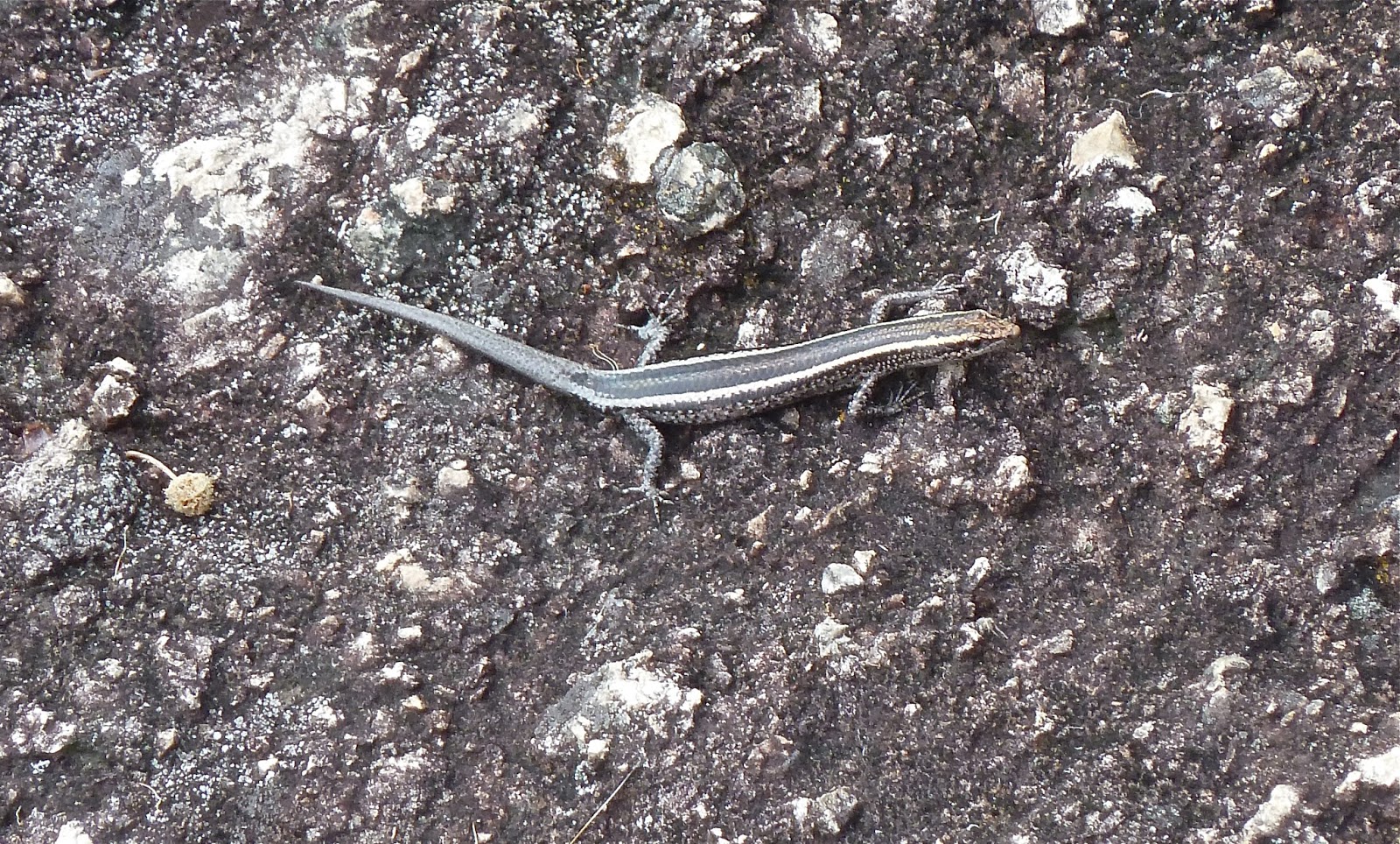
And roughly halfway, after slow progress along a rocky trail, was the Somerset Lookout, with more skinks than you could shake a stick at and an extraordinary caterpillar, as well as the view.
It was a thoroughly enjoyable trip that engendered thoughts befitting of Australia Day*.
* See also That day at the end of Jan, January 2016
This post was last updated on 1 February 2016