June 25, 2013

Outback: Brisbane to Charleville

A gentle harp wakes us at 5, but departure is nearly two hours away, despite much packing and loading last night. Endless food prep, or so it seems; final list checking; locking; wondering... what have we forgotten? The roads are quiet even though it's a holiday weekend, and the Ipswich Road out of Brisbane is uncannily empty. It's a high-cloud morning, but there's the promise of sunshine in the bright bits.

Is there anything beats the anticipation at the outset of a long day's drive at the start of a serious road trip?
click on pix to see them big
We've never been west of Toowoomba on the Warrego Highway. I know there's a lot of mining and agribusiness to come, but I'm still excited. First up, Oakey Power Station, right next to the Roma-to-Brisbane gas pipeline. Pretty in its own way.
Our first pit stop is at Oakey, for fruit salad, cold toast and hot coffee. Trip themes gradually emerge over time, but here is a big clue to one of them...
Back on the road – I wonder how many times I'll write that in the next few weeks – coal was making its presence felt by the Western Line Railway. Still no covers on the coal wagons, then?
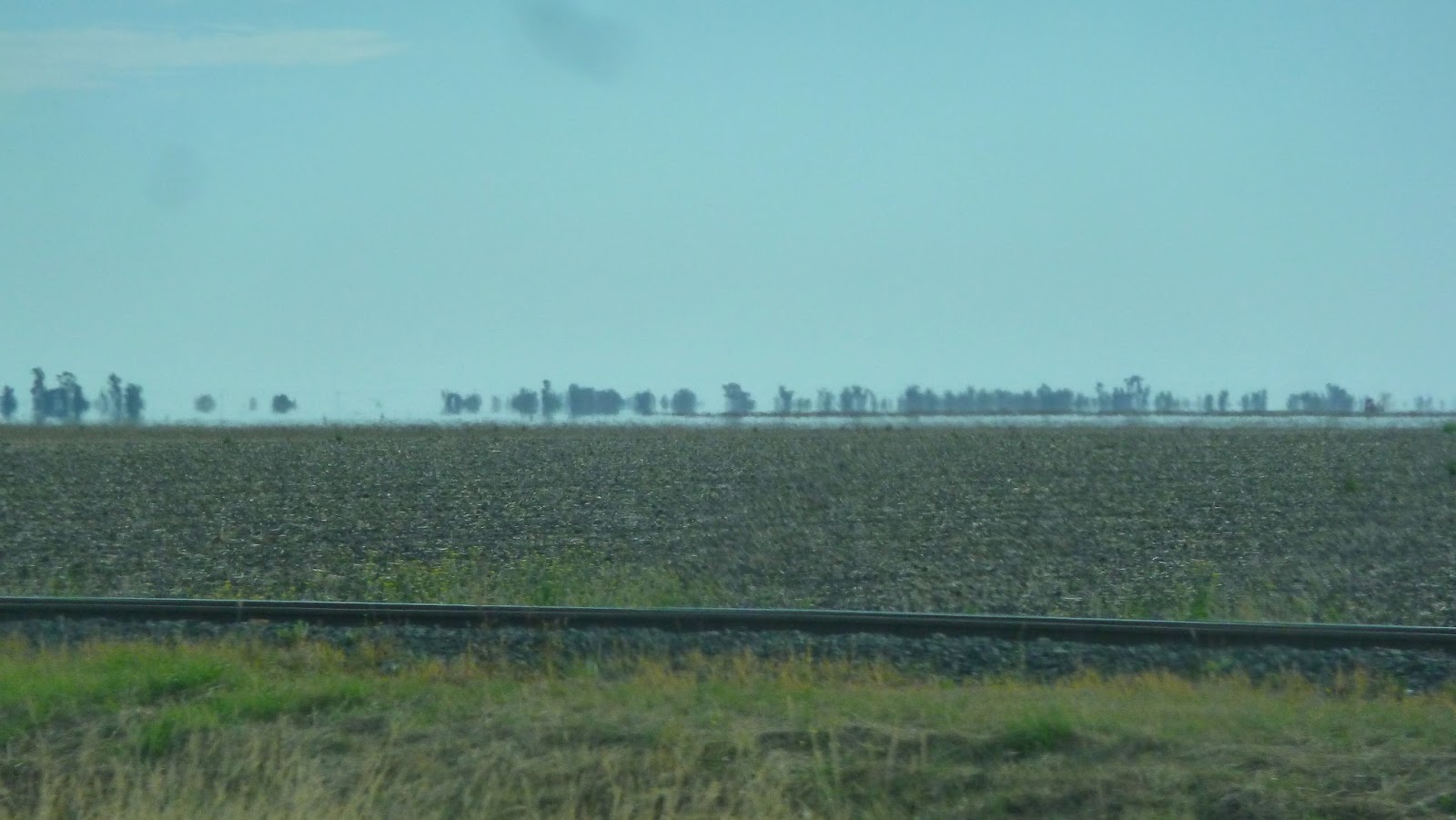
By now the plains of the Darling Downs are so flat they are miraging.
And then we're in cotton country, around Dalby. Much of the crop has been harvested, but I am on a photographic mission to find bolls still on the stem and stacks of striking yellow bales.
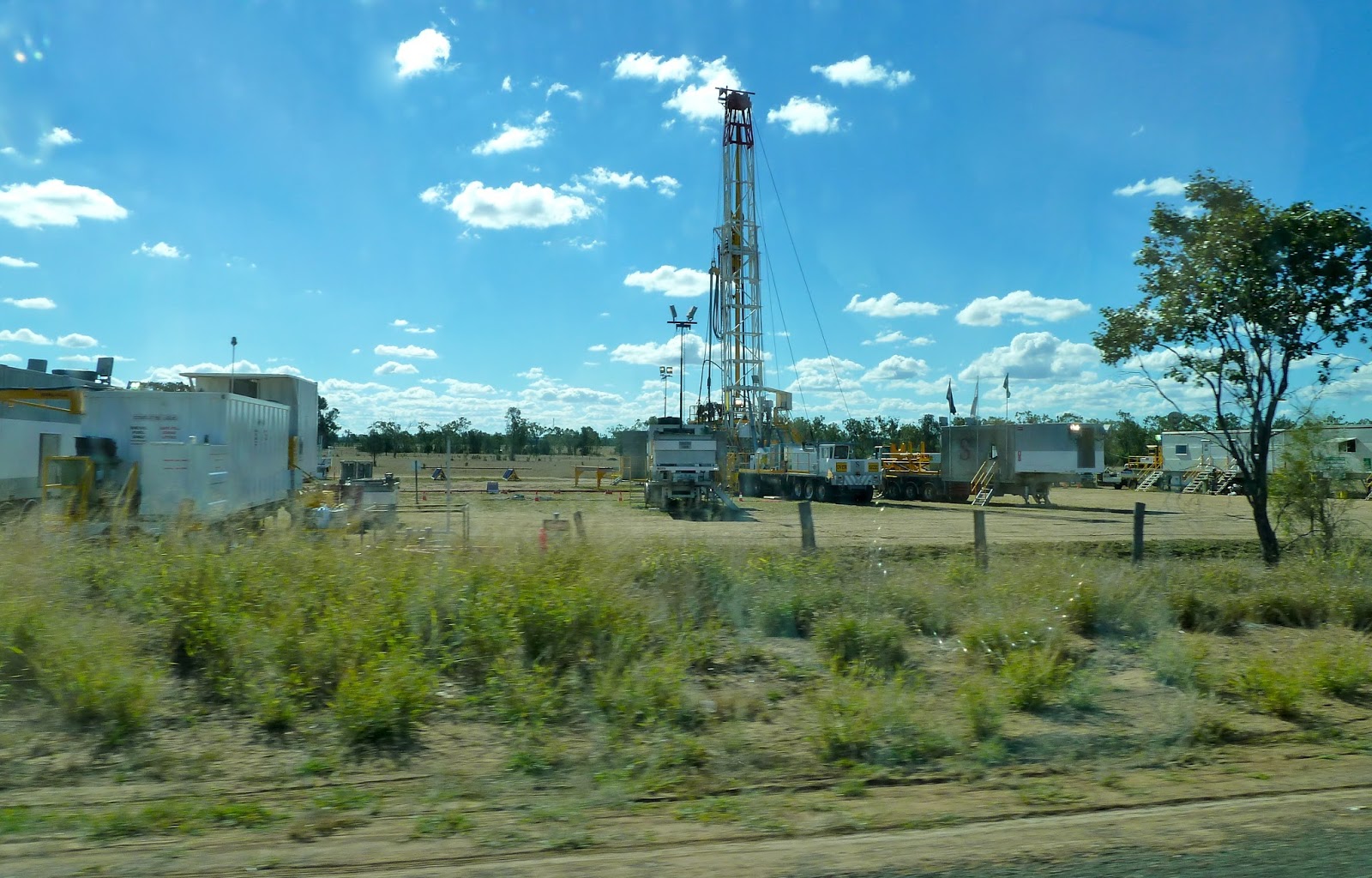
Dalby is 210 km from Brisbane. I have never seen so many pieces of machinery – tractors, ploughs, backhoes, cultivators, harvesters, balers, excavators, rockbreakers, scrapers, loaders, dumpers, graders, you name it. My friend simply says: 'Don't like this. One frickin' big plant park'. On Myall Creek, a tributary of the Condamine River, Dalby is the administrative hub of the Western Downs as well as supporting a highly productive agricultural region and servicing an ever-growing resources sector. Cattle, cotton and coal. Signposts along the Warrego are all too familiar: Tara, Acland, Cecil Plains. Offices of the energy companies are in all the big towns, along with commercial property agencies, huge new industrial sheds 'with highway frontage', warehouses and workshops. This is a more pleasant view.
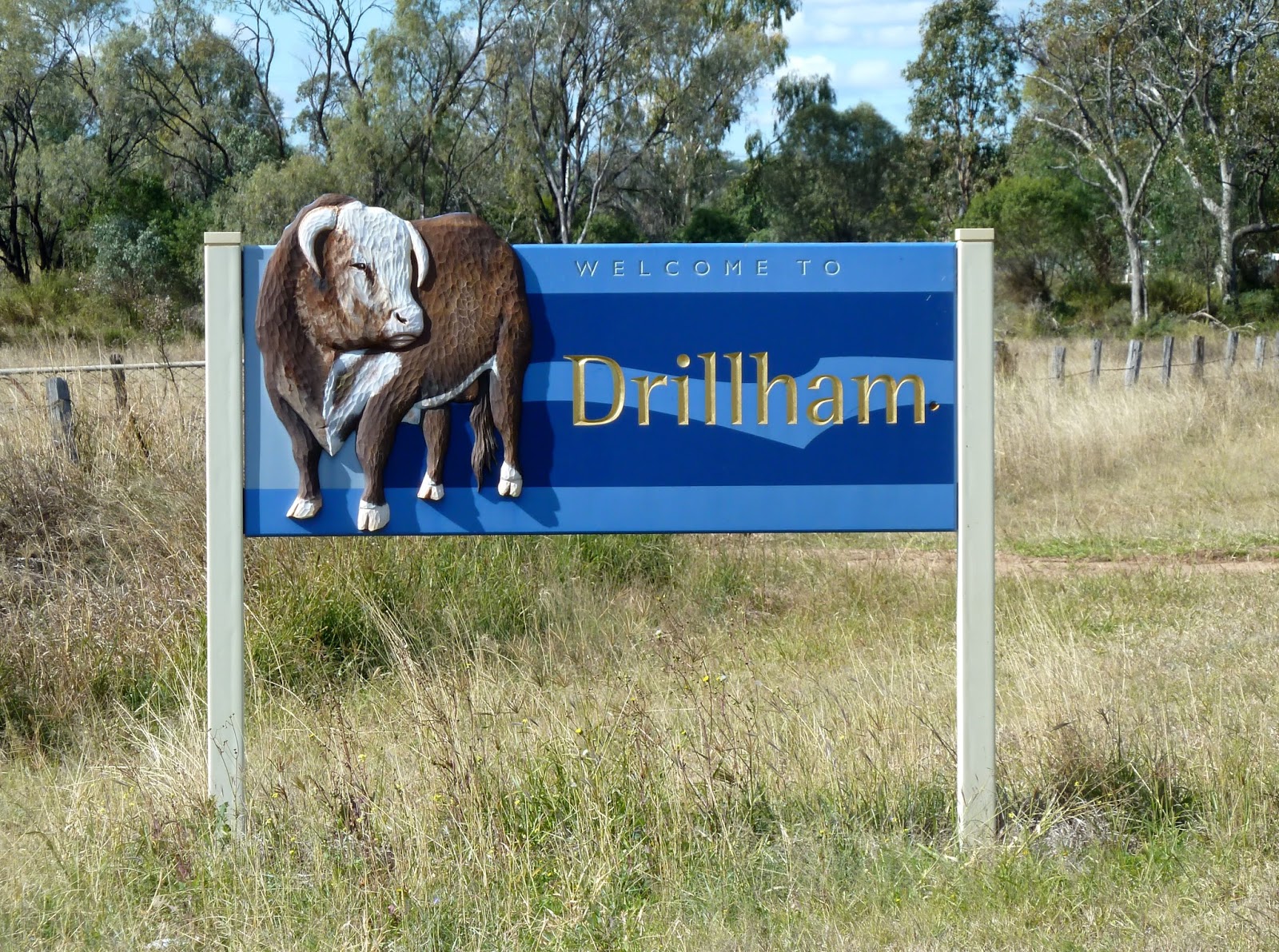
Chinchilla is about 300 km from Brisbane and has a much nicer feel to it, starting with its welcome sign. Here we see our first road train, another theme-to-be.
Not surprisingly, I didn't know the Melon Festival was so renowned. I didn't know there was a melon festival. Chinchilla produces a quarter of Australian melons (including watermelon, rockmelon and honeydew) and the festival began in 1994 to raise the spirits of producers devastated by drought. Its popularity has increased, and now there is melon skiing, melon bungee, melon bullseye, melon ironman, a pip spitting competition and melon head smashing – cracking open watermelons using only the head. The record currently stands at 47 in a minute. Crazy Chinchillians.

There is Miles more agriculture and mining development in the Western Downs. And big numbers still to do. Miles is on Dogwood Creek and was thus named in 1844 by my old mate Ludwig Leichhardt, but then renamed after a Queensland Colonial Secretary, William Miles. The early colonists went in for honouring bigwigs. More nice name signs and big silos follow.
I'd expected Roma, 515 km west of Brisbane, to be bigger than most of the main towns along the highway. I know it has an expanding fly-in fly-out population, and there is evidence of workers' camps, storage yards for heavy machinery, signs to rigs and so on. What I wasn't prepared for was the huge number of Queensland Bottle Trees. They're everywhere, hundreds of them, in the main drag, lining side streets. Remarkable.
We stop for a picnic lunch on the other side. From now on the vegetation is sparser, the road emptier and the towns smaller. The railway is still with us.
Advice for Outback drivers includes a warning to watch out for kangaroos active at dawn and dusk. We've seen several dead by the roadside for the past few hours, but onward from Mitchell – 587 km west of Brisbane and 176 east of Charleville – it's carnage. Unfortunately this is something we're going to have to get used to. We come across our first live one standing in the road at 3.45 pm, 28 km from Charleville. So much for dusk. We cut our speed, even though progress has been hampered by extensive roadworks. They add at least an hour, if not more, to our journey time today and we'd quite like to get there now.

But then, big excitement. My friend spots our first echidna in the wild, on the verge. As we screech to a halt and turn around, he's crossing the road painfully slowly: the image below is blurred not by his speed but my excitement. I anxiously watch the road for trucks. Do you think they'd stop if I stood in the middle flagging them down? Our spiny friend makes it but he's aware of us now; he stops and hunkers down. We have to take his picture quickly before leaving him alone so he'll head for the undergrowth and safety.
And, a few minutes later, a Major Mitchell's Cockatoo, unfortunately with no photograph to prove it. I spot it high in a tree by the roadside with another bird I can't identify as we pass. Major Mitchells are restricted to arid and semi-arid areas and their range is contracting as a result of their favourite woodland habitats being fragmented by land clearance. Later, we are assured we'll see more of these distinctive birds.

Finally, a welcome sign. I can't help looking back for a moment, however. We head straight for our accommodation.
A few years ago, I typed 'the best place in Australia to view the night sky' into Google. Charleville was the answer. In 2010 we had a weekend booked – what a helluva drive there and back in a weekend – but had to cancel because of a cloudy forecast. At last, tonight, we're booked in at the Cosmos Centre at 7.30. Cloud has been building since later afternoon, but I know it can often clear by evening. We head to the Cattle Camp Hotel for a delicious steak (but too few chips) and a Barossa Cab Sav. We've just ordered when I get the call: tonight's viewing of the heavens has been cancelled. I rebook for tomorrow night, after the Bilbies! When we leave the pub at about 7.45, large areas of the sky are clear and many stars are blinking at us. I can see the Milky Way from the middle of town there is so little light pollution. Tomorrow is another night.


June 7, 2013

How to reduce electricity bills

I'm sick to death of people banging on about the cost of electricity here. It is always top of the agenda in the cost-of-living debate. I would be less cross if that debate ever included even the smallest reference to the environmental impact of high energy usage, but it doesn't. Complaints singularly focus on Australian pockets with ne'er a mention of carbon footprints.

Electricity price increases have just been announced in Queensland – as much as 22.6 per cent for some households. Premier Campbell Newman had promised a $100 electricity rebate, but his government was not able to balance the books in quite the way they'd planned, so an increase was, they suggest, unavoidable. The style of the State Government is to blame others for their own inability to deliver, but unfortunately this time they couldn't agree among themselves who the culprit should be.

Treasurer Tim Nicholls blamed the cost of maintaining the network infrastructure; Energy Minister Mark McArdle blamed the Federal Government's carbon pricing scheme*. Collectively they blame anyone who's incentivized or subsidised solar power uptake: the Federal Government's rebates, incentives and subsidies to facilitate the installation of solar panels; the former State Government for setting a solar feed-in tariff** that the current government has to honour; and, by default, anyone installing solar power.

The Queensland Government owns the transmission and distribution sectors of the electricity industry. It could, if it wanted to, tell network operators to write off infrastructure spend to keep costs down, or to lower their profit margins.

You might have expected them to consult the (independent) Australian Solar Council when appraising the costs of electricity, since the solar feed-in tariff is subsidised by all electricity users, but they did not, according to CEO John Grimes.

Governments' only way of interesting the majority of Australians in going green is the carrot of cheaper electricity: saving the planet appears to be a side issue. I doubt Dennis (top) is thinking too much about reducing carbon emissions.

In this, the sunniest continent on earth, there is a reluctance to embrace renewables that is truly staggering; to the extent that those Queenslanders who over the last few years have saved and invested heavily in a low-carbon energy future are now being demonised in order to absolve a government that is still wedded firmly to fossil-fuel resource development and power generation.

The most straightforward way of cutting power bills is to use less energy. Australians have ample scope to do this: Australia is gadget land, after all. Lifestyle choices are going to be compromised in the very near future by society's need to curb energy consumption and hence carbon emissions. Then we will be forced to do this by governments: we should be doing it now, responsibly and willingly. Get used to the idea. Here are some suggestions.

• Hang your wet washing on a clothes airer on the balcony or in the yard. If you're in Queensland, it'll dry more quickly most days than in your power-hungry dryer in the laundry room.
• If it's chilly while you're having a barbie, fling on a sweater or a jacket rather than using outdoor heating. It's not a constitutional right that you should be able to do everything in all seasons and weathers dressed only in T-shirt, shorts and thongs.
• Sweep leaves up rather than blowing them to another part of the driveway/garden.
• Trim the hedge using a pair of manual shears or hedge clippers.
• Trim the lawn edges with a pair of long-handled shears or a half-moon edging tool.
• Mow the lawn using a manual hand push mower. You'll get fit at the same time.
• You don't need a high-pressure water hose to clean your front steps. Use a brush and a bucket of water.
• Tell the body corporate that you don't need the pavement outside steam-cleaned; that you can walk through the lobby for five seconds without it being kept at arctic temperatures.
• Don't automatically reach for the air con control if you're too warm. Open the windows back and front so you get a through breeze.

Listen to the wind, man, rather than the thrum of machines.

* carbon pricing appears to have successfully helped to reduce electricity consumption: http://www.businessspectator.com.au/article/2013/6/5/energy-markets/no-sign-end-falling-electricity-demand?utm_source=exact&utm_medium=email&utm_content=
310397&utm_campaign=cs_daily&modapt=
** a premium rate paid for electricity fed back into the mains grid 


June 4, 2013

Ready for the off

The preparations for our trip to the Channel Country and Far West and Central West Queensland have been more extensive – and more expensive – than for any other trip.

What the Aussies don't know about trips of this nature isn't worth knowing, so it's best to listen to their advice and follow their recommendations. We have spent a number of hours at ARB, whose 4x4 accessories are 'designed tough to withstand the harsh condition of the Australian Outback'. They advised us about fridge-freezers, maps and radios, among other essentials.

Months ago, we debated about fitting bull bars, but decided against it for fear of compromising certain safety features on the car, although the jury may still be out on that, I think. Also, if you watched Kangaroo Dundee, you'll appreciate how the affable Aussie character who rescues joeys from their road-killed mothers' pouches probably tipped the balance against bars on the car. Call me a softie pommie if you will, but I'd rather drive for longer hours at slower speeds than have to deal with roo remains. Land Rover UK rather unhelpfully didn't respond to our questions. Instead we are fitting sonic animal guards, devices that emit high-frequency sound waves to warn animals away from moving vehicles. I suspect we will only know for sure if they don't work.

The absence of roo bars and the fact that the bonnet (hood) of the car folds over the wings meant fitting an aerial to increase the range of our UHF CB radio was something of a challenge. We now have one, but I promise you a fishing rod holder will not be next on our accessories wish list.

We have a lot more paraphernalia accumulating than usual before a road trip. There is a boys' bag, containing torch, a tool roll, rope, ratchet straps, WD-40, spare batteries and bulbs, electric cable, spare gas canister, catapult and jar of small stones! We have acquired a 22-litre jerrycan, an 'adventure' (gas) lantern, a high-performance gas stove and aluminium kettle. So, if we get stranded or lost, at least we can have tea while attempting to ward off unwelcome critters*.
We've had the driving-in-sand tuition, and a few weeks ago ventured into Landcruiser Mountain Park (top), serious off-road territory. But you can never be sure you've covered all eventualities. I have to check Bulloo Shire road condition updates as late as possible before departure on Saturday. We're hoping to use a few minor tracks to reduce daily distances and free up more time for exploration, but they'll be out of the question following heavy rain. This region isn't called the Channel Country for no good reason.

We have 1:250,000 topographic maps of the whole of Australia installed on our iPad. And we have a GPS receiver. My friend has set up EOTrackMe online so friends and family can locate our destinations and see how far we've progressed – or not. A Brisbane pal has a list of all accommodations  from which I will check in, technology permitting, upon arrival.

Just to add a frisson of concern during the few days prior to departure, we ordered a number of spare parts a little late and they still haven't arrived from Europe**. If they get here in time, there'll be another bag in the back of the car for fan belt, radiator hoses, air filter, tyre repair kit, bulbs and fuses, break oil, power steering oil and radiator coolant. Three more days...

I think we've done most of the things you're supposed to do to avoid mishap in remote regions. However, no amount of preparation will save us from obscurity if we happen too closely upon the Min Min lights. And if you don't know what they are, then you'll just have to read my Outback posts over the next few weeks.

* I'm actually not really sure why there's a catapult in the boys' bag
** they've arrived!
This post was last updated on 7 June 20113


May 31, 2013

Seeney's war

It is to be hoped that the Senate will soon pass the Gillard Government's legislation ensuring that the cumulative effects of coal seam gas mining on water resources will, finally, be investigated and considered as part of the approval process for future CSG resource development rather than after the event.

Water has always been a big issue in Australia. Beleaguered farmers working prime agricultural land have long argued that groundwater baseline studies are necessary before mining companies with exploration leases even think about drilling wells or excavating mines. Independent MP Tony Windsor, whose constituency includes rich agricultural land under threat from miners in New England, New South Wales, introduced a 'water trigger' amendment to the Government's bill so that final approvals for CSG wells must be the domain of the Commonwealth, not state governments.

Jeff Seeney is Deputy Premier and Minister for State Development, Infrastructure and Planning in the ruling LNP Coalition in Queensland. He is not a personable man: he always look a bit lip-curly; he smiles infrequently; he talks to journos and broadcasters with a hint of derision. When he's interviewed in his constituency of Callide, a large electoral division including key farming regions such as the Burnett as well as mining towns, he wears an Akubra (iconic bush hat) and a cattleman shirt. Until 2008 he was a member of the National Party. Are you getting the picture?

Mr Seeney doesn't like 'green tape'. It prevents the LNP government from doing what it wants to do, whether that is approving more mines or coal exporting ports, allowing cattle to graze in national parks, permitting farmers to clear more native vegetation, or freeing up the commercial dumping of other states' rubbish in Queensland.

This week he has revealed what he really thinks about people who are concerned about the above. He encouraged oil and gas companies to stand up to the efforts of environmental groups, whom he accused of trying to delay and halt every project in the resource sector. He was addressing the Australian Petroleum Exploration and Production Association in Brisbane on Wednesday.
'We see it daily in Queensland where every proposal for development is portrayed as a threat that will lead to total destruction of the Great Barrier Reef. Not only is it claimed that LNG plants in Gladstone harbour will kill the Reef... port development, wherever it is proposed, will apparently kill the Reef.
New mines, hundreds of kilometres inland, will kill the Reef.
Even ships carrying bauxite from the other side of the Cape will kill the Reef.
Take up the fight against the radical greens campaign... because it has the potential to cost your industry many times more [than the mining super profits tax].'
This is the man, of course, who stated in the early days of the LNP state government that the Great Barrier Reef was hundreds of kilometres away from Gladstone.

He has many allies in the Federal Opposition, too. Coalition resources spokesperson Ian Macfarlane has declared, should they come to power in September, they will 'get around' the new legislation and hand over environmental assessment procedures solely to the states, although standards will be determined by the Commonwealth.
'We'll delegate approvals to the states. We already have an expert panel to assess water impacts. Labor is assuming the state governments are incompetent and don't have processes in place to deal with it.'
I assume he was referring to the Independent Expert Scientific Committee on Coal Seam Gas and Large Coal Mining Development set up in November 2012 as part of amendments to the Environment Protection and Biodiversity Conservation Act (1999). This was in response to community concerns about the 'critical gaps in scientific understanding of the water-related impacts associated with coal seam gas and large coal mining activities'. The committee was announced after Tony Windsor and another Independent, Rob Oakshott, obtained Julia Gillard's commitment in return for their support for the Government's Mineral Rent Resource Tax, aka the mining tax.

I'm pleased that Mr Macfarlane has such faith in the Expert Scientific Committee. I hope he recommends it to Jeff Seeney. Under the Coalition's proposals to hand back approval of EISes to the states, how will he, or the Queensland Government, ensure the standards set out by the Committee are adhered to in future? A grand idea is all well and good, but a management plan must be put in place to monitor progress and results in the form of hard data.

Meanwhile, Mr Seeney moves on to mine water releases and Gulf water resource planning. Is anything safe on his watch?


May 30, 2013

A funny thing happened on the way to Cooloola

Cooloola Beach is one of my favourites. It resembles the long, long beach on the eastern side of Fraser Island but with not as many people, less rubbish and few or no dingos to worry about. (I don't mean I'm frightened of dingos; I'm talking about the stress of seeing them lean and hungry, skulking around car parks in search of food because they're prevented from roaming freely in their natural habitat by overzealous interventionist policies by National Parks rangers.) I say 'less rubbish', but that was until last Sunday.

Maybe I should be calling it Teewah Beach. Cooloola refers to a large recreation area that extends from south of Rainbow Beach town to Double Island Point, down to the Noosa River and west to parts of the Great Sandy National Park where there are long-distance walks by dunes, open heathland, Banksia and Scribbly Gum woodlands, rainforest remnants and freshwater lakes. On one map I have, however, the northern half of this extensive sweep of beach is called Cooloola and only the southern part is Teewah. I've always called it Cooloola. Please put me straight if you know.

Following a couple of days in Rainbow Beach, we decided to return to Brisbane via Teewah Beach and the Tewantin ferry across the Noosa River. We accessed the beach along Freshwater Road from Rainbow Beach Road, and a most pleasant drive through the forest it was. But the beach looked vastly different from previous visits. Extensive mounds of pumice lay along virtually the whole of its 40 kilometres; there were large amounts of other debris ranging from small bits of plastic in a rainbow of colours to lengths of string to thongs, wooden flotsam and larger pieces of plastic. All in all, it wasn't pretty. Scum was the word that came to mind. On my beautiful Cooloola.
The beach had been badly eroded, too. The entrance to Red Canyon (below) used to be a gradual incline. Lots of Casuarinas lay uprooted and fallen on the sand. The foredune area had been inundated and in the undergrowth a wave of material extended along the highest tide mark. It reminded me of tsunami creep.
So, what was going on? Large ocean swells of up to 2.5 metres had combined with higher than usual tides (over 2 metres) over the weekend – and were expected to continue until midweek. The Department of National Parks (Recreation, Sport and Racing) issued an alert on Monday about conditions on the beach and in campsites. They estimated the pumice was up to 30 cm thick in places. There was another hazard to be negotiated on Noosa North Shore where much more coffee rock than usual had been exposed by the removal of sand. Fortunately, we were travelling down at low tide**.

Coolum Boardriders Club reported back at the beginning of April that they'd noticed a lot of pumice washed up on the beaches of both the Sunshine and Gold coasts as well as drifting offshore. They speculated that it had originated in underwater volcanic eruptions off Indonesia and in the western Pacific and had been carried south by ocean currents before being cast up on the beach by storm surges or large swells and tides. Some pieces had sea growths on them and others were quite round, suggesting they'd been around a while. While most of the pumice was light grey, some was black. Curiouser and curiouser.

The Queensland coast usually experiences damage to beaches during cyclones, when huge waves are generated by strong onshore winds. If large waves coincide with high tides then erosion is far greater. If a cyclone is severe, more than 400 cubic metres of sand per metre of beach may be removed and the beach recede by 50 metres.

But back to the pumice. I would like to know if there's been a pumice deposition like this before. And exactly where it's come from. And whether the Parks Department think it will gradually be removed back into the ocean. And whether all the sand eroded away will eventually be redeposited back on the beach or will visitors to Red Canyon need stepladders in future. I am on the case*.

Cooloola was, of course, still beautiful. But there was an awful lot of pumice.

Post script I contacted Queensland Parks & Wildlife Service, who were very helpful and consulted a coastal scientist on my behalf. He confirmed that pumice is commonly deposited on beaches. Local wind and wave conditions may result in concentrations on some beaches. The pumice may become buried in the dunes as they rebuild and then released during the next erosion event. There has been a lot of erosion in recent times in this region. On being shown the photograph of the dune scarp at the entrance to Red Canyon, he surmised that the pumice may well have come out of the scarp face. In the past he has seen pumice layers up to 150 mm thick in dune scarp faces.

** Get your tide tables here: http://msq.qld.gov.au/Tides/Tide-tables-2013.aspx
You cannot drive in Cooloola Recreation Area without a valid vehicle access permit: http://www.nprsr.qld.gov.au/recreation-areas/vehicle_access_permit_fees.html

This post was last updated on 1 June 2013


May 20, 2013

Cows and national parks

There are some people in Australia who want to see national parks opened up for hunters and shooters and now, cattlemen and their stock. The failure of monsoonal rains in Northern Queensland has created a situation in which increasingly hungry cattle are roaming on rapidly developing dust bowls. What is to be done?

The Queensland Government's solution is to let them into national parks to graze, an idea that hasn't gone down too well. The National Parks Association of Queensland is alarmed.
'National Parks are there to conserve our wild animals, plants and landscapes – not to be used as cow paddocks! This is a disturbing move, and currently would constitute a breach of the Nature Conservation Act.'
Federal Environment Minister Tony Burke has gone further, and said no. Another stand-off twixt Feds and State. Last year he stood in the way of the reintroduction of cattle into the Alpine National Park of Victoria.

The cattle farmers of northwest Queensland are not just suffering from a lack of rain. Cattle prices are low and farmers have not recovered their incomes since the temporary ban on live cattle exports to Indonesia in 2011. They allege that Indonesia still lacks confidence in the Australian beef market. Bush fires further added to their woes.

The national parks chosen are not necessarily national parks as we know them. Some may be former grazing lands purchased by the previous State Government since 2010 with a view to increasing Queensland's small percentage of land (compared with other states) given over to national parks. The National Parks Association called for these roughly 400,000 hectares to be gazetted as national parks earlier this month. But the State Government is dragging its feet until a 'scientific' review of all Queensland national parks is complete. That's 12.5 million hectares.

The areas currently earmarked to be used as temporary emergency feedlots are not easy to identify. It is claimed that five national parks and eight reserves are involved. One I have managed to identify is Blackbraes Resource Reserve. This was formerly Blackbraes Pastoral Holding, which was gazetted in 1998. A grazier from near Einasleigh in Northern Queensland has been told she can graze 1000 of her cattle on Blackbraes. (I have no idea what a Resource Reserve is, before you ask.)

There are many arguable aspects of the proposed grazing plan. Many national parks have not been adequately maintained and are overrun by invasive plants species. An uncontrolled undergrowth build-up provides 'fuel' for bush fires that decimate fauna and flora. In theory, grazing animals help to reduce weed infestations. The Government claims that what they are proposing will be a temporary measure, for six or 12 months, so damage by the cattle would be minimal. The RSPCA is in favour because of the animal welfare issues: 25,000 cattle may have to be culled if farmers cannot feed them.

Government-subsidised food could be dropped for starving cattle, but short-term temporary measures are not the answer. Greens Queensland Senator Larissa Waters claims the Government is not addressing the longer-term problems for graziers of climate change.

And then there are those who believe farming practices in Australia need complete overhaul in terms of fertility maintenance and water management. Peter Andrews, grazier and racehorse breeder, knows all about resuscitating run-down grazing properties and restoring fertility to parched land. He calls his methods natural sequence farming, and his book Back from the brink: how Australian's landscape can be saved should be essential reading for rural landowners.

There is no reason why responsible grazing cannot be combined with the successful conservation of Australia's rich biodiversity. It happens at Bimblebox Nature Refuge, for instance. Privately owned productive land has long been recognised for the important role it can play in landscape conservation and is at the heart of the National Reserve System*.

The current plight of Bimblebox illustrates, however, that even when corrective measures are in place, big bucks and weak governments combine to render them meaningless. Cattle and shooters roaming through national parks; mining companies devastating nature refuges; they amount to carelessness with this country's remarkable landscape.

* http://www.environment.gov.au/parks/nrs/about/protected-areas/index.html


May 7, 2013

May Day is Labour Day

Monday 7 May 2012 was Labour Day in Queensland and a public holiday. We had a lovely long weekend in Rainbow Beach.

Yesterday, Monday 6 May 2013, was an ordinary working day in Queensland. Labour Day has been moved to Monday 7 October, by Campbell Newman's government, ostensibly to bring us into line with New South Wales, South Australia and the Australian Capital Territory, and to spread out public holidays more evenly throughout the year.

May Day is traditionally a Northern Hemisphere event with its origins in pagan festivals. It is associated with the end of winter and the beginning of summer, with flowers and fertility, and it is certainly a cause for celebration, often exuberant. These celebrations take many forms: in the UK it's all about dancing with ribbons around maypoles, and May Queens, and baskets of flowers, and more dancing, this time by men wearing bells and baldrics.

In Australia, of course, it's coming on winter. There are, on the other hand, Morris men in every state.

May Day is also marching day, if it's Labour Day and since it's International Workers' Day. The latter originated in post-Civil War Chicago, when workers, many of them immigrants, fought for an 8-hour day. A new law was supposed to come into effect on 1 May 1886. The cause of those who died in the ensuing violence when it didn't materialise was shared with nascent workers' movements in Europe – and Australia – protesting for the rights of unions and immigrant workers. In the US shortly afterwards, a day celebrating the contribution of workers to society was designated later in the year (the first Monday in September) to disassociate it from Socialism, Communism, and the violence of the struggle.

The date of Labour Day in some countries reflects significant events in the history of the labour movement of those countries. It differs from state to state in Australia: in Tassie, for instance, it's the second Monday in March and is called Eight Hours Day. But for anyone of European origin, May Day is Labour Day. It's a strong tradition in Queensland, too. One of the first Labour Day/May Day marches ever held in Australia was in Queensland in 1891, in Barcaldine in the Central West. The Labour Day date started to be moved to different times of year in some states after the Second World War. But only now in Queensland. And the workers aren't happy.

The reasons are spurious. Why would Queenslanders care about being in line with the southern states? They stubbornly refuse to switch to Daylight Saving Time, so for half the year they're in a different time zone. The queen's birthday had already been moved from June to October by the previous State Government, evening out the holidays following a government discussion paper to which the public were invited to respond. But Newman has moved it back to where it was and moved Labour Day instead. Amendments to the Holidays Act (1983) were passed on 30 October 1012 without further public consultation.

So, in many parts of Queensland last weekend, marches and other traditional May Day events took place regardless of what many see as Newman's attack on workers' traditions. For many people in the labour movement, it's the final straw. Thousands of public servants have lost their jobs since he came to power, and now there's talk of public asset sales.

In Barcaldine, the annual Tree of Knowledge Festival saw hundreds turn out for, among other things, the goat racing. In Brisbane there was a march and a rally addressed by PM Julia Gillard. The Queensland Council of Unions claimed that tens of thousands marched, the biggest number in a decade. The Courier Mail, Queensland's only statewide daily newspaper, didn't see fit to even mention the rally or the PM's presence in its online edition yesterday. No need to tell you who the paper's owners are.

Some unions are so unhappy about the change of date that they're planning to protest on the new Labour Day in October and every subsequent May Day weekend until the holiday is reinstated. About 500 gathered noisily outside the State Law building in the CBD on Monday morning. Emotions ran high – and not just among drivers caught in massive congestion on their way to work.

And the name of the winning goat in Barcaldine? Rather appositely for the birthplace of the Labor* Party, it was Up the Mighty Worker. I kid you not.

* the Australian Labour Party was influenced by the American labour movement in its early years and changed the spelling in 1912. It was also considered useful to distinguish the Party from the Australian labour movement