Yesterday was damn hot. The forecasters said it would reach 38C or 39C in Brisbane: in fact, it reached 37.9 at 15.29, 12 degrees above average for South East Queensland. It was hotter elsewhere in the state: the top temp was 43, at Century Mine, which has a splendid name and is the second-largest zinc mine in the world. It is 1760 kilometres northwest of Brisbane.
Since I arrived in Brisbane almost three years ago, it's been 33C, or maybe even 35C, in the summer of 2011, but that extra couple of degrees yesterday seemed to make a difference. The surfaces in my apartment were warm, as if we'd whacked the central heating up; the water coming out of the cold tap wasn't; my computer was definitely struggling; and the crows were quiet. I stayed in all day and wrote about climate change.
It's difficult to convey a sizzling city, photographically: the sky whites out and the high-risers lose detail and colour. This was the view from my cityside balcony at 9 am, 11 am, 1pm and 3 pm, just before the hottest point of the day. It became hazy-cloudy around about lunchtime but, after a slight drop, the thermometer moved on up.
By mid-afternoon there was quite a stiff breeze. I should add at this point that I didn't have the aircon on. We don't do aircon, my friend and I: we might occasionally use a fan, if the going gets really tough. We live on the 5th floor of an apartment block by the river, with wide-opening doors at either end, so the through-draught is considerable. Yesterday it was more like being hairdryered than cooled, however. It was particularly challenging to keep the apartment cool after about 5, by which time the sun was hitting the cityside and the gusty wind meant I couldn't have the blinds down and the doors open. I didn't succeed, and I wouldn't be surprised if you think I was mad to try.
So, was it the hottest December day on record in Brisbane? As far as I can determine, it was the hottest for a decade (40C on 24 December 2001): but the record was 41.2 in 1981. I need to check these figures with BOM.
I think the heat must have affected aircraft navigation systems. I watched these contrails at about 18.30.
December 5, 2012
December 4, 2012
Few reasons to be cheerful
This week has started much like last: with another dire warning that we've done too little too late to curb carbon emissions, and are now looking at global warming of between 4C and 6C by the end of this century, which will be catastrophic. It is twice the degree target UN member countries have been grappling with at previous climate change conferences as they try to limit and then reduce emissions effectively and quickly enough.
So, all those people who were fairly confident that the consequences of failure would not be experienced in their children's lifetimes, now need to reappraise their forecasting.
Today, BOM are forecasting 39C in Brisbane, which would be the hottest December temperature on record.
This time it's the Global Carbon Project delivering the shocking news that global emissions rose by 3 per cent in 2011 and 2.6 this year, despite a relatively weak global economy. And emissions from fossil fuels have reached unprecedented levels, 54 per cent greater than in 1990, the Kyoto Protocol reference year. They are growing three times faster than they did in the 1990s; and 80 per cent of the growth in emissions in 2011 was in China. Dr Pep Canadell, Executive Director of the Global Carbon Project and CSIRO marine and atmospheric research scientist, is one of the authors of the latest report and crunches the key numbers today on the ABC much better that I can. See http://www.abc.net.au/unleashed/4406350.html.
It's nitty-gritty week for the UN Climate Change COP (Conference of the Parties) in Doha, capital of Qatar in the Gulf. If the conference doesn't produce many results, at least they'll be dripping with irony. Qatar has the highest per capita carbon footprint in the world, largely because of air conditioning and water desalination. Electricity and water are free in this tiny desert nation with 15 per cent of the world's gas reserves, so there's hardly any incentive to cut back on either.
Australia is all set to sign up to the second commitment period of the Kyoto Protocol – having not signed up to the first – and confirm its emissions reduction target during the new phase of the agreement from 2013 until 2020. Unfortunately, a Federal minister revealed unintentionally last week that Australia was bringing to the Doha table a reduction target of just 0.5 per cent (of 1990 levels). This is, in fact, consistent with the lowest level of its own projected range of 5-25 per cent (of 2000 levels), but is hardly consistent with the strong international image it wishes to convey – having an example-setting carbon pricing scheme an' all – especially when it's exporting fossil fuels hand over fist to developing economies who aren't signed up to Kyoto. Australia's Climate Change and Energy Efficiency minister, Greg Combet, isn't attending, the team instead being lead by Parliamentary Secretary (Assistant Minister) Mark Dreyfus, who has been present at most of the pre-COP meetings this year so is more than qualified (his press secretary tells me).
(Australia was similarly spineless when it came to the UN vote on the Palestine territories' non-member observer status. Having celebrated its new role on the Security Council, it meekly abstained on this vote along with all the other nations, including the UK and the US, who lack the gumption to stand up to or risk offending Israel, a country that has violated 128 United Nations resolutions. But I digress.)
Most (of the 197) countries are in favour of extending Kyoto into the next phase, although Russia, Canada and Japan have pulled out of the first-round commitment in recent years, and the US and Australia were among others that never joined in the first place. As Australia opts into the second phase, New Zealand will be opting out, thus underlying a fundamental rift that has derailed previous conferences and will doubtless thwart this one: should developing countries, many of them with huge and increasing emissions, be bound by the same emission targets as wealthy nations. China insists it has to continue its economic growth in order to lift millions of its people out of poverty: this time around, New Zealand is not alone in arguing that any new climate pact must include emerging economies. Related to this stumbling block is the issue of how the rich help poor countries with 'climate financing' (the switch to renewables and aid following climate change damage to health, agriculture and their economies in general).
A report, Policy Implication of Warming Permafrost, has been presented to UN delegates at Doha. Scientists have been measuring methane 'leaking' from the Arctic permafrost as it melts, ahead of predictions. Carbon emissions from this phenomenon were not included in either the Kyoto Protocol or certain climate change models because the melt rate was thought to be too slow to be significant. Not any more. And permafrost emissions could ultimately account for 39 per cent of total emissions, according to the report's lead author. For more details, see http://www.smh.com.au/environment/climate-change/where-even-the-earth-is-melting-20121127-2a5tp.html
The World Meteorological Society has published its preliminary findings* on the State of Global Climate in 2012 (the final report will be released in March 2013). Here are just a handful of interesting snippets:
Also worthy of note was a Los Angeles Times report of scientists' bafflement and alarm about a coral reef infection on a Hawaiian island that is killing coral and fish. And, closer to home, the sea turned blood red at some of Sydney's famous beaches last week due to an algal bloom that can cause skin irritation and may be linked to a sudden rise in water temperature.
What is encouraging over the last few weeks is an increased coverage and analysis of many climate-change-related issues. Better still, there seem to be fewer climate-change-sceptics phoning into talkback radio stations with the news that climatic change and extreme weather phenomena are nothing new.
But really, unless Doha can deliver, there's precious little to celebrate.
* http://www.wmo.int/pages/mediacentre/press_releases/documents/
966_WMOstatement.pdf
So, all those people who were fairly confident that the consequences of failure would not be experienced in their children's lifetimes, now need to reappraise their forecasting.
Today, BOM are forecasting 39C in Brisbane, which would be the hottest December temperature on record.
This time it's the Global Carbon Project delivering the shocking news that global emissions rose by 3 per cent in 2011 and 2.6 this year, despite a relatively weak global economy. And emissions from fossil fuels have reached unprecedented levels, 54 per cent greater than in 1990, the Kyoto Protocol reference year. They are growing three times faster than they did in the 1990s; and 80 per cent of the growth in emissions in 2011 was in China. Dr Pep Canadell, Executive Director of the Global Carbon Project and CSIRO marine and atmospheric research scientist, is one of the authors of the latest report and crunches the key numbers today on the ABC much better that I can. See http://www.abc.net.au/unleashed/4406350.html.
It's nitty-gritty week for the UN Climate Change COP (Conference of the Parties) in Doha, capital of Qatar in the Gulf. If the conference doesn't produce many results, at least they'll be dripping with irony. Qatar has the highest per capita carbon footprint in the world, largely because of air conditioning and water desalination. Electricity and water are free in this tiny desert nation with 15 per cent of the world's gas reserves, so there's hardly any incentive to cut back on either.
Australia is all set to sign up to the second commitment period of the Kyoto Protocol – having not signed up to the first – and confirm its emissions reduction target during the new phase of the agreement from 2013 until 2020. Unfortunately, a Federal minister revealed unintentionally last week that Australia was bringing to the Doha table a reduction target of just 0.5 per cent (of 1990 levels). This is, in fact, consistent with the lowest level of its own projected range of 5-25 per cent (of 2000 levels), but is hardly consistent with the strong international image it wishes to convey – having an example-setting carbon pricing scheme an' all – especially when it's exporting fossil fuels hand over fist to developing economies who aren't signed up to Kyoto. Australia's Climate Change and Energy Efficiency minister, Greg Combet, isn't attending, the team instead being lead by Parliamentary Secretary (Assistant Minister) Mark Dreyfus, who has been present at most of the pre-COP meetings this year so is more than qualified (his press secretary tells me).
(Australia was similarly spineless when it came to the UN vote on the Palestine territories' non-member observer status. Having celebrated its new role on the Security Council, it meekly abstained on this vote along with all the other nations, including the UK and the US, who lack the gumption to stand up to or risk offending Israel, a country that has violated 128 United Nations resolutions. But I digress.)
Most (of the 197) countries are in favour of extending Kyoto into the next phase, although Russia, Canada and Japan have pulled out of the first-round commitment in recent years, and the US and Australia were among others that never joined in the first place. As Australia opts into the second phase, New Zealand will be opting out, thus underlying a fundamental rift that has derailed previous conferences and will doubtless thwart this one: should developing countries, many of them with huge and increasing emissions, be bound by the same emission targets as wealthy nations. China insists it has to continue its economic growth in order to lift millions of its people out of poverty: this time around, New Zealand is not alone in arguing that any new climate pact must include emerging economies. Related to this stumbling block is the issue of how the rich help poor countries with 'climate financing' (the switch to renewables and aid following climate change damage to health, agriculture and their economies in general).
A report, Policy Implication of Warming Permafrost, has been presented to UN delegates at Doha. Scientists have been measuring methane 'leaking' from the Arctic permafrost as it melts, ahead of predictions. Carbon emissions from this phenomenon were not included in either the Kyoto Protocol or certain climate change models because the melt rate was thought to be too slow to be significant. Not any more. And permafrost emissions could ultimately account for 39 per cent of total emissions, according to the report's lead author. For more details, see http://www.smh.com.au/environment/climate-change/where-even-the-earth-is-melting-20121127-2a5tp.html
The World Meteorological Society has published its preliminary findings* on the State of Global Climate in 2012 (the final report will be released in March 2013). Here are just a handful of interesting snippets:
During the first ten months of 2012, above-average temperatures affected most of the globe’s land surface areas, most notably North America, southern Europe, western and central Russia, and parts of northern Africa. However, cooler-than-average conditions were observed across Alaska and parts of northern and eastern Australia.
Across parts of Australia, maximum temperatures were well-above-average from August onwards. Of particular interest, Evans Head had a maximum temperature of 41.6°C on October 20th, the highest October temperature on record for any coastal New South Wales site. Meanwhile, Birdsville had its earliest spring 40-degree day on record when it reached 40.6°C on September 20th.
After extremely wet years in 2010 and 2011 associated with La NiƱa, precipitation returned to near-normal over much of Australia in 2012... The April–October precipitation total, nationally, was 31 percent below normal, the 11th lowest on record. Regionally, Western Australia had its third driest April–October on record. A number of sites in the interior of Western Australia and northern South Australia received less than 10 millimetres in the seven-month period. An indicator of the dry conditions was that no rain fell at Alice Springs Airport in the 157 days from April 25th to September 28th, the longest rainless period in the site’s 71-year history.
After having its driest March on record, the United Kingdom had its wettest April and June on record. The wet weather continued through the summer, which turned out to be the nation’s wettest since 1912.
The Arctic reached its lowest sea ice extent in its annual cycle on record on September 16th, 2012 at 3.41 million square kilometers. This value broke the previous record low set on September 18th, 2007 by 18 percent and was 49 percent or nearly 3.3 million square kilometers below the 1979–2000 average minimum... The difference between the maximum Arctic sea ice extent on March 20th, 2012 and the lowest minimum extent on September 16th was 11.83 million square kilometers—the largest seasonal ice extent loss in the 34-year satellite record.Not directly related to these findings, but of course inexorably linked, is the publication of Tim Flannery's Quarterly Essay, After the Future: Australia's New Extinction Crisis. You can read an extract at http://www.smh.com.au/national/dead-and-dying-our-great-mammal-crisis-20121116-29hi9.html?skin=text-only. The dramatic collapse of some of Australia's distinctive flora and fauna populations is down to many factors, but a species struggling because of loss of habitat is not going to be helped by serious change in the weather.
Also worthy of note was a Los Angeles Times report of scientists' bafflement and alarm about a coral reef infection on a Hawaiian island that is killing coral and fish. And, closer to home, the sea turned blood red at some of Sydney's famous beaches last week due to an algal bloom that can cause skin irritation and may be linked to a sudden rise in water temperature.
What is encouraging over the last few weeks is an increased coverage and analysis of many climate-change-related issues. Better still, there seem to be fewer climate-change-sceptics phoning into talkback radio stations with the news that climatic change and extreme weather phenomena are nothing new.
But really, unless Doha can deliver, there's precious little to celebrate.
* http://www.wmo.int/pages/mediacentre/press_releases/documents/
966_WMOstatement.pdf
November 30, 2012
A candle for Campbell
I was listening to talkback radio yesterday morning. The voters of Yeerongpilly were asked to say whether or not they supported their 'rogue' MP, Carl Judge, who has fallen foul of LNP bigchiefs in the 'Party Room'. Only one, a lady, rang in to say that, although she didn't carry a candle for the LNP – I think she may have confused candles and torches – she thought Campbell Newman & Co were right to deal firmly with recalcitrant backbenchers. In the middle of her comments, however, gremlins scrambled her phone so we couldn't hear a word.
If you voted for Newman et al last March – and you're a good Aussie catholic to boot – you might like to light a candle for him today. It sounded to me like one almighty intervention on that phone. At the very least, it was an ominous omen. Newman flew off on a trade mission to India today, leaving the charmless Jeff Seeney in charge, whose demeanour is unlikely to woo moaning minnies back into the fold. He doesn't appear at all concerned about losing three Members in as many days: so maybe they were right to complain.
Carl Judge isn't the first. Earlier in the week, Condamine MP Ray Hopper left the LNP to join (Bob) Katter's Australia Party because, he claims, backbenchers aren't being listened to. And then the former chairman of the important Ethics Committee and Member for Gaven on the Gold Coast, Alex Douglas, got into a spat with Newman about whether he'd wanted to stand down or whether he was persuaded. Carl Judge was 'dis-endorsed', allegedly for refusing to pledge allegiance to the Premier.
Will Judge and Douglas now become Independents? A much worse scenario is that they will tip big-noise resource investor Clive Palmer over the edge into forming a new political party. He has convinced himself that a quarter of Queenslanders would vote for him. Dear gods. A couple of days ago he held a press conference on the steps of the Parliament building in Brisbane to announce he would make a decision over the weekend. Am I the only person who thinks it outrageous that Palmer should use such a location to entertain the media? Is this privilege extended to all mining company bosses?
Meanwhile, among the Feds in Canberra, it was also the end of term. If you thought Parliamentary conduct has been abysmal during the last few months, this week it reached new depths. The Opposition Deputy, Julie Bishop, went into Groundhog Day mode as she repeatedly asked the same question of Julia Gillard at PM's Questions, demanding an explanation of Ms Gillard's alleged involvement, as a young lawyer, in the setting up of a union slush fund. The words sleaze and smear (pronounced smee-ah in Aussie) were overused this week. Leader Tony Abbott sat impassively as his number two generated her own sleaze, by inconsistently accounting for conversations with one of the chief protagonists in the union mire, thereby undermining her case against the Prime Minister.
In poll after poll, Australian voters register their disillusionment, disaffection and disinterest with regard to pollies of all parties. Political commentators decry the lack of talented, charismatic leaders. There will be a federal election next year. Let's hope that nationally the electorate doesn't follow the example of Queenslanders last March who were desperate for a change but didn't think through the alternative. Nine months later, serious cracks are appearing.
2012 is a year in politics here that most people will want to forget. There is now a long holiday for everyone: in Australia the end of the calendar year is the end of the school year and the political term. Let's hope when the politicians return they can raise their game and deal with some of the real and massive issues that they're there for.
This post was last edited on 1 December 2012
Reflections on the Daintree
The rivers of the world are a rich source of fantasy. Long before you might get to see them in reality, you've already got an idea in your head; a vision based on movies or history or travel ads. It might be because they form borders – the Rio Grande, the Jordan or the Indus; they're grand old working rivers – the Rhein or the Thames; they are steeped in history – the Tigris-Euphrates, the Nile or the Kwai; they're among the longest on the planet – the Amazon or the Yangtze; they provide the most romantic setting – the Seine or the Danube; or they're subject to catastrophe or conflict – the Ganges, Huang He and, closer to my current home, the Murray-Darling.
The Daintree mightn't be on everyone's list of world-renowned rivers, but if you find yourself in Far North Queensland and only do one thing, visit the Daintree River, preferably to float on it. It was named after Richard Daintree, a British geologist and gold prospector who surveyed geologically and collected plants in Northern Queensland in the mid-19th century. James Cook completely missed it, and it wasn't discovered until 1873 by European gold diggers, principally George Dalrymple, a Queensland gold field commissioner.
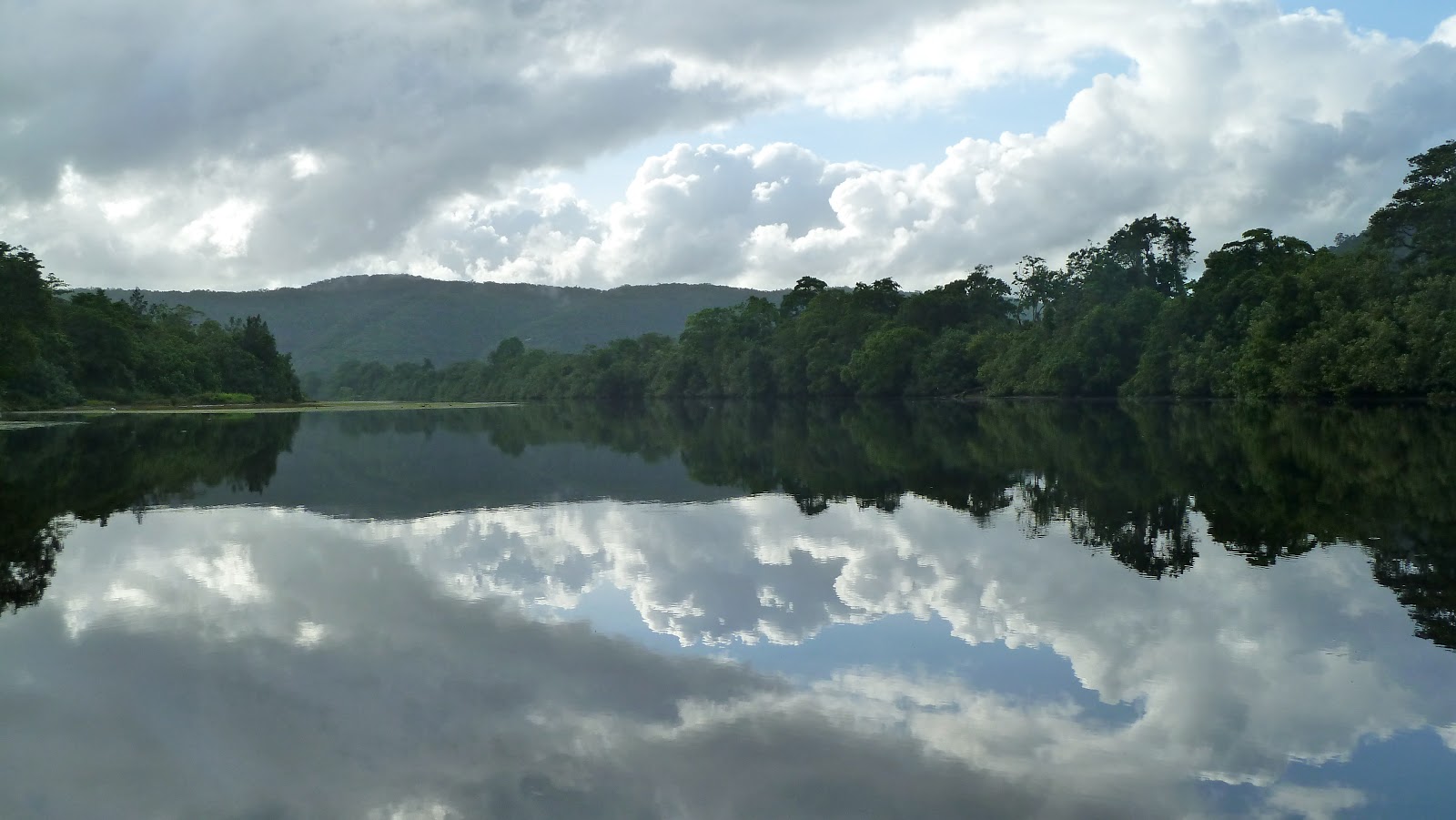
We got up at 04.30 in order to be at Ian 'Sauce' Worcester's boat, at Daintree Village jetty and the end of the road, by 6*. It was a beautifully peaceful morning, with misty whisps: just perfect for observing busy birds. (Male Papuan Frogmouths sat still as twigs on their nests, but they were the exception.)
And the birds? Where do I start? Below are an Azure Kingfisher, Shining Flycatcher, Royal Spoonbill, Cotton Pygmy Geese, Spangled Drongo, Brown-backed Honeyeater, Golden Oriole, Papuan Frogmouth and Darter.
We also saw, or heard, Torresian Imperial-pigeons, Welcome Swallows, White-rumped Swiftlets, White-breasted Woodswallows, Large-billed Gerygones, a Black Bittern, Eastern Koel, Dotterel, Yellow-spotted Honeyeater, Helmeted Friarbird, Latham's Snipe, Whistling Kite, Nankeen Night Heron, Little Egret, Yellow-bellied Sunbird and Shrike-thrush (once again, I don't know which one).
If you love birds, this is the place for you. There isn't much Sauce doesn't know about the birds of this region. (But even he got excited about the Cotton Pygmy Geese.) He told us that, of 11 Kingfishers in Australia, 8 of them live in the Daintree; that the bubbles in the river were from rotting vegetation (no coal seam gas up here... yet!); that a White-rumped Swiftlet spends 90 per cent of its life on the wing and shuts down half its brain for periods in order to 'sleep' (rather like a whale, I thought); that Gerygones are Australia's smallest birds and bathe in dew drops that collect on leaves; that the call of the Golden Oriole is the sound of the tropics; and that the winter of 2012 has been the longest, driest and coldest he has ever known (he would be beyond retirement age if he didn't have such a wonderful job).
Drive the 12 kilometres downstream from Daintree Village to the river crossing. There are no bridges; only a small cable ferry that plies back and forth unhurriedly. The Daintree forest became World Heritage Listed in 1988, despite resistance from the Queensland state government and the timber industry. It may have stopped the loggers but unfortunately not the real-estate developers. There is a Buy Back and Protect Forever Project that deserves support**. The Daintree is an ancient, magical world of dense dark forest, spectacular ferns and fan palms, yet more glorious coast and unique creatures. But it is a fragile environment that is probably in more danger than ever. You'll see notices advising you to leave no trace, should you have the privilege to visit. Please take heed.
November 27, 2012
How will I live without them?
A couple of friends have moved on from Brisbane in the last few weeks, and more are scheduled to leave next year. It gets you thinking about how you'll feel when it's your turn. Will you be going somewhere where the sun don't shine so warmly on so many days? Will you be able to drive off road across dry deserted landscapes or wander through ancient rainforest reaching for the sky? Or buy good-quality food that has been sourced on the same continent? Or see weird wild things? Will you be able to pop to the beach – and what a beach – when the feeling takes you on the weekend?
I will never take Australian beaches for granted. I still get a thrill when I'm approaching a new one for the first time, along an increasingly sandy path through coastal scrub, with the sound of surf getting louder. There are so many almost ten-out-of-tenners – and I haven't even visited most of them yet. If you're a person who regularly seeks solace by the shore, then you're bound to think, what on earth will I do when I haven't got beaches on my doorstep?
Where will I... get wave therapy to soothe a troubled mind, blow the cobwebs away, monitor the weather, photograph art, collect shells and other treasures, study rocks, conduct sand analysis, scan the horizon for huge and mighty creatures, talk to gulls, feel the power, and stand on one of the planet's most intriguing boundaries. In which golden temples will I worship?
Meanwhile, back in Far North Queensland, beaches like this one lie right by the Captain Cook Highway, often with no name.
And they're rarely this crowded (Four Mile Beach, Port Douglas).
Just south of Oak is Pretty Beach. It was.
And last, but not least, Wangetti.
I have been thoroughly spoilt. For the rest of time.
There is another hazard on the beaches of Far North Queensland, however, as well as stingers and salties. Getting hit on the head by a falling coconut would not be funny. And, by the way, they're not for harvesting.
I will never take Australian beaches for granted. I still get a thrill when I'm approaching a new one for the first time, along an increasingly sandy path through coastal scrub, with the sound of surf getting louder. There are so many almost ten-out-of-tenners – and I haven't even visited most of them yet. If you're a person who regularly seeks solace by the shore, then you're bound to think, what on earth will I do when I haven't got beaches on my doorstep?
Where will I... get wave therapy to soothe a troubled mind, blow the cobwebs away, monitor the weather, photograph art, collect shells and other treasures, study rocks, conduct sand analysis, scan the horizon for huge and mighty creatures, talk to gulls, feel the power, and stand on one of the planet's most intriguing boundaries. In which golden temples will I worship?
Meanwhile, back in Far North Queensland, beaches like this one lie right by the Captain Cook Highway, often with no name.
And they're rarely this crowded (Four Mile Beach, Port Douglas).
Here are a few more we called in at on the drive from Daintree to Cairns.
Rocky Point
Palm Beach/Newell
Pebbly Beach is, of course, pebbly, and the only one of its kind I've come across in Australia. Mixed in with the pebbles in one small area were hundreds of tiny delicate shells. I stalked a bird I spotted sneaking about on the rocks (there were rocks as well as pebbles, but 'Rocky' had already been used, right?). I only realised when I looked at my photographs later that in fact there were two of them. I think they were Wandering Tatlers.
Next up was Oak Beach. The path of totality of the solar eclipse centred on this beach, which is quite a claim to fame. There were numerous stones on this beach that were larger than pebbles. And lots of She-oaks. What I thought for one excited moment might be a Squatter Pigeon turned out to be a Bar-shouldered Dove.Just south of Oak is Pretty Beach. It was.
And last, but not least, Wangetti.
I have been thoroughly spoilt. For the rest of time.
There is another hazard on the beaches of Far North Queensland, however, as well as stingers and salties. Getting hit on the head by a falling coconut would not be funny. And, by the way, they're not for harvesting.
Subscribe to:
Posts (Atom)