November 25, 2012

Escape to the Far North

In the past I've debated the relative concept of Far North as opposed to North (see Roadtrip 1: Heading up North, July 2010). But for the sake of argument, let's just agree that last week I spent three wonderful days in Far North Queensland. It's a special place.

I flew into Cairns and drove straight out again, heading north for Port Douglas along what must be one of the world's most beautiful coastal drives, except it was close to midnight so I barely saw a thing, save when breaking waves glinted in headlights. But I knew the ocean was just there. And within easy reach was the mystical world of the Daintree, an ancient and lush, largely forested world that abuts the Coral Sea in palm-fringed and pale-sanded gems of beaches.

Turning off the Captain Cook Highway for Port Douglas, there's a seemingly endless six kilometres of golf and other resorts. Fine if you like big resorts, but if I were you I'd stay right in the heart of Port Douglas, just off Macrossan (we stayed in The Pavilions apartments) or Wharf streets, with their excellent restaurants and cafes, small shops and still-villagey feel.

The first day was spent researching a suitable location for observing the total solar eclipse the following day, the reason we were here (see A total solar eclipse... not, November 2012). We also booked a Daintree River trip, shopped Macrossan, dodged heavy showers in Anzac Park, and generally mooched around lovely Port Douglas. (Fourth picture below: a young Osprey seemed unperturbed as we walked beneath him at the southern end of Four Mile Beach.)
That evening we ate at Nautilus, which will have its 60th birthday next year. We chose to share the oldest option on the menu – their 35-year-old special, whole Coral Trout dusted with light Asian spices, and crispy rosemary and garlic potatoes. It was delicious but I almost preferred my starter, crisp skin of pork belly with Granny Smith apple soufflé and piccalilli. My friend began with duck ravioli. And, since I seem to going backwards describing this meal, we relaxed before going to our table with a mango daiquiri (above), and drank to a successful eclipse. The restaurant has a deep-in-the-forest feel even though it's just north of the main drag. There were still showers about, but we didn't care, especially while enjoying a Chandon Pinot-based rosé.

As far as the eclipse went, this crescent sun is probably the closest we got to totality visually. But we viewed from a beautiful setting, there was a convivial atmosphere among observers, and the silvery light show was intriguing.
After breakfast we needed a mission so we didn't hear many more people talking about how clear it had been where they were. We headed inland along the Mossman-Mt Malloy Road. It climbs steeply over the Range with views back over the coast to the north. 
Before Julatten we turned right and climbed Mt Lewis Road as far as a grassy clearing and followed a track into the forest. Many of the high rainforest-clad peaks of the Wet Tropics World Heritage Area are not easily accessible: Mt Lewis is an exception. Along the way we came upon some birdwatchers and compared notes. There wasn't much they didn't know about upland rainforest species, and they pointed out Yellow-throated Scrub Wrens (in the centre of the picture below – how's that for camouflage?), a Grey-headed Robin and a Shrike-thrush. We also saw what we're fairly sure was a Lemon-bellied Flycatcher (below but one). 

This was Golden Bowerbird territory and our twitcher friends had heard the call. They went 'off-piste' to track him down and found his bower, but that's not what you're supposed to do. The Golden is Australia's smallest Bowerbird but it constructs the largest bower, which is a display area for the males to attract females. Bowers are made of twigs at the base of two young saplings: the twigs are stuck together with saliva and embellished with moss, lichens, flowers and fruit. The male hangs out on a branch or buttress linking the bowers and struts his stuff, but I've only seen that on David Attenborough.
The forest included huge palms and smaller interesting bits and pieces.
Mr Twitcher gave us a useful tip when I told him we were off to Lake Mitchell on the Mulligan Highway between Mt Malloy and Mareeba. You can pull off the road to view the Lake but you need binoculars to make out any wildlife – and you might have to compete with a van-load of Japanese tourists with far too much equipment. We drove up a dirt road that had gates pretending to be private: the chain and padlock were for show. By the water, big heat contrasted with the shady rainforest.

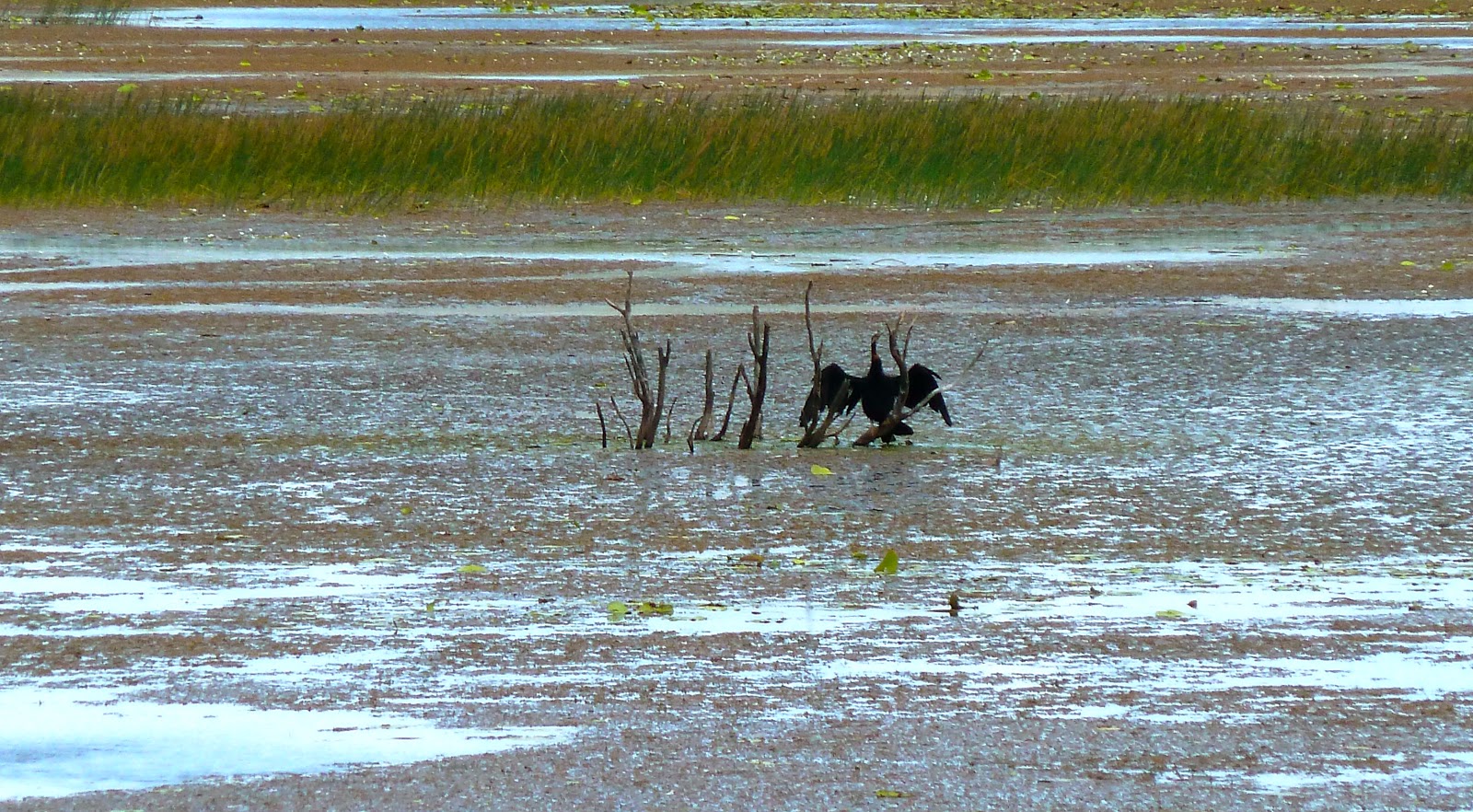
Black swans swam peacefully with Hardhead and Green Pygmy ducks; there were Brolgas and Magpie Geese and Cattle Egrets in their breeding colours; and Darters with wings out to dry.
On the way back to PD we stopped off briefly at the unfortunately named but prettier than expected Abattoir Swamp. Even though there was a bird hide, there were few to see, with the exception of a family of White-cheeked Honeyeaters making a to-do by the boardwalk.
 
That evening we soothed our totality-deprived souls by eating at On the Inlet. We began with Jansz bubbles; shared delicious prawns to start (throwing the debris over the side of the deck to opportunistic fish); I followed with barramundi; and then affogato. As we sat down, the light was fantastic, the White-breasted Woodswallows were cute, and boats were returning to Dickson Inlet. All was well with the world again.
Our last-of-three days started with the second consecutive 04.30 alarm. It was still dark as we set out for Daintree village: we were scheduled to leave on our Daintree River Wild Watch with Ian 'Sauce' Worcester at 6. The magic of this mighty river, however, deserves its own post (see Reflections on the Daintree, November 2012).

After hearty cooked breakfasts and large strong flat whites in the village, we started what was in fact the journey back to Cairns, but we meandered and relaxed and took most of the day. The idea was to visit some tropical beaches that we hadn't visited before; perhaps even sit and read awhile on one of them. We began at Rocky Point (aka Dayman Point) between Wonga, which we visited on our roadtrip in 20120, and Mossman, and ended at Wangetti 50 or so kilometres north of Cairns. For a beachfest, see How will I live without these, November 2012.
We dipped into Palm Cove, Trinity Beach and Yorkeys Knob among Cairns' northern beaches, but – perhaps with the exception of Palm – they're rather too urbanized for me.

I love this part of the world. It's peaceful and distant and tropical and beautiful. As far as I can see, there'd only be one problem with living here – the stingers that would prevent swimming in the sea for a huge chunk of the year, if not all year round, depending on whom you talk to. So it was with reluctance that I flew back to busy Brisbane and South East Queensland, but with the seeds of plans for future long weekends perhaps.

This post was last edited on 26 November 2012


November 18, 2012

A total solar eclipse... not

My Mum was a stargazer who, on cold Northern winter evenings, would take me outside to look at four tiny dots around Jupiter (its Galilean moons) and a slight bump on either side of Saturn's disk which, she explained, was a glorious ring system. The telescope wasn't high magnification and could at best reveal only a fuzz of a nebula in Orion's sword, but it was exciting to explore nevertheless. I went on to study Astronomy as a subsidiary subject at uni, and got my first editorial break in publishing when the Science and the Universe editor took off for India and I was the only person who could tell whether photos of constellations and cosmic phenomena had been flopped!

My Mum always wanted to see a total eclipse of the sun, and I promised at a young age to take her to the tip of Cornwall on 11 August 1999 for the first total eclipse in the UK since 1927. It was nine days before what would have been her birthday; but she'd died nine years before the eclipse. I didn't go without her – it didn't seem the same, somehow. The weather was typically August holiday weather: few spectators had a cloud-free eclipse experience. I watched with colleagues on Waterloo Bridge in London where, despite 96 per cent totality and high cloud, it remained disappointingly light. The quality of the light was strange, however; nothing like it is at sunrise or sunset. It's often described as metallic, or silvery: it's unique, for sure. And I was surprised to see the event revealed in shadows on the ground: beneath leafy trees there were crescent shapes as the gaps between leaves acted as pin-hole projectors.

Long before we knew we were coming to live in Brisbane, we'd planned a holiday in Far North Queensland to coincide with the 2012 total eclipse. Once here and settled, I got down to planning our eclipse trip to Port Douglas. Some accommodation was already booked out, by mid-2010.

I'd realised from the outset that mid-November is on the verge of the Wet, and that cloud might be a spoiler. But I dismissed it from my mind. Not in the Sunshine State, surely? The weather forecast looked a bit iffey the week before. But there's none so deaf as those who don't want to hear. On Tuesday, Four Mile Beach looked more like the northwest of Scotland than Far North Queensland; but I couldn't believe things wouldn't go according to plan the next morning. When I posted the picture below a friend advised me to go inland; she warned me against meteorological unpredictability in Port Douglas. But I fancied the idea of watching the eclipse from a stunning palm-backed tropical beach rather than taking my chances along some highway heading inland to Mt Carbine (Mt Carbine?!). We'd read that it was better to view from (low down on) the coast. Locals only told us after the event how clear it had been just a little way up the Mowbray River. We were about to make a monumentally wrong decision.
Wednesday morning was still dark as we drove past people heading for the northern end of Port Douglas's famous main beach. We drove on empty roads to the southern end, which we'd identified the previous day as our preferred spot. As the sun rose about 5.30, it dipped in and out of clouds dotted along the horizon, but not ominously so, at first. To the south what looked like a storm was headed for Cairns. As the sun rose, we realised we'd missed the start of the eclipse: we caught tantalising glimpses of the crescent sun – through special viewing glasses, of course. My friend was having difficulty with the filter we'd driven to the Gold Coast to procure the previous weekend: it wasn't dark enough.

The countdown to totality became increasingly stressful as the sun appeared sporadically in holes between clouds that seemed to be travelling at the same speed and in the same direction as it was. Suddenly, the light was weird; substanceless, faded. It was getting dark again, barely an hour after daybreak. We couldn't hear if the birds had been silenced; just the sound of waves breaking and a low excitable hubbub. And then it was almost dark. Spontaneous applause broke out among our fellow observers. The eclipse was total, but a great big slow-moving cloud blocked the pièce de résistance that I seemed to have waited so long for. No Diamond Ring Effect; no Bailey's Beads. But bright Venus shone like a gem in a clear patch of sky. 

I can't quite describe the disappointment. It morphed from disbelief to anticlimax to resentment to cheerlessness. I should have fancied champagne with my breakfast: instead, I listened to a couple from Victoria on the next table describe their clear view from Mt Carbine and their enjoyment of their third total eclipse. 'S not fair.

I saw a partial eclipse, which I've seen several times before. I marvelled at the changing light, as I'd done in London. A new aspect did strike me about the phenomenon, however: the sun took on the characteristics of the moon that was concealing it. We were briefly on the beach in moonlight on a partly cloudy night.

My camera could only cope with the sun when it was behind clouds, which really did have silver linings. Below is what I saw... and then I started planning our trip to the US in 2017. It's unfinished business. And hopefully I'll identify a location that will as near-as-dammit guarantee us a completely clear sky.


November 10, 2012

While I was away... again

For the last two weeks I have been comparing sand quality from Sunshine Beach near Noosa in Queensland, to Wategos at Byron and Broken Head in New South Wales, to Torquay Surf Beach and Apollo Bay on Victoria's Great Ocean Road. (Wategos was the winner.) Temperatures varied from 32C in Brisbane to 8 (at night) on the Surf Coast by the Southern Ocean.

My adventures already seem a long time ago. It's been raining in Brisbane for the last 19 hours. But we need it, don't we? My enthusiasm for constant rain, however, wanes in direct proportion to my sunshine deprivation.

The rented house in Torquay had neither adequate heating for the cold nights nor an internet connection. I must confess to enjoying an enforced break from Australian politics. No one could escape news of Hurricane Sandy battering New York, however. Images – real or doctored – of monstrous clouds threatening the Statue of Liberty and torrents issuing from subway lift shafts were redolent of The Day after Tomorrow.
                                                                                                NASA
Inevitably there followed great debate about the superstorm in the context of climate change. The Australian Climate Commission even published a statement. Sandy was the most intense tropical storm (in terms of pressure) ever to hit the east coast of America north of North Carolina. The surface waters of the Atlantic Ocean that fed the storm were 3.5C warmer than usual (source: National Oceanic and Atmospheric Administration). The storm surge – a wall of water pushed on to land by a storm at sea – was enhanced by a high tide but also the fact that the base sea level has risen by 20cm over the last century, and at a greater rate during the last two decades. This may not sound like much but it significantly increases the risk of damaging floods.

The Climate Commission concluded:
'The costs of Hurricane Sandy are and will be massive. Hurricane Sandy highlights the costs of extreme weather events. Australia has also been hit by recent extreme weather events, including Cyclone Yasi and the 2010-11 Queensland floods, which highlight the risks to Australia of very costly extreme weather events. In the future, devastating storms such as Hurricane Sandy and Cyclone Yasi will become much more common unless carbon dioxide levels are stabilised in the atmosphere at safe levels. This requires urgent action on carbon dioxide emissions.'
The Economist has also counted the cost of Sandy. In contrast, they talk about the 'relatively tolerable price tag of the storm', and, like many scientists and journos, are reluctant to directly attribute this particular weather event to a climate that is indisputably changing. But they sum up America's choices in a carbon-challenged world as follows:
'Americans may... decide that the smart choice continues to be a course of inaction. They may decide that the storms – and droughts and heat waves and blizzards and floods – to come will be manageable because they'll be richer and well-equipped to adapt. Hopefully, there will at least be a better sense of what that is likely to mean and the trade-offs it will involve. Adaptation will be an ongoing, costly slog, with a side order of substantial human suffering. It will be one American icon after another threatened. Adaptation is not going to be easy. Hopefully Americans will ask themselves whether it's so much worse than the alternatives – high carbon taxes or large public investments or both – after all.'
It's worth reading the whole article (http://www.economist.com/
blogs/freeexchange/2012/10/hurricane-sandy), and also a Scientific American blog it links to (http://blogs.scientificamerican.com/
observations/2012/10/30/did-climate-change-cause-hurricane-sandy).

The other big big news was also from the States: the re-election of Barack Obama. I must confess, when the result was beyond doubt, to jumping for joy and shedding a tear or two. The alternative, you see, would have been truly appalling for the very same carbon-challenged world. An outpouring of relief – that the world had been spared Mormon-Mitt – was palpable across the social media, which also gave us this image, tweeted by the man himself. The Obamas much surely be the coolest First Family in American history.
BUT – and it is a big but – Obama has failed miserably when it comes to action on climate change. In 2008 he promised that his presidency would 'mark a new chapter in America's leadership on climate change', and include 'strong annual targets'. His Federal cap and trade system (of carbon) was downed in the Senate in 2010. In April of this year, he announced that how to deal with global warming would be part of his election campaign, but then he went very quiet. According to George Monbiot in The Guardian, his strategy team decided the subject was far too difficult. For the first time since 1984, climate change didn't get a mention in any of the presidential debates (http://www.guardian.co.uk/commentisfree/2012/nov/05/obama-romney-remain-silent-climate-change). 

This is a shocking and terrible indictment of America's ongoing contempt for its responsibility as a world leader. But there is hope – in the form of five new 'climate hawks' just elected to office* – that during President Obama's four more years he might be held to greater account on his promise the first time.

* Democrat Jay Inslee, Washington state's new governor; Democrat Martin Heinrich, New Mexico senator; Independent Angus King, senator for Maine; Democrat Pete Gallego, Texas Congressman; and Democrat Carol Shea-Porter, New Hampshire Congresswoman
This post was last edited on 11 November 2012


October 29, 2012

Julia Gillard and that speech

Australia has recently won a place at the top table; a two-year term as a non-permanent member of the UN Security Council. Since ex-PM Kevin Rudd first suggested it five years ago, $25 million dollars have been spent on diplomatic whizzing and lobbying. (The irony of chocolate koalas in goodie bags is not lost on me!) Australia yearns to be an important player on the world stage and, more importantly, be recognised as such.

But their Prime Minister, Julia Gillard, has done more for Australia's international reputation in the last few weeks than networking diplomats, although you'd never know it from the media here. She voiced what hundreds of thousands, if not millions, of women have been thinking but didn't like to say: that sexism is alive and kicking in Australia, especially in politics and the media. Australia has been lauded in countries far and wide; not as a military ally, or a carbon-pricing example-setter, or even a sometimes sporting giant, but for speaking out against an 'entrenched prejudice against women' – the new definition of misogyny. Who would have thought that Julia Gillard, who'd finally maxed out on sexist bullying by the Federal Opposition, would have struck a chord that reverberated around the world?

The details of exactly how Ms Gillard's outburst was triggered on the day hardly seem relevant. And whether or not you like her or her government's policies are side issues. She has been on the receiving end of sexist comments – some trivial, some cutting deep – since she became Labor leader. I come from a country where pollies describe their combatants as being 'economical with the truth' rather than liars. I was shocked and appalled in 2011 when Opposition Leader Tony Abbott appeared in front of television cameras at an anti-carbon-pricing rally with a placard behind him describing the Prime Minister as 'Bob Brown's bitch' (Bob Brown was leader of the Greens, who support Gillard's minority government).

Fellow Parliamentarians, political and other commentators, and ill-mannered LNP supporters phoning talkback radio have commented ad nauseam about the fact that Julia Gillard is not married, has no children and lives with a hairdresser; they deride the cut of her jacket, the size of her bottom, and her voice. Her ousting of Kevin Rudd and her carbon pricing U-turn have not been tolerated as they would have been under her male predecessors. After she lost her father a few weeks ago, a right-wing shock-jock proclaimed that he'd died of shame. On the day of Ms Gillard's sexism 'rant', Tony Abbott came within a whisker of the same degree of bad taste.

In fact, it's much much worse than any of this: see http://annesummers.com.au/speeches/her-rights-at-work-r-rated.

The moment Ms Gillard finally had enough ricocheted around the world. The Guardian in the UK featured the implications of the event for a couple of weeks, including an editorial. It took the Australian media the same amount of time to realise they'd completely underestimated its impact. Polls since have recorded an increase in the PM's popularity, although Labor would not be re-elected if there was an election tomorrow. I have heard Australian women say that they will now vote for Gillard as a direct result of what she said. But there are women who have been well schooled by their Aussie men folk and think they should quietly get on with their lives as wives and mothers rather than shouting about inequality and sexism.

I recently learned that only in 1970 were women no longer excluded from drinking in public bars in Queensland. And only in 1969 was the ban on married women working in the Queensland State public sector lifted. Progress in some areas of women's rights therefore came very late, it's worth remembering.

I think Julia Gillard was entitled to hit back at her sexist detractors. And maybe she's made a good few women think about issues they've been sweeping under the carpet for too long; and not just here in Australia. Good onya, girl.