August 16, 2012

I know it's only words, but...

Recently at my Pilates class I used the word 'crook' to describe my knee. I hadn't planned to: it just popped out. I'm not sure I used it correctly. Crook may mean ill or sick, rather than injured. I also surprised myself in David Jones (Australia's John Lewis) while looking for a cover for the thing that you snuggle beneath in bed when it's cold – a doona. Sometimes you have to use the vernacular otherwise people don't understand. 'Quilt cover' drew a blank.

I read Cloudstreet by Tim Winton: it was on my 'essential Aussie read' list. It's a good book that offers a brilliant insight into what it's like to be Australian, but if you're a newbie here you'll need an dictionary to hand. A new word to me – chiack (to jeer or trick) – cropped up a lot. I've no idea how to pronounce it so it doesn't sound like a bird call. In any case, I'm reticent to use new words. The nuances of language come with time, and I'd rather sound terribly English than someone desperate to be fluent in Strine.

My Aussie friends and I have highly entertaining times discussing pronunciation and the use of language. Last week's word was Cairns. I've been there: I've used the name with confidence. (Unlike when I went to Tassie and practised 'Launceston' beforehand so I'd get it right – Lon-sess-ton; three syllables). I've assumed for years the Northern Queensland capital was quite straightforward: Care-n-z, right? Well, not necessarily: ABC reporter and presenter Jessica van Vonderen pronounces it as if she's talking about things in tins. Some travel websites put '(pronounced Cans)' after the name. So now I don't want to talk about it, although I'm going there in a few weeks.

I'm still struggling with gouge and rort and stoush and spruik (see It's only words, December 2011). Now there are new words, phrases, pronunciation and uses of Australian English to acquire.

back-blocks = remote country out west (where are back-blocks in
   relation to Perth?)
bloomist = florist
dud (verb) = to swindle
firies = firefighters
furphy = rumour, fanciful tale
French press = coffee plunger = cafetiรจre
lure pronounced as if it was spelt loo-ah
medal (verb) = to win a medal (at the Limpics)
open slather = freedom to operate without constraint
permeate = by-product of separating cream from milk that has
   previously been added to milk but no longer is, so milk is
   advertised as permeate free or, most recently, 'naturally permeate
   free'. (I suspect most people didn't know they wanted permeate-
   free milk until the bottle told them so.)
realty = real estate (yet another Americanism)
as popular as a snake in a sleeping bag
protest the logging (or whatever). In this sense, protest is an
   intransitive verb, which means it doesn't take an object. You
   protest about something, but not in Australia.

Food opens up a whole new experience here. I am trying to get to grips with the concept of yoghurt cheese... with fennel. I think I must have led a sheltered life. I thought Quark was an elementary particle and a fundamental constituent of matter until I went to Brisbane's Delectable Festival.
And finally, some of my favourite signs.
And, in support of my long campaign against the bastardization of apostrophes...

This post was last edited on 29 September 2012


August 13, 2012

Perfect peace... and granite

There is a place, just over three hours' drive from Brisbane, where I guarantee you will find perfect peace. No distant traffic rumble, no roaring motor bikes, no over-revving of unmuffled engines, no overflying aircraft, and only the occasional, essential gadget. You'll have lots of Eastern Grey kangaroos for company and hear birdsong from first light to sundown. And the Milky Way will straddle the darkest night sky with billions of stars forming a cloud bridge to the further reaches of the galaxy. For this is a special place: this is Girraween.

Girraween lies just east of the New England Highway between Ballandean, south of Stanthorpe in Queensland's Granite Belt, and Wallangarra on the New South Wales border. If you turn off the Highway on to Pyramids Road for the few kilometres to the National Park, you'll pass Girraween Environmental Lodge, where we have stayed before and where we returned last week – to realise our visitors' desire to see roos in the wild.

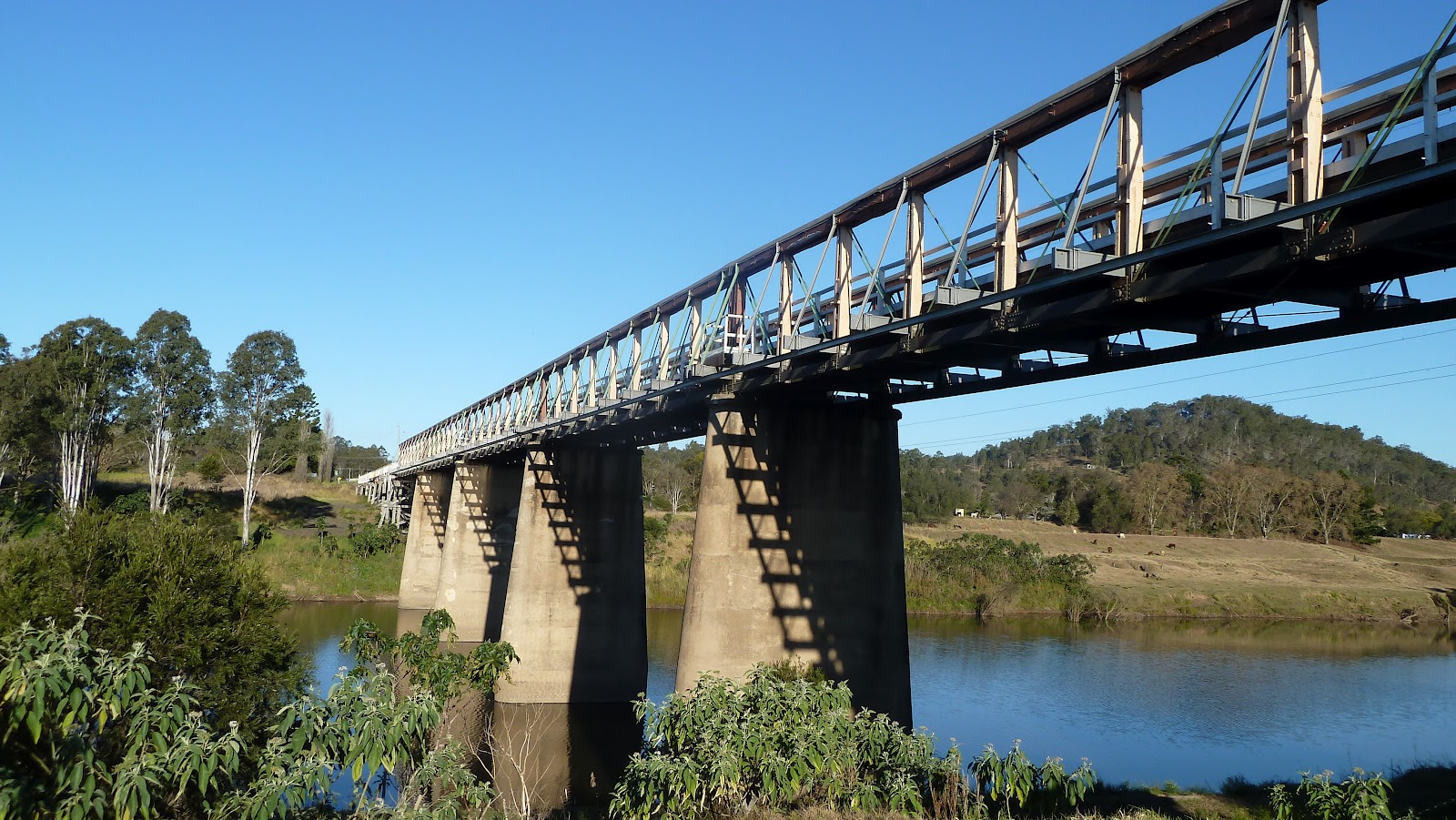
We'd been in Byron Bay for three days before heading off on the Bruxner Highway (Route 44) across northern New South Wales, via Lismore and Casino, to Tenterfield. Along the way, up on the Richmond Range, we saw Mt Warning from a new angle, and crossed the Clarence River on what is reputed to be the longest single-span wooden bridge in the southern hemisphere, at Tabulam. Beyond here, the Bruxner Highway traverses increasingly remote country, winding up through native forest (with Bell Miners tinking) and pretty deserted rural districts with names such as Sandy Hill and Black Swamp.
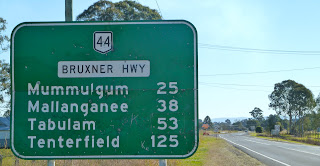
Tenterfield is the 'Federation town', where Sir Henry Parkes, an English-born New South Wales Premier, delivered a speech in 1889 that ultimately lead to the federation of the Australian territories 11 years later. We stayed in the delightful, colonial-style Annie's Folly and ate barramundi that evening in the local pub. The New England Highway passes straight through the middle of this small agricultural town (population about 3,000): next day, we shopped for provisions before heading north.
A few kilometres north, a lovely old rickety-rackety railway bridge over Tenterfield Creek sits alongside the highway, but you take your life in your hands to get a decent pic. Less than 20 kilometres up the road is the railway's destination – the border town of Jennings (NSW)/Wallangara (QLD), where the disused station has a plaque describing an old rivalry between the two states.
Girraween Environmental Lodge is surrounded by the National Park on three sides, but has 400 acres of its own that you need never leave if you bring enough provisions. You can walk for hours through open eucalypt forest (and the occasional stand of conifers), crossing creeks and climbing impressive granite outcrops. This time around we combined Rock Pools with Giants Marbles. At the Rock Pools, Ramsay Creek tumbles through pot holes formed along a weakness in the rock: Giants Marbles features a huge granite slab littered with various-sized remnant boulders and dotted with moss- or lichen-filled depressions. Everywhere brilliant-yellow wattle was enhanced by sunlight.
The wooden cabins are set far enough apart in the bush for you to believe you're on your own. Wood-burning heaters make them toasty-warm even on frosty nights – it's 900 metres above sea level here. We had company on an early-morning walk in the form of Tasman, GEL's lively dog-in-residence, but the roos were unimpressed.
 
We observed lots of Crimson Rosellas and King-Parrots, and spotted an (Australasian) Darter, as well as the usual suspects such as Kookaburras, Masked Lapwings, Magpies and Honeyeaters. And on our walk I think I caught a fleeting glimpse of a Long-nosed Bandicoot.
The quickest route to Girraween from Brisbane is down the Cunningham Highway (Route 15) off the Ipswich Motorway west of the city. Join the New England Highway north of Warwick and head south for Stanthorpe (see Great Granite, October 2010). Alternatively, you can take Route 93 at the top of the Cunningham Highway, then Route 90 to Boonah and the Falls Drive (off the Boonah-Rathdowney Road) as far as Killarney Road (see Off road: Mt Superbus and the source of the Condamine, May 2012). Heading south, Killarney Road joins Mount Lindesay Highway (Route 13) at Legume: south of Liston take Amosfield Road to Stanthorpe. This latter route includes an unsealed section, but you won't need a 4x4 under normal weather conditions. 

Whenever I've been to Girraween, I've revelled in the natural sounds and the silence. There are few places down Australia's eastern seaboard where you can escape all forms of noise pollution. The landscape here has a remote feel, yet it's benign and soothing. There's something very pleasing about granite, gum and wattle. In spring the wildflowers are spectacular, and I imagine this place would provide a cool respite from summer in the city. Go and see for yourselves.


August 4, 2012

While I was away...

I've been away, for about ten days. First I visited my lovely Aussie family in Torquay, on Victoria's Great Ocean Road, and then Rainbow Beach, back in Queensland, with family from the UK.

One cold but brightening morning the first week, I went down to the beach to take photographs (Torquay Main Beach, below). It suddenly struck me: how would I ever endure not having glorious beaches on hand? There are lovely beaches in the British Isles and Europe, don't get me wrong, but they're much further and fewer between... or colder... or smaller yet more crowded... or parking is a nightmare. Here, there are so many long and beautiful expanses of near-perfect sand and crashing surf that I can't even begin to choose which are my favourites. (Apart from those at Byron, I mean.) The privilege of being able to drive along some of them – not on an organised tour – has been a uniquely Australian part of our adventure (Cooloola Beach, below but one).
The Limpics are underway but seem to be something of a disappointment for the Aussies this time around. They've not as yet collected as many medals as they hoped. 100-metre silver medallist Emily Seebohm cried an Olympic pool and blamed her failure to win gold, as expected, on too much tweeting on race day. There's certainly disappointing TV coverage for non-Australians. A couple of nights ago we endured the whole of a dull women's hockey match just because the 'Aussie girls' were playing. What will happen if there are no Aussies in some of the exciting track and field events to come: will there be no coverage?

The Airport Link opened, with little fanfare, while I was away. It's being well used already – it is toll-free until 22 August – and punters are impressed by the engineering feat that is this latest addition to Brisbane's infrastructure. Well, it was built by my friend. I returned from the airport in it (to the Campbell Street exit for Fortitude Valley), which was vastly preferable to endless traffic lights along Kingsford Smith Drive.

Campbell Newman has continued his massacre of environmental protection measures, this time promising to develop Cape York (pointy top bit of Queensland) by revoking the wild rivers declarations. A 'wild river' in Australia (and America and New Zealand) is a river system that has been designated by government to be protected in its natural state from all development. The Wild Rivers Act 2005 was introduced by State Premier Peter Beattie, and continued by Labor under Anna Bligh to include 13 river systems in Cape York, on Fraser Island and in the Channel Country in Queensland's remote southwest. Environmentalists fought long and hard for this legislation, but it was opposed by Aboriginal leaders who believe that it stifles their communities' economic development. How good to know that Newman and the LNP are fighting for Aboriginal rights... as well as smoothing the way for bauxite mining companies in the 'wild' Wenlock River catchment, of course.

It's been a month since the introduction of carbon pricing, and there is still sky over Queensland – a beautiful August blue one as a matter of fact. There were companies, of course, that attempted to deceive their customers and subvert the purpose of carbon pricing. Our electricity (and gas) supplier, the Origin Energy Company, announced an increase in their charges from 11 July: the price per kWh was going up by 13.8 per cent, while the service fee per metering point (a daily charge) was increasing by – wait for it – 125.4 per cent. The kWh price has to be increased to encourage people to reduce energy consumption and hence carbon emissions. However much they did that, Origin's customers would still have seen a massive increase in their power bills as a result of the huge rise in service fee, unrelated to their consumption. Origin offered no explanation as to how carbon pricing had affected their service fees. How iniquitous was this strategy?

Not surprisingly, there was an outcry from their customers, a major one of which happened to be the Queensland Government. Their threat to change supplier probably had more impact than my friend's strongly worded letter of complaint: ten days later a letter to customers explained that Origin had 'listened closely to our customers and decided to significantly reduce the previously advised increases' that would 'now match the current government [sic] regulated rates (Tariff 11)* for 2012/13. This change in rates supports the Queensland Government's [sic] initiative to "freeze" the regulated Tariff 11 excluding the impact of the carbon pricing scheme.' What this meant was that the kWh price increase is 11.5 per cent and the service fee is not increased. If Origin can afford this revision, just imagine how much profit they would have made out of the service fee hike.

Another energy company, AGL, don't seem to get carbon pricing either. I spotted this poster a few weeks ago. What Dennis should be doing, of course, is saving energy to save the planet.

* Tariff 11 is the residential rate (my note)


July 22, 2012

Not a great week for Aussie blokes

So, gender inequality is alive and kicking in Asia Pacific.


First, we learned that the Japanese men's football team had flown business class to Europe for the Olympics while the much more successful – in fact, world champion – women's team travelled in economy. I wasn't surprised: Japan isn't exactly up there as far as women's rights are concerned, is it? I was shocked, however, when news broke of the Aussie men's basketball team (the Boomers) travelling in business, while most of the women's team (the Opals) flew premium economy.


Let's just take a moment to dismiss some of the rubbish put about in the wake of this news. First, legroom. Both the women's and the men's basketball players are tall: the average Boomer height is 200cm (6ft 7in) while the average Opal height is 183cm (6ft), but star Opal Liz Cambage is 203cm (6ft 8in), which is 20cm (8in) taller than Boomer Patrick Mills. Second, success. The Opals won silver at the last three Olympics and bronze in 1996; the Boomers have never won an Olympic medal. Third, satisfaction with travel arrangements. Head of team Australia Nick Green told the media in London: 'As I understand it, the women's basketball team were very comfortable with their travel arrangements'. The Age reported, however, that some of the current ladies team are frustrated because they've been lobbying for better treatment for some time.


Turns out the Opals are not alone in being treated as second-class sportspeople. The national women's football and cricket teams also travel in economy while their male counterparts travel business class. As in basketball, the women's football team has a much higher international ranking. Basketball Australia have seen the error of their ways and are to review their travel policy for players.


Much more iniquitous, however, is the utter cluelessness of Aussie lads' mag Zoo Weekly, which is searching for 'Oz's hottest asylum seeker'. It's hard to recall something quite as tasteless as this in a long while:
'Are you a refugee not even the immigration minister could refuse? Then we want to see you! ...if you've swapped persecution for sexiness, we want to shoot you (with a camera – relax!). Send [us] your pics and a short story about your tragic past.'
Obviously Zoo are being even more crass, offensive and sexist than usual. But the outrage here about ogling (or worse) female asylum seekers or refugees is tinged with extra awkwardness as a result of Australia's relentless drive to 'stop the boats' and rather ambivalent attitude to offering their occupants the safety and opportunity one might normally expect in a society such as this. 


I was searching in a newsagent's a couple of days ago for a magazine about birds, which makes me sound well twitchery. Never mind. Inevitably, I spotted the section of Zoo-like publications. When my children were little, I used to turn over magazines and gutter press with covers that might have given them the impression I found it acceptable to have images of naked women on garage forecourts and in convenience stores for all the world to see. In this particular shop the section was headed Men's lifestyle, the second word of which had been covered by 'restricted'. Not visually, unfortunately. 'Lifestyle' here didn't seem to include cars or fishing or DIY. In the light of the new depths to which Zoo Weekly has plummeted this week, Australia's womenfolk might like to suggest a few new subject headings. Gratification? Indulgence? Relish? If you'd like to leave your ideas in the comments box, I'd be happy to pass them on to the shop.


July 18, 2012

Newman hits defenders of the battlers

On Monday at least a couple of thousand public sector (PS) workers protested outside Parliament House in Brisbane. They are extremely concerned that more job cuts are in the offing – 20 per cent of the workforce in some departments, it is alleged. And this despite Campbell Newman's 'promises' before he was elected back in March that frontline services would be safe in his hands. On 30 June, the end of the tax year, about 3000 PS workers' temporary contracts were not renewed. According to Deputy Premier Jeff Seeney on ABC Radio yesterday, temporary contracts are just that, temporary, and have no guarantee of renewal. Some of the people who now find themselves unemployed had previously had their contracts renewed year after year, however. I worked for years in London publishing houses as a 'temporary freelancer': I had a certain amount of job security and they didn't have to pay the extra costs of permanent employees.

Once the LNP were in power in Queensland, they discovered a huge debt resulting from Labor's profligate spending (they said), but probably as least in part due to two big natural disasters that hit the state within months in 2011. Action-man Newman didn't waste any time cutting costs, from the small-scale, such as The Queensland Premier's Literary Awards and special-needs support groups, to large-scale, public sector jobs culls.

The former group includes the Environmental Defenders Office (EDO), which helps individuals, community groups and conservation groups seeking to protect the environment in the public interest. This non-profit, non-governmental network of community legal centres has an office in every state, and two in Queensland (Brisbane and Cairns). Each office is staffed by one or two solicitors specialising in planning and environmental law. As well as advising and acting for individuals and community groups, the EDO has a role in the reform and formulation of environmental law and providing education (in the form of workshops, fact sheets and publications) that enables communities to participate more in decision-making about their environment.

In Queensland, the EDO's funding comes from the Commonwealth and – until 30 June – State community legal service funding programmes. In addition, there used to be small amounts of money from the Environmental Protection Agency (EPA) project funding. The EDO relies on donations, however, for public interest legal work, and is also supported by members and private donors. It will be much more dependent on the latter from now on.

State Attorney General Jarrod Bleijie explained on 10 July to ABC Brisbane's Steve Austin that funding for all community legal centres in Queensland comes from Legal Practitioners Interest on Trust Account Funds (LPITAF). According to Mr Bleijie, trust account funds have not accrued as much since the GFC because of fewer house sales, and there are no longer the funds available to give to the EDO. So, the cut has absolutely nothing to do with Campbell Newman's avowed intention to cut 'green tape', making it easier for the resources industry to gain approval for their projects, thus speeding up production and ultimately the receipt of royalties into Treasury coffers? Really and truly? Because weeks ago, when I first read about the noble efforts of the EDO, I predicted that they would soon be in the Premier's sights.

Reading Rich Land, Wasteland: How Coal is Killing Australia by Sharyn Munro, it's hard to imagine that certain sectors of the resource industry need further help with approvals. The book is a heartbreaking catalogue of lost farmland and homes that have been in families for generations; of health impaired by dust, 24-hour bright light, audible noise, the much more insidious low-frequency noise, and stress; of disappearing water courses and contaminated creeks and swamps; of fighting spirits broken in the face of all-powerful coal and gas companies that can march in, procure, destroy, break promises, expand, and fail to monitor their impact or adhere to conditions attached to approval.

Increasingly over the last 18 months to two years the EDO's solicitors have advised landholders and communities in their battles against the increasingly foreign-owned coal and gas companies: individuals and groups that lack the money to engage lawyers; country people who do not necessarily support one political party or another; who are not against the mining industry per se, but whose lives have been turned upside down and whose livelihoods are seriously at risk; and who need a fair go to defend themselves. The EDO provides outreach legal services to help such people mount a challenge in the absence of support from local council or state government; if necessary, to go to court; to lobby for conditions attached to approvals. The EDO have a unique role in building awareness and broadening knowledge of rights and laws and planning processes, which must help those managing the conflict between resource exploitation and environmental protection. But the EDO are not only concerned with the impacts of mining: they are just as likely to advise those trying to have their say in the felling of trees or the widening of roads or the development of mega quarries (like that planned for the Kerry Valley, top).

EDO funds have been halved at a stroke, when six month's notice should have been given. The first casualty is their invaluable publication The Community Litigants Handbook, in its third edition but unlikely to be reprinted. In the pipeline, but now dependent on a lot more donations for its completion, is the Community Mining and Coal Seam Gas Legal Handbook. With mining leases covering a large proportion of this state, such a publication is likely to be of use to increasing numbers of communities. If you would like to help make this possible, or support the EDO by becoming a member, go to http://www.edo.org.au/
edoqld.


July 12, 2012

G20 in Brisbane

When I announced in 2009 that I was moving to Brisbane, most friends and colleagues were excited for me and many were envious – of my prospect of endless sunshine, best beaches, extraordinary wild places and overall great Australian adventure. I wondered, however, how many of them knew precisely where it was. Could they have accurately stuck a pin in a map? Did they realise it was in Queensland? Did they care? 


Once I was here, one of my first friends, a native of Melbourne but recently arrived from living in Perth, curled her lip slightly as we walked together along the riverbank. 'Brisbane is a small town pretending to be a big city,' she pronounced, as if the river were throwing up an unpleasant odour. She was not impressed by the city's self-affixed label 'Australia's New World City'. 


PM Julia Gillard has been on a week-long tour of Queensland to bolster Labor support and persuade people that carbon pricing does not mean the end of the world as Australians know it. In Brisbane yesterday, she smilingly announced that the G20 Summit was coming to town in 2014. Most people seem to agree that this mega-event will put Brisbane on the map. (Did you know where Los Cabos was before June?). And, for a nation that continually claims to punch above its weight in the global arena while failing to sound totally convinced itself, it will provide a chance to show off both city and state (Finance Ministers will convene beforehand in a different regional centre). Ms Gillard summed up:
'Hosting the G20 in 2014 provides an invaluable opportunity for Australia to influence the global economic agenda... With Queensland a driving force behind the nation's economy, there could be no better place to welcome the world's leaders than Brisbane.'
Needless to say, not everyone is as enthusiastic. It's a bit tricky for State Premier Campbell Newman. Previous Premier Anna Bligh jumped at the opportunity when the Commonwealth first asked for expressions of interest, but a lot of water has flowed under Brisbane's bridges since then, and Mr Newman is naturally reticent about the huge costs involved in playing host to the G20 leaders, estimated at getting on for $400 million. He cannot appear churlish, however, in the face of such an opportunity to put Brisbane on the lips of millions across the globe. 3000 media are expected as well as 4000 delegates.


Sydney's nose has been put well out of joint. What on earth does the Prime Minister think she's doing, insulting the world's most powerful leaders by sending them to such a provincial outpost when everyone knows that Sydney is Australia's real new world city. Indignant New South Wales Planning Minister Brad Hazzard is convinced it is a purely political move and Sydney should win based on any criteria. Like it's congested airport that regularly delays visitors (both my inbound and outbound flights a couple of weeks ago)? And its convention centre that will be closed for three years of refurbishment from 2013?


Brisbane Convention and Exhibition Centre has been rated in the world's top three (by the International Association of Congress Centres) at least three times since it opened in 1995, and regularly hosts thousands of conference attendees. Next month, for example, more than 5000 International Geological Congress delegates will rock up. It can accommodate more than 40 concurrent sessions; and has a high security component, being very close to the CBD yet in its own precinct that can be locked down. And Brisbane will, in a matter of days, have a brand-spanking-new airport link to whizz visitors into town: its construction was the reason my friend and I came to this city. Below is a highly complex junction where the airport link connects with the Clem7 Tunnel and the Inner City Bypass.
My first instincts were that G20 will be good for Brisbane and Australia. While I am hugely cynical about the tangible results of such conferences, global issues will be highlighted in a country that is geographically isolated, at times politically reclusive and largely environmentally backward. There will undoubtedly be protesters, and so there should be, as long as they are peaceful. They would do well to know what they'll be up against, however, in the form of police and security forces. The scale and nature of Australia's, and particularly Queensland's resource boom and development, with its potential impact on global climate and the Great Barrier Reef, may combine with anger and frustration about the world's financial shortcomings, economic hardship, corporate greed and political ineffectuality to create a potentially explosive situation.


Will I still be in Brisbane?