January 3, 2012

Walking the Walk (NZ)

Whatever else you do in Kaikoura, walk the Peninsula Walk. You'll see weirdly spectacular limestone coastal scenery, New Zealand Fur Seals, thousands of noisy members of seabird colonies and high-peaked mountains backdropping dairy pastures that could be mistaken for Swiss alpine meadows. Look a little way out to sea and visualise a deep, deep canyon cutting a twilight zone, teeming with sea life. In South Bay you can even imagine you're on a photo shoot for a Pink Floyd album. And you'll get a great feel for this faintly desolate yet mesmerising stretch of coast.

You can start walking from the car park on West End in town, along The Esplanade, Avoca Street and Fyffe Quay to Kean Point, but in places there's only the roadside verge to walk on. Alternatively, you can drive and park at the Point to start the serious bit of the Walk. There's a steep climb up to a viewpoint but it's easy walking thereafter: allow a good half-day for the 11.7 kilometres. You're advised to wear warm, windproof clothing, but we were caught out by sun that was at least 10 degrees hotter than we'd been expecting. I also hadn't appreciated the heightened risk of sun damage here, since the ozone hole over Antarctica extends as far as New Zealand. Hats and sun block are a must: I didn't have either and got a Rudolf nose to prove it.

At Kean Point there's an extensive tidal mudstone platform that is a seal haul-out zone. The seals nearest the car park are more than likely to be males, but there are females further out on the platform and they have recently started to breed there. You may see wading birds such as oystercatchers on the platform; there are rock pools to investigate; and you can snorkel or dive off the platform in possibly the clearest water I'd ever seen – until a couple of days later while fossicking in Woodside Creek on the way to Blenheim.
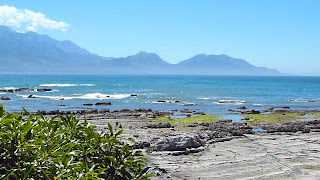


From the viewpoint you can also see the site of a Maori fortification called a pa, which consisted of a series of defensive terraces. Continuing along the cliffs to Whalers Bay (so called for obvious reasons), there is a 360-degree view – of ocean, coast and mountains.


Along the Peninsula's crenulated shoreline, Whalers Bay is perhaps the most pleasing. The largest of its eroded limestone sculptures is the Sugarloaf, which you're requested not to climb (thus exacerbating the erosion), but people do. Another good reason not to make the detour that traces the old whalers' route from their lookout on the cliffs to the shore is so as not to disturb the South Island's largest colony of Red-billed Gulls, aka 'Bird City'. You wouldn't want to mess with this, would you?


Folded strata attest to an eventful geological past in these parts. Sit and stare and take it all in before continuing to South Bay.


You'll pass a predator-proofed enclosure that's been established in recent years as a new breeding ground for Hutton's Shearwaters. Yet another of Kaikoura's wildlife treasures, the Shearwaters are endangered endemic seabirds that used to breed throughout the Kaikoura Ranges. They were believed to be extinct, but then eight colonies were rediscovered in the 1960s. Now just two remain, in the Seaward Range. With nests between 1,200 and 1,800 meters up, these are among the loftiest seabirds in the world.

The Hutton's Shearwater Charitable Trust* and its volunteers brought some 300 chicks down the mountain to artificial burrows in the new Peninsula colony between 2005 and 2008. They hand-reared the chicks in the hope that they would imprint the site before migrating across the Tasman Sea to winter off Western Australia. Shearwaters return to the New Zealand mountains in August to breed, and chicks hatch in December. The Trust report that at least a dozen adults returned this summer to the Peninsula's colony, which is great news. They sent me this.

The Hutton's Shearwater Charitable Trust
During the breeding season large flocks of Shearwaters feed during the day off the coast of Kaikoura. On our first day we were lucky enough to see them just by the mouth of the Hapuku River (see Happy New Zealand, January 2012). It's not often you see such large numbers of birds.


By this time I was having to shield my Rudolph nose with the Kaikoura Peninsula Walk brochure. Photography was tricky, but the peculiar mudstone shapes and bird perches were irresistible.


It was extremely difficult to spot birds such as Pied Stilts foraging on the rock platform. Impossible, in fact, unless they moved. Or you had binoculars.

At the end of this section of the Walk there are three pouhenua. One of these striking Maori carvings depicts the demigod Maui fishing North Island out of the ocean.

Then it's time to head in the direction of South Bay's marina and follow signs back to Kaikoura town centre via the South Bay Track and Tom's Track to The Esplanade.

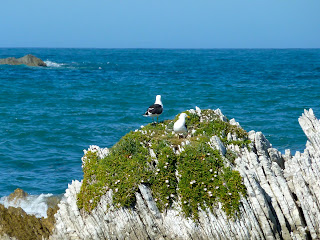
It was still quite hot and it seemed a long way back to the car at Point Kean, although there was a splendid avenue of Norfolk Island Pines, Black-backed Gulls on dramatically tilted rocks and yet more stunning views.



We rewarded ourselves with an early crayfish supper from a van parked on Armers Beach. This, we had been told, was the best way of enjoying the seafood that gives Kaikoura its name (roughly translated, 'crayfish dinner'), and that costs a small fortune in restaurants. It's a small lobster, is what it is.

I could live quite happily without eating seafood: I love prawns (but I'm not allowed to eat them because they're bottom-trawled**) and mussels when they're cooked the Basque way†, but everything else, well, I can take it or leave it. And I can happily leave crayfish, even though it's very big in KK. It was OK, don't get me wrong, and I loved the idea of eating it sitting by the sea. But all I could really taste was garlic. Chewy garlic. Sorry.

The Walk was thoroughly enjoyable, however.


** This fishing method churns up sediment (restricting light, encouraging algal blooms and redistributing pollutants); damages seabed ecosystems; and kills other sea creatures

† Caldo de almejas


January 2, 2012

Kaikoura flora... (NZ)

When you have an intuitively good feeling about a place, it's easy to look around and see beautiful things. Colour was big in NZ.

On South Island there were wildflowers almost everywhere – by the roadside, on stream and river beds and banks, at the back of beaches. (Yellow has always been my favourite colour.) At times the sea was a most extraordinary light turquoise colour and the mountains a purple haze in the hot afternoon sun. I have never counted so many blue hues in a landscape.


These tall, purple-blue flowers were all over the place. They are Viper's Bugloss, or Blue Borage, which flowers from December to March. Blue Borage honey is particularly pure (there is a low risk of pesticide and chemical contamination) and has a delicate flavour with a herbal or fruity scent. It is not a cultivated plant: it grows wild in dry areas with poor soils. South Island is a primary source of Viper's Bugloss honey.

There seemed to be lots of different trees (from Oz): they were often clumped in close proximity, creating pleasing arboreal patchworks.


Related to Australian Melaleuca, the Manuka (above), or tea tree*, is a common shrub or small tree with whitish or pinkish flowers. It's well-known for its antibacterial properties and is also used in honey production.

New Zealand boasts its own tree ferns. These were in the Puhi Puhi valley near Hapuku.

Lone sentinels were a feature of the landscape, and included 'my tree', the subject of many photographs taken from Hapuku Lodge. One afternoon I got as close as I could to it, also in the Puhi Puhi valley.


The silver fern has become New Zealand's unofficial national symbol and the All Blacks' (and other teams' and organisations') logo. When we first arrived, we enthused about all impressive ferns in the hope that they were the one, but in fact none of them was. Rather like New Zealand's official national symbol, the Kiwi**, they are few and far between. Neither of these is a Silver Fern.


Flax is one of New Zealand's most distinctive native plants. It isn't related to flax as we Europeans know it but was given the same name by settlers since it produces similar long leaf fibres. The Maori have long used it for clothing, sandals, baskets, mats, cooking utensils, string and rope, animal traps, fishing nets and lines, sails and rigging, roofing, a host of medicinal purposes and as a sweetener (using the nectar).


…and fauna
Birds love flax flowers which makes them easier to photograph; the birds, that is. The Yellowhammer (below) was imported from Europe (where is it now in decline) in 1862 and quickly established itself throughout New Zealand's islands. Only the male has a bright yellow head, and the duller females are often mistaken for House Sparrows, of which there are many. The Sparrows look fatter and more robust than their European cousins.


The Tui (above) is a member of the honeyeater family and a real New Zealand character. It didn't seem to mind sharing its patch with Hapuku's guests, and provided an almost constant vocal presence. I noticed frequent twittering birdsong that reminded me of home, and at first I assumed it must be several birds. The Tui, however, has two voice boxes that enable it to produce a range of very different sounds, and even imitate humans, like a parrot.

Talking of which, Red-crowned Parakeets, or Kakariki, were being reared in an 'incubator' at Hapuku Lodge as part of a breeding programme. Endemic to New Zealand, the birds are seriously endangered because of habitat destruction and predation by invading mammals. The Lodge plans to release the parrots' offspring every autumn in the hope that they'll stick around and establish a resident colony in the Manuku grove beneath the tree houses. The Kakariki were curious and friendly and made soothing chuntering noises.

The Black-backed Gull, or Karoro, is a bit of a bruiser. It's a huge great thing (bigger than Brighton's monsters back home) and described as 'robust, intelligent, opportunistic and aggressive' (http://www.nzbirds.com).


The Red-billed Gull – a relative of Australia's Silver Gull – is gregarious and loves gravel beaches and rocky headlands so is at home here.


I had never seen an Albatross before. (Thanks to my friend for the picture above, and the whales below.) As our whale-watching boat scoured the ocean for spouts, these magnificant birds rose and swooped, never flapping but quietly gliding using their massive wingspan. I'm fairly confident this is a Buller's Albatross. We probably saw different varieties, and of Petrels. Most were impossible to ID without reference, and our minds were on other things at the time, namely Sperm Whales.

These creatures are year-round visitors to Kaikoura, but are by no means the only whales to frequent these teeming waters. Migrating Humpbacks, Southern Rights, Blue Whales and Pilot Whales also visit. Sperm Wales are the largest toothed animals and we were lucky enough to see those teeth. The whales usually spend about ten minutes on the surface breathing – they looked a bit like logs, I thought – before diving back down to the depths to feed again. One we saw, however, didn't flip his tail up and head down, and our guides thought he might be feeding just below the surface. A few minutes later, he reappeared, open-mouthed and brandishing an impressive row of bottom teeth.

Sperm whales are the squareheads of the ocean. As well as holding the largest brain ever known on earth, their massive head contains large quantities of what is called spermaceti; but the oily fluid is not sperm. Its function is not entirely understood but is believed to help the whale regulate its buoyancy when diving and resurfacing: it solidifies in the cold depths into a waxy substance. Sperm whales dive to about 1,000 metres after giant squid, and can hold their breath for about 90 minutes while doing so.

Whale watching vessels compare sightings to help each other predict where and when whales might surface next, and use underwater microphones to detect the whales' calls. We spent about two and a half hours on the water and saw three or four Sperm Whales in that time. Unfortunately we didn't see any Dusky Dolphins – they hang out further inshore. (You can swim with them on dolphin encounter tours organised from Kaikoura.) We did see a small shark, possibly a young Blue.


We did have several encounters with New Zealand Fur Seals (Kekeno in Maori). They can be seen all around the coast of South Island, but look carefully because sometimes they're barely distinguishable from rocks. We visited the seal colony at Ohau, a few kilometres north of Hapuku (start looking out for seals from Half Moon Bay onwards), and we also spotted them around the Kaikoura Peninsula. Both these sites are haul-out points. Seals look very awkward on land, but can move quite quickly. You should not approach to within 20 metres of one, and never place yourself between a seal and its escape route to the sea: they have sharp teeth and males are quite bulky.

Seals are extremely graceful movers in the water. They can dive for food for about ten minutes, and to a depth of up to 300 metres, but it's usually more like a couple of minutes at most. When they haul themselves out on to rocks there's a lot of jostling for position and squabbling. Youngsters keep out of the way of dominant males who seem to do a lot of posturing and showing off, but are seen off by protective females. The breeding season is November-December and pups are born from November to January. They're weaned by the following September. There were quite a few babies on the rocks at Ohau Point.


A short, easy walk inland from a large car park on the left of Highway 1 (travelling north) will get you to the Ohau waterfall. At the base is a plunge pool where young seals gather in winter to play. We weren't there at the right time of year, but a couple of young adults were making their way down the boulder-strewn creek to the sea. We were on the bank of the stream, and the seals clocked us, but they cautiously made their way past within less than a metre of where we were sitting, motionless. As if to reassure themselves, one looked back at the other and they touched noses. My friend caught this delightful moment on camera.


* So-called because Captain Cook used the leaves to make a tea-style drink

** Each of the five species of Kiwi live in isolated pockets, four on South Island and one on North. All are endangered as a result of deforestation and predation by invasive mammals such as stoats, ferrets, cats and dogs