December 17, 2011

It's only words

I've worked with words all my adult life: first in book publishing; then as a ghostwriter; and, most recently, in magazines. It's hard for me to think, 'it's only words'. I love the use of language and the evolution of that usage. I'd like to think I'm not a stickler for grammar, but I have been known to get a bit cranky about the incorrect positioning of apostrophes. And the proliferation of dangling modifiers.

I've been thinking about writing this post for a long time, but I'm still not sure where to start. Perhaps with a headline I spotted earlier in the year: 'Furious Queenslanders dob in flood rorters'*. One of the attractions of coming to live in Australia was that we wouldn't have to learn a new language. In theory.

Usage and comprehension
Some Australian phrases I can work out from the context, even though we'd never say it in English. Some words you might find in an English dictionary but are seldom used: coronial enquiry; land gale; mortgage delinquency; muscle car; nature strip (grass verge); rort; swiftwater rescue; victimology.

Sometimes, even the simplest usage can be confusing. When you went into the CBD, did you find a park? Yes, the Botanic Gardens were lovely. No, no, a parking space.

Other times I haven't got a bloody clue what you're on about, mate. When I'm at the supermarket checkout; do I have flybuys? Talking to a neighbour; have I seen the body corporate rules? What on earth are camel packs? Does a muffler shop sell gloves, too?


Here's some help with translation:
Aussie battlers = struggling, lower-income families
backflip = U-turn (in politics)
bail up = to corner someone
bastardry = malicious or cruel behaviour
biffo = punch-up
billabong = stagnant pool
billy = small pot used by a bushman
blackfellas = Aborigines (blackfellas is not offensive;
 Abos is)
blacktop = tarmacked road
bloodnut = redhead
bogan = ill-educated person from low-income demographic**
bowser = petrol pump
camel pack = hydration pack worn on the back
chook = hen, chicken
cream = to beat
diggers = soldiers
doona = duvet or quilt
dudded = swindled
dunnie = toilet
durrie = cigarette
esky = cooler box
eventuate = to happen
fair dinkum = genuine; expression of surprise/acknowledgment
farewell = to lay to rest; give a send-off
freedom camping = not using a campsite
gerni = to (high-pressure) hose down
grass slashing = mowing the lawn
hoon = someone who drives fast and dangerous to show off
icy pole = ice lolly
ladder = league table
lolly = sweetie
lounge = sofa
lounge room = lounge
manchester = bed linen
ocker = a stereotypical Australian
onya (goodonya) = good for you, well done
over it = had enough
recreate = to spend leisure time
ridgy didge = all right, genuine, true
rort = dishonest practice
sanga = sandwich
scats = animal droppings
singlet = vest or vest T-shirt
skips = English-descent Australians (quite rude)
slasher = tractor-mounted mower
spruik = to harangue
squib = to flee, escape, be cowardly
stoush = fight or dispute
thongs = flip-flops
top score = to achieve the highest number of runs, goals etc
tucker = food
unit = apartment
whipper-snipper = strimmer
wog boys = Greek or other Southern Europeans (not offensive)
verbal = to twist what an opponent says in a debate
youse = you (plural)

Sayings
There are lots, of course, but these are some favourites:
He couldn't make a decision if a train was about to hit him
He couldn't raffle a chook in a pub (useless)
I'm flat out like a lizard drinking (busy)
She was as mad as a bag of cut snakes
To throw an echidna among the balloons (upset the apple cart)
As nervous as a long-tailed cat in a room full of rocking chairs
Don't be a galah (stupid)
Don't come the raw prawn with me (treat me like an idiot)
Whatever blows your skirt up
He couldn't lie on a bed straight
To do a Maralinga (do the dirty on someone)
She'll be apples (it's OK)

Short forms
Everybody knows the Aussies love short forms:
Abo, ambo (paramedic/ambulance), arvo, avo, barbie, bikie, boardies (surfer's long shorts), breakie, Chrissie, chrysies (chrysanthemums), cosie (swimsuit), doco (documentary), footie (rugby or Aussie Rules), freshie (fresh water crocodile), garbos (dustbin men), hedgies (hedge cutters, clippers or trimmers), journo, kindie (kindergarten), leggie (leg rope attaching a board to a surfer's leg), pines (pineapples), pollies, postie (postman), Quickie (Quiksilver surf and lifestyle brand), rashie (rashguard, protective swimwear), rego (registration plate), rellies, renos (renovations), saltie (saltwater crocodile), schoolies (Year 12s and their end-of-school celebrations), servo (petrol station), sunnies, toolies (attendees at the schoolies' end-of-final-year celebrations but who left school last year or even longer ago), tradie, ute (utility vehicle)

And place names don't escape: Breakie Creek, Brizzie, Coochie (Coochiemudlo Island), Freo (Freemantle, WA), The Gabba (stadium in Woolloongabba, South Brisbane), Rocky (Rockhampton), Rotto (Rotnest Island, WA), the Sunnie (Sunshine) Coast, Straddie (North Stradbroke Island), Tassie

Maybe it's just too hot to be bothered to say the whole word.

Verbosity and tautology
The Aussies may abbreviate loads of words, but sometimes their sentences are massively overcomplicated. On the back of a charity Christmas card we were sent it said: 'Spotlight's Stitch in Time program is committed to enriching and supporting positive community development outcomes'. Eh?

Signs especially tend to be over-long. I can't help thinking 'Beware of snakes' would be more immediate and therefore more helpful than...

I mean, have any snakes been seen recently? There's a sort of inference that, even though snakes have been seen, they've never been a problem. Whereas everybody should be on guard against snakes at all times, even if there's only the vaguest possibility that one might appear. And what about simply 'No tipping' instead of...
I don't really know where to start with the sign below. The verb to swoop is intransitive, which means it can't have a direct object. Magpies swoop on, or upon, an intruder. An important piece of information is missing: when is the breeding season? And the advice to carry an umbrella: is it to beat off an attacker or open as a protective shield? How many people will bother to read all this?
Fish cleaning is prohibited on seats on the little ferry over to Coochiemudlo Island. To be honest, I'd rather there was no fish cleaning at all. I don't even want to see fish innards on the floor. How quaint that the ferry operator should tell us what the seating is for. In all my years of looking at signs, I've never considered what Notice means at the top of a notice? I know that what I am reading is a notice; so is it telling me to Take notice because it's saying something important? Does it really mean Attention or Warning?
By the way, something is either prohibited, or not. It cannot be partially or totally prohibited. And to prohibit prohibited goods is tautology.

Just plain weird
'Like a drowned man floating to the surface of the dam', Booker Prize-winning Australian author Peter Carey wrote in Theft. A dam is a construction that blocks a river, creating a lake, not the lake itself, goddamit. Travel brochures describe dams stocked with fish. No. Fish don't swim in concrete or rock. If I lived here until I was 100 I could never bring myself to call a lake a dam.

Bashed describes someone who's been beaten up, murdered even. Rather than being a very informal term, it is used in official statements by police and by news presenters. Shortly after we arrived in Australia, a notorious gang leader was 'bashed to death' in a Melbourne prison. All media reported it thus. The other day someone somewhere was 'hit over the head with a cricket bat': wasn't he 'bashed'? Am I missing something? Incidentally, there is an element of violence in quite a few Aussie expressions: grass slashing I've already mentioned; price gouging is charging unreasonably high prices; and how do you fancy smashed spring pea and cucumber salsa, or a smashed egg and lettuce sanga?

Why does Council never have a definite article?

Sometimes I can't help but feel that there's an element of contrariness – bolts and nuts; buck's night (stag do); a kettle of worms; saucer and cup; wickets for runs (in scoring cricket). And Aussies bunker down rather than hunker down. The latter is known as linguistic contamination, I have it on good authority.

Pronunciation
This may seem a more trivial topic but a funny thing happened to me last week. I was listening to President Hamid Karzai speaking at the Bonn Conference on Afghanistan. I kept thinking he was talking about tourism, but he looked very serious and it didn't seem an appropriate subject for such an occasion. In fact, he was saying 'terrorism'. Now do you see how important it is?

I have long agonised over the so-called long A. Shark Park, home of Cronula Rugby League Club in Sydney, is a great name for practising your Aussie accent. But I'm not sure know how to spell the 'ar' sound in order to help you. It is not as in pirates or cute kittens – 'ar' or 'ah'. I have enquired of a well-known linguistics expert who has a regular language spot on ABC Brisbane local radio but doesn't answer emails. This sound is almost as significant in identifying the key elements of an Australian accent as the HRT (high-rising tone or terminal) at the end of a sentence. The nearest I can get is as in aaagggghhhhhh!

But wait; this morning a possible breakthrough. Try this: first, make the sound of an 'a', as in cat. Now say 'a' quickly followed by another 'a', and another, like ca-a-a-t. Now pretend that 'park' doesn't have an 'r' in it at all, but several 'a's instead. Paaak. Shaaak Paaak. I live in New Faaam Paaak.

Australian English is non-rhiotic, which means an 'r' in a word is pronounced if it is followed by a vowel sound but not if it comes before a consonant or at the end of a syllable. So it is pronounced in 'rabbit' or 'watery', but not in 'car' or 'hard' or 'hear'.

All sorts of things are suddenly falling into place. Now I understand why Australians say:
year as if it were spelled yee-a
beer as if bee-a
mature as if ma-chew-a
picture as in pic-cha
and Twitter as if Twitta

Australian pronunciation isn't straightforward or consistent, however:
boutique is pronounced as if it were spelled beautique (bow-teek)
route as if it didn't have an 'e'
debut as day-boo or day-b-yew
pasta as if parster
Milan as if Milarn
Chile as if Chillay, with the emphasis on the 'ay'
maroon as if marone (rhyming with bone)
memo as if meemo
polo as if pollo (ie, a short 'o')
but yoghurt as if yOghurt (ie, a long 'o')

Right. Got all that off my chest.

Just one more thing. H. In the UK, if you pronounce 'aitch' as 'haitch' you're considered poorly educated and even a bit common. The same as if you added other letters that aren't there and said 'skellington' or 'mischievious'. Other differences in pronunciation are less loaded with loathing or ridicule: how do you say 'ate', 'garage', 'says' and 'schedule', as a matter of interest?

In Oz, three accents are usually recognised, none of them reflecting region, class, income or ethnicity. The Broad Australian Accent is spoken by Aussie blokes and not many women. It says, 'I am a man of the people who treats everyone equally; I am your mate' (see ex-PM Bob Hawke in a lively interview at http://www.youtube.com/watch?v=yoq8_PlhBug). The General Australian Accent or Australian English Accent is associated with neither ideology nor stereotyping and many speakers don't think of themselves as even having an accent. Nicole Kidman is apparently a good example of this. Finally, there's the Cultivated Australian Accent, which is more sophisticated and spoken more by women (such as cultural ambassador Cate Blanchett) – and men who want to sound posh and statesmanlike.

So, back to H then. I have been told that in Australia it's the opposite of in the UK: posh people say 'haitch'. Hmmm. I have also read that it reflects a Catholic (haitch) or Protestant (aitch) upbringing. I'm searching for the definitive answer from Kath and Kim†, but in the meantime I'll leave you with this clip:
http://aso.gov.au/titles/tv/kath-and-kim-money/clip1/.


* Turns out many Brits understand the verb to dob in, meaning to report to the authorities, but where I come from, in the North of England, a dob is a poor buy, such as something you've just bought that doesn't work by the time you get it home

** This is an inadequate definition, but it had to be a one-liner (bloody designers)

† Award-winning Australian sitcom that has acquired something of a cult following, both at home and abroad

This post was last updated on 30 January 2012


December 14, 2011

The great Australian rip-off


My friend insists on budgets: how much we need to live on each month; how much a holiday is going to cost; paying off our crazy car deal; affording home improvements back in the UK. As we prepared to come and live in Australia, in late 2009, he researched comparative costs of living in the UK and Australia, and concluded that living here would be about ten per cent cheaper. I don't know which websites he used, but they were as much use as a chocolate teapot.

On our very first day in Brisbane, we wandered around the centre of town, drifting into a bottle shop and a bookshop in Albert Street. In the first, we found a favourite wine for roughly twice what we used to pay at home: in the second, our faces fell further as we picked up interesting books and then looked at the price labels superimposed on the RRPs of foreign titles. 'We are going to have to revise our budget,' pronounced my friend gravely. I was time-zoned out and sandfly*-ravaged from the Botanic Gardens, and suddenly felt a little teary.

Two years later, I would like to share two lists with you. The first is of goods and services we have found to be cheaper in Australia than in the UK:

Prawns; Audi car servicing; tax advice/accounting; extra virgin olive oil; lightbulbs; fuel

Here's the 'more expensive' list:

Tickets for concerts and sporting events; cinema tickets; wine; many foods (notably cheese, fish, certain vegetables, processed foods); eating out; books; internet provision; mobile phone tariffs; computers; clothes; shoes, especially trainers; hairdressing and hair products; cosmetics; car hire insurance; house contents insurance; bank charges; credit card interest; 'middlemen' charges; rents; removal costs; gas and electricity; new cars; parking in cities; window cleaning; hotel accommodation; tattoos; penalty fines; cut flowers; flights to Europe; healthcare, especially dentistry; entrance fees to tourist attractions...

Some of the above need qualification. Certain food items may be more expensive, but we have never eaten better in our lives. On the other hand, some hoteliers rub salt in the wound by demanding full payment upfront 30 days before you're going to step over the threshold. You win some, you lose some: you pays your money and you takes your choice.

Australia is a very wealthy country, mainly because of vast mineral deposits that are exported to hungry customers in Asia. It therefore survived the Global Financial Crisis relatively unscathed by comparison with most other developed economies. But Australians don't feel well off. They complain about the cost of mortgages or rents and petrol and utilities and food and many other essentials, yet they earn good money, compared with Europe.

Today some light is thrown on this in the form of a report – Price Drivers: Five Case Studies in How Government is Making Australia Unaffordable – by the Centre for Independent Studies (CIS), who describe themselves thus:
'...the leading independent public policy 'think-tank' within Australasia. The CIS is actively engaged in supporting a market economy and a free society under limited government where individuals can prosper and fully develop their talents. Through positive recommendations on public policy and by encouraging debate amongst leading academics, politicians, journalists and the general public, the CIS aims to make sure good ideas are heard and seriously considered.'
Read this report at www.cis.org.au/images/stories/policy-monographs/pm-125.pdf. It is particularly interesting with regard to bananas and cars.

During tropical cyclone Yasi earlier this year, vast numbers of banana plants were flattened in Northern Queensland. Prices shot up to $14 a kilo (from $2-3 beforehand); and so it was that those growers whose plants were still standing profited enormously. Many people boycotted bananas, which are usually in great demand. Australia is by no means a major world producer, but bananas are big in Queensland – in every sense. Residents of this state are not nicknamed banana benders for nothing**. And growers' interests are represented forcefully by none other than the Federal Member for Kennedy, Bob Katter (see Limbo dancers, August 2010; And then there were two, September 2010).

In such a time of dire shortage, the Australian government could have bought bananas from the Philippines, a relatively close neighbour, so that their citizens would not be deprived of their favourite fruit. But that was not possible. Bananas, you see, cannot be imported under the terms of the Quarantine Act 1908, being of 'biological material', unless there is no risk in doing so. One of the authors of the Price Drivers report, Dr Oliver Hartwich, believes that, at the very least, the other, non-banana-growing states of the Commonwealth could import bananas without any risk. Instead of paying the price of such a protectionist policy, Queenslanders should be able to choose whether to support the growers or reduce their food bills by buying imported, much cheaper bananas like the rest of the world does.

On the other hand, bananas coming from Northern Queensland don't earn air miles. And today, I notice, they are back to their pre-Yasi price, if not lower. And do farmers not need supporting in this era of great mining hoo-hahs?

Australia protected its apple growers in the same way until this year, when it had to bow to a World Trade Organisation ruling that import restrictions in place since the 1920s represented a trade barrier to New Zealand apples rather than a genuinely protective measure against fire blight.

But never was Australian protectionism so forceful as in defence of its car manufacturers. There is a five per cent import tax on all foreign cars; the luxury car tax (LCT) adds 33 per cent above the LCT threshold (currently $57,500); so-called Australian Design Rules deter foreign car manufacturers from converting their cars to meet standards here; and private importation is virtually impossible as a result of good ol' Aussies rules (the vehicle must have been 'owned and used' for a year before importation, to mention but one hurdle).

What this amounts to is that Australians pay 20-30 per cent more for a fairly average family car than if they were buying the same car in Europe or America. Curiously, Australian-made cars sell in the US for two-thirds of what they cost here.

I care more for books than bananas, or cars. These three books cost me just over $100 in total, which at today's exchange rate is just over £64. Had these books been published in the UK, they would probably have cost about £40 (even less on Amazon), but they are only available here. I had to bite the bullet.

The Copyright Act 1968 states that, should an Australian publisher acquire copyright of a book within 30 days of its release overseas, book retailers may not import foreign-published editions of the book. Readers here have to pay whatever the Australian publisher dictates and cannot buy what would almost certainly be cheaper imported versions. This had the original intention of encouraging Australian readers to buy works by Australian writers, but a person's reasons for choosing a book don't often include substitutability options.

We make a list of books we want and then order all other than uniquely Australian titles through Amazon.co.uk, who, having cottoned on to an Australian demand, are offering free international delivery (on orders of £25 and above) until the end of next year. And some Aussies, who are nothing if not resourceful, use the fact that they don't pay import duty on items costing less than $1,000, to bring in supplies from abroad. One of my friend's colleagues imported bicycle components from all over the world (but mostly from the USA) and assembled a bike for $1,800 that would otherwise have cost him $5,000 to buy whole in Oz.

Within a couple of months of our dispiriting bottle-shop experience in Albert Street, we were pointed in the direction of Dan Murphy's, a big-box liquor store that keeps its prices down by buying in bulk and sourcing many of its wines directly from overseas. Owned by Woolworths, Dan Murphy's sells very cheap wines and reasonably-priced fine wines, thus saving us from both penury and despondency.

Australians and non-Australians seem to agree that it is very expensive to live here. Those of us who are temporary residents may have a lifestyle the envy of friends back home, but we do worry those friends won't be able to afford to come see Australia.


* Under the heading Biting midges in Brisbane on their website, Brisbane City Council say, 'midges are often called sandflies but not every sandfly is a midge. Sandfly is a common name for a number of types of small biting insects'

** Urban Dictionary's definition of banana bender: alternate name for a resident of Queensland, Australia, where bananas grow and people with nothing better to do put a bend in them


This post was last updated on 2 March 2012


December 7, 2011

Crazy days of summer

Raindrops keep falling on the pool. I last saw the sun on Sunday morning, rather appositely.

Today is Wednesday, and I should have been at Eumundi Market, near Noosa. I don't know if anyone will be there. In Brisbane, steady rain has fallen incessantly out of grey Tupperware since 6am. It is now 1.57pm.

I hope all the people who fretted about the water release from Lake Wivenhoe a couple of weeks ago will sleep easier tonight. Under their doonas. It's currently 18C* in the city, 11 below average. Some southern and western towns in Queensland are as much as 15 below average. Coolangatta on the Gold Coast had its coldest December day yesterday for 46 years. And why? Cold air coming from the south, big cloud cover and wind chill.

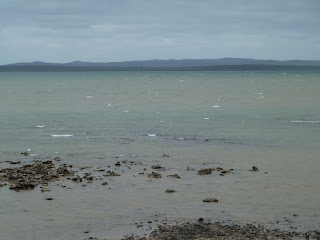
Yesterday a friend and I went for lunch on the Bay. We doggedly sat outside on the deck at The Lighthouse on Cleveland Point (view from, above) and wished we'd worn more clothes. Even the tufty tops (Crested Pigeons) looked miserable, their crests blown all dishevelled.

I saw two things I've never seen at Cleveland Point before, the first being a Grey-tailed Tattler.


I drove almost 65km for lunch not only because Cleveland Point is a lovely spot but because we need to put kilometres on the clock. Novated leasing is a way of financing the purchase of a car. You do it through your company, as a consequence of which there are 'tax advantages'. Another consequence – of the loopier kind – is that, having predicted how many kilometres you will drive in a year in the car as part of the enormous equation to calculate your monthly payments, if you fall short you will be liable for thousands of dollars of back-tax at the end of the financial year. I have heard of people driving from Brisbane to Sydney or Adelaide, or driving round the city for hours on end day after day, or lending their car to others to take on a trip – and all because they've got to reach the lower limit of their predicted annual kilometerage. So, in a nation that has the highest per capita carbon emissions in the world, the government incentivizes people to drive further and use more fuel and enlarge their carbon footprint.

More disturbing than the weather outlook or our crazy car deal is the news from Japan this morning that the whaling fleet has left port for the Southern Ocean with the intention of slaughtering 900 whales over the next three months. All in the name of 'science', of course. After Sea Shepherd's attempts to thwart them last year – the conservation group estimates they saved 863 whales and sent the Japanese whalers home six weeks early – the whaling boats are putting extra security precautions in place, funded by the Earthquake Recovery Fund. How thankful I am that I didn't donate. I don't eat Japanese food or buy Japanese goods either. And I will never go there.

Japan ignores polite protest and reasoned argument: direct action is the only way. See http://www.seashepherd.org/uk/uk.html or http://www.seashepherd.org/australia/

Also announced today was the fact that the government has awarded a ten-year contract to broadcast Australia's international broadcast service, Australia Network, to the state-owned ABC rather than Sky News, partly owned by News Corp. The alternative would have been akin to the BBC World Service going to BSkyB, a proposition so preposterous and thoroughly unacceptable and galling to those of us with UK experience of Murdoch's odious grip on the media as to induce hysterical outpourings. But the monstrous magnate is Australian, isn't he? So, all they seem to be worried about here is whether or not the decision was taken as part of a power struggle between Julia Gillard and Kevin Rudd. See http://newmatilda.com/2011/12/07/sky-fell-rudd

I haven't even brushed my hair today. It's a day for lots of layers and cabin socks (and the penguin blanket later, I suspect). And numerous cups of tea and sweet treats. And blogging.

On the way home yesterday I passed a Traffic Signal Box that I hadn't previously managed to snap. I'm sure one of them must be screaming, inwardly at least.


* The temperature did not rise further and today was Brisbane's coldest December day since 1888

This post was updated at 9pm on 7 December 2011


December 2, 2011

The South Burnett: wine and peanuts

The South Burnett is to weather forecasts in Queensland as South Utsire is to the shipping forecast back in the UK. It's a name you're very familiar with but you don't necessarily know where it is. I found out as I planned a long weekend in the Bunya Mountains.

Kingaroy is the main town of the South Burnett region and peanut capital of Australia*. Peanuts have been grown on a significant scale here since the 1920s. The red basaltic soils and serried young plants are very photogenic. We also have the fridge magnet and postcards.

Peanuts – aka ground nuts or monkey nuts – aren't nuts; they're legumes (beans). You can see Kingaroy's massive (43-metre-high) peanut silos miles away – and they overshadow everything. There have been numerous damaging fires in the town's history: in 1951 the silos, bag shed, peanuts and machinery were destroyed in a dramatic blaze.
Right opposite the imposing silos is the Kingaroy Information, Art and Heritage Precinct. This encompasses the visitor information centre, the Kingaroy Heritage Museum and an art gallery. The museum has all things peanutty, including an old harvester, and when we were there the art gallery had an exhibition of sculptures made from machinery parts.


What about the navy beans, I hear you cry. We need to talk about navy beans. I am not the only one who didn't know what they were. When I first searched for haricot beans in Australia for my lamb and bean stew and multi-bean salad, I was met by a series of blank faces. I was offered cannelloni beans, which are bigger and related to haricot beans but not the same thing. Navy beans are the same as haricot beans but I was not offered those. I have never seen navy beans in the supermarkets or The Nut Market in James Street Market which sells beans that other shops do not. So, where do they all go? Baked beans is the answer, according to my learned friend (and bean expert). They get their name from the fact that the US navy used to carry them as a food staple: they don't go bad and they're very nutritious.

Kingaroy is almost as famous for one of its pollies as its peanuts. Johannes (Joh) Bjelke-Petersen was Queensland's longest-serving Premier (1968-87) and is still much talked about in these parts, as much with loathing as approbation. Born in New Zealand to Danish immigrant parents, Bjelke-Petersen moved to Kingaroy when he was two. As Premier, he presided over a period of massive growth in Queensland's population (spurred by his abolition of inheritance tax), building and infrastructure. Airports, bridges, dams, mines, power stations, roads, tourism (resorts and hotels) and universities all bear his hallmark. But he was no friend of protesters, Aborigines, the media or the Opposition, and, although supposedly in favour of strong law and order, a number of his ministers were jailed later for corruption. If, in your travels, you wonder how an eyesore could ever have been built, chances are it was because of special legislation passed by B-P's government to exempt its developer from local government planning regulations.

On a much more satisfactory note, wine production in South Burnett dates back to the mid-1850s. Today, Clovely Estate in Moffatdale is one of Queensland's largest vineyards, with 430 acres. There are grapes (and goats) in the centre of Kingaroy. We didn't rate a lunchtime white we tried but enjoyed a reasonable local red with a steak at the Broadway Hotel (Ruby's Restaurant) in Kingaroy Street the night before we left. This was the cheapest dinner we've ever eaten in Australia: $56 for two rump steaks, chips and salad and a bottle of Bellbird Cab Sav seemed like a real bargain. The next morning we tasted at Moffatdale Ridge cellar door and liked a sparkling cuvee, a Semillon and a Cab Sav enough to buy a couple of bottles of each.
(Shame about the yellow monstrosity.)
We stayed a few kilometres north of Kingaroy on the Booie Range. Hillview Cottages promised a great view and delivered.

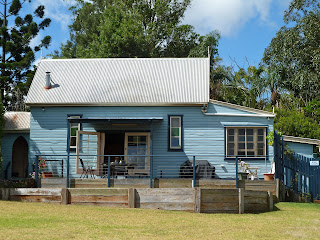
We stayed in a former church that was once in the valley below but moved up in the world in 1996 and was beautifully renovated a few years ago. The welcome was warm and the atmosphere totally relaxed.


A working farm, Hillview was complete with visiting grey mare Connie, Cookie the German short-haired Pointer, and April, 'the mouser', who was more aloof, being a cat.
The first evening, I paid for my beer-o'clock gazing at all before me with the first mozzie bites of the summer, but it was a small price. A couple of days later, Hillview was a hard place to leave on another lovely morning on the Booie.

We headed north on what was still the Bunya Highway. The first item of interest was an unusual crop – Dubiosia, or Corkwood. It is said that Aborigines used to throw the crushed leaves into ponds, whereupon fish would be unable to swim and float to the surface as easy prey. These days, the plant's component hyoscine is used in antispasmodic drugs to treat stomach cramps and motion sickness, and as a surgery pre-med. Tonnes are exported to pharma companies in Europe and Asia.
We passed through Memerambi, where our little church originated, and Wooroolin. Wondai was a pretty little place.
Murgon is the gateway to the South Burnett wine region proper. The name derives from Aboriginal words meaning 'lily covered pond'. There were some fine lilies, but also not-so-fine litter, and we quickly moved on to Moffatdale. I sometimes have too-high expectations of small towns along our way. Some are victims of their own publicity: one that shall remain nameless is described in Touring the South Burnett 2011-12, an otherwise useful brochure from tourist information offices, as 'an appealing boutique town', but I don't think they mean the shops.
While travelling the Murgon-Barambah road, we detoured to look at Lake Barambah, created in 1988 by the Bjelke-Petersen Dam. Caramba! What a bleak place. You won't 'Discover the Magic' of South Burnett here. You can drive across the earth dam, which is mildly interesting, and we spotted Cormorants and Black-winged Stilts, but the often sterile aspect of a man-made lake was never more in evidence than in this vain attempt to sell tourism and recreation. Instead, I looked upwards.
My desire to travel the Kilcoy-Murgon road so as not to repeat any section of our route was thwarted by an unexpected 80-odd-kilometre stretch of unmade-up-ness. So, back to the Burnett Highway. We inadvertently stopped to eat our lunch by the southeastern extremity of Lake Barambah. Dead drowned tree stumps and abundant flies did nothing to change my opinion.
We continued on to Nanango and from there to Yarraman. Tinkling Bell Miners soothed our second wait to negotiate the D'Aguilar Highway roadwork. From Kilcoy we turned south along the Esk-Kilcoy Road and the Wivenhoe-Somerset Road, and then east up Northbrook Parkway and down Mount Glorious Road through the Brisbane Forest to home. This route enabled us to see Lake Somerset and Somerset Dam for the first time, a final flurry of birdlife, the best view of Lake Wivenhoe imaginable and, last but not least, a Carpet Python that had a lucky escape (thanks to my friend's adept swerving) just a stone's throw from Brisbane.
It seems only fitting, however, to sign off with the best name we came across on this trip.

* Australia produces only 0.2 per cent of the world's peanuts. China is top, followed by India and the USA. Queensland produces 95 per cent of Australia's peanuts

This post was last updated on 18 December 2011