October 14, 2011

N.I.M.B.I.N

Now to Investigate My-Byron's Intriguing Neighbours.

The whale-watching weekend was, by definition, extra special (see New south whales, October 2011). But there were additional treats during four days in MFP (my favourite place) a couple of weeks ago.

Kingscliff wasn't one of them. I'd decided we should look at what promised to be tucked-away coastal gems between Tweed Heads and Brunswick Heads if you detour off the Pacific Highway just over the border into New South Wales.

A huge stretch of beach at Kingscliff has been declared potentially unsafe by some nanny-state committee or other. This sign was really off-putting since what I'd come to see was the beach.

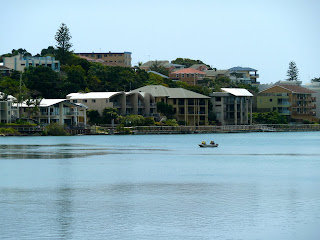
Marine Parade, the main drag, resembled so many others it was equally disappointing, so we headed south along Casuarina Way (great name). Cudgen Creek was, however, an unexpected surprise and delight.


Mt Warning loomed ghostly behind us, and a pair of Pied Oystercatchers (not that common in NSW) were resting, one-legged, despite the inevitable little-irritant jetskier. Nanny had also been here, too.


Further down the coast, Pottsville beach was another joy, although there were hints of trouble ahead.


When we arrived in Byron about four, clouds stormed over Julian Rocks. The light was indeed fantastic.


Sunday was monthly market day. In all my visits to Byron, I've never been there. The overwhelming first impression was of colour.


And the sort of items for sale that you'd expect...


You could browse without being bothered. It was sunny and warm; I felt relaxed; I was at home.

In the afternoon we walked the cliff path south from Broken Head. This resembles the track to the Lighthouse from Wategos, but there were far fewer people. Broken Head Nature Reserve guards a residual pocket of littoral rainforest. The Environment Protection and Biodiversity Conservation Act of 1999 (EPBC) protects the Littoral Rainforest and Coastal Vine Thickets of Eastern Australian as a specific ecological niche. Such areas are at risk from clearing and the invasion of weeds such as Bitou Bush. Even the ubiquitous Pandanus tree is under seige by an insect that causes dieback, and so is being monitored. The more unusual Kangaroo Grass headland also has to be protected – from those that wander off path.


A dirt road wends its way from Broken Head to Seven Mile Beach through the forest. You can access isolated beaches if you are minded to climb down. It was here I discovered my new favourite beach – Kings.


Monday was excursion day. To Nimbin and Nightcap National Park. Nimbin is what Byron used to be or could have been had adoring tourists not transformed it into a gold mine – capital of Alternative Australia. Cullen Street speaks for itself.


Once a sleepy village in the middle of a lush dairy valley...

...Nimbin hosted the Aquarius Festival in 1973 and never looked back. It's a mecca for hippies, backpackers, visionaries and idealists. Slap bang in the middle of the real world, however, following the completion of a solar farm project in March this year, Nimbin can satisfy 75 per cent of its domestic power needs on a sunny day. A shining example to the rest of this solar-reluctant nation.

Even the supermarket resembles an inner hippie sanctum, and everywhere you look there is the pursuit of alternativism. There is, inevitably, a 'Peace Park', a candle factory, an Aquarius Butcher & Baker and a Spangled Drongo restaurant.


Whim-catering: now, there's a worthwhile occupation.

I had wanted to drive around nearby Lilian Rock in search of the rarely sighted Lyrebird. This creature can imitate a number of other bird calls to thwart you. Along with landowners: the lady at the tourist information office on Cullen didn't seem to know about an unsealed back road around the rock, claiming it was all private property. Hmmm.

So we settled for Mt Mardi in Nightcap National Park. The Pholis Gap walking track is named after Athol Pholi who was killed by a tree fall in the area. (I don't know whether he fell from a tree or a tree fell on him.) Warm temperate rainforest gives way to drier woodland with grass trees near the escarpment you descend towards and from which you can look north over valley and range.


Unfortunately there were leeches to spoil a pleasant walk for my friend. He has never quite got over the leech of Mt Mee. While examining our boots for evil creatures, I spotted these at our feet.

On the way home we stopped for tea at The Channon. This image epitomises Australian small-town wayside hostelries on roads to nowhere very much.

Finally, although this is ostensibly a post about other places, here are a few reminders of how beautiful is Byron.


October 13, 2011

Storm warning

It amuses me most of the time that I, one of the world's biggest wusses when it comes to thunder and lightning, should come to live in the tropics.

They don't do storms by half here. The gods really are playing bowls. Thunder doesn't start low and rumbly and build to a crescendo: it cracks suddenly and violently and gunshot loud. Free-standing items rattle and larger structures shudder. Sheet lightning surprises, but the fork lighting here knows no bounds to terror: it cuts through every window and finds me wherever I am. Thousands of strikes per storm are regularly counted by weather stations.

In our last house, floor to ceiling windows rendered every serious electric storm an ordeal. I had a cubby hole in the kitchen – between the larder and the fridge – where I could sit on the step-up and try to read. But close by was a long narrow frosted window overlooking the gap between us and next door that saw very little direct sun yet always let lightning in.

Today there has been a storm warning. Australians are very good at weather warnings. They're explicit and specific about where a storm will hit and what you can expect.

We haven't experienced hailstones yet. Apparently hail-manufacturing clouds turn a bit green, and then you know to move your car undercover and stay inside yourself. Golf-ball-sized are seriously damaging, and quite common, and lots of people take photos of the largest on their mobiles and the Courier Mail publishes them so that its readers can simply marvel.

Sometimes it can be perfectly sunny yet you hear distant claps. Other times, the sky acquires a not-quite-right look that might be a sign: is that blue or grey by that bubbling fluffy white.

You can track an approaching storm cell on BOM's radar loop: scarlet, burgundy and black splodges mean scary-heavy rain and possibly worse.

Most storms approach Brisbane from the west or the southwest. Today they're coming from the north, and are associated with 'shearing winds'. I'm not quite sure of the meteorology there, but the terminology adds to a sense of menace, don't you think?

At the height of a storm – and I'm always in my bunker by then – the sky has no detail. Visibility is minimal and everything is grey and formless in the wall of water or blurry from bending in the squalls.

The first storm I experienced in Brisbane was on Day 2 in January 2010. I was on a CityCat. You couldn't see the banks of the river and rainwater swilled through the cabin from bow to stern. Lightning cracked and thunder boomed. Nobody on board batted an eyelid and our host on this orientation tour of our new city streamed his information unperturbed. I was jet-lagged and possibly a little homesick for my girls as I tried to suppress jumpiness. Raindrops bounced off the surface of the river as if it were a pavement.

You hear waterwall rain before you see it or feel it. There are no spits and spots. You hear a noise a bit like a rushing wind and then a wet curtain drops from the sky.

Of course, if you get a storm warning and then it doesn't materialise, there's this massive feeling of anticlimax and wasted photo ops. But today wasn't one of those days. The following photographs alternate views from our river and city balconies as I rushed twixt both like a frenzied fly.


On the fifth floor of an 7-storey apartment block, do you think I still need a bunker? The guest bathroom has no windows at all...


October 8, 2011

Red Squirrels and Hairy-nosed Wombats

What's that expression? When a door closes a window opens?

A couple of weeks ago The Guardian reported* on the continuing demise of the Red Squirrel, especially in England and Wales. The UK, like Australia, has suffered from the introduction of animals that outstayed their welcome. The Grey Squirrel came from the US in the late 19th century: it's bigger and feistier than the indigenous Red, which is now found only in isolated pockets of the British Isles.

Greys damage the bark of broadleaved trees, bully birds out of suburban gardens, and carry squirrel pox virus, identified in 2005. There are thought to be more than 3 million of them. By contrast, the more timid Reds have dwindled by more than 50 per cent in 50 years (exact figures are not known but may be as low as 120,000).

The Common Dormouse isn't faring too well either. Nor the Harvest Mouse, Mountain Hare, Water Vole, Scottish Wildcat and the humble hedgehog. There were 30 million hedgehogs in the 1950s: now there are about 1.5 million.

But otters and bats are doing better as a result of biodiversity action plans. Otters now enjoy cleaner rivers following the banning of sheep-dip chemicals in the late 1990s. Brown Hares, Polecats and Greater and Lesser Horseshoe Bats are also increasing in number.

On the other side of the planet, the Northern Hairy-nosed Wombat of Northern Queensland is among the world's most endangered animals. There are fewer of them than Giant Pandas or Sumatran Tigers. NHN Wombats are shy, nocturnal creatures. They have lost their territory to cattle, sheep and rabbits, and fall prey to wild dogs and drought. Numbers fell to 35 in 1983. Under a state government protection programme, however, their numbers have been increasing – from 115 to 138 between 2007 and 2009.

Their last natural stronghold was in Epping Forest. That's near Emerald, not northeast London; the town sits on the Tropic of Capricorn 275 kilometres west of Rockhampton. Then came plans to establish a second colony, in southwestern Queensland, just in case the one in Epping was wiped out by an extreme event. With sponsorship from the mining company Xstrata (Emerald is located in a huge mining region), a suitable site was found and developed at Yarran Downs near St George. A predator-proof fence surrounded the Richard Underwood Nature Reserve, and DERM (Department of Environment and Resource Management) rangers dug 'starter' burrows for the translocated animals and cleared the area of undesirable weeds. During 2009 and 2010, 15 wombats were moved. Wombat monitoring and fire, weed and predator management are ongoing.

In March and April this year came news of the birth of two joeys at the second colony.

Habitat destruction – whether it be the result of logging, mining, farming or urban development – plays a significant role in the demise of fauna and flora the world over, and especially so here in Australia. Perhaps it takes the occupants of a big country longer to appreciate the toll taken by extensive resource development.

The relocation of just a few NHN Wombats took a huge amount of time and effort. Many other animals need help to survive now, or they will do very soon, including koalas, bandicoots, possums, Tasmanian Devils, quokkas, quolls, dugongs, turtles, dolphins and sharks – to name but very few** of the most exotic. Even Rainbow Lorikeet numbers are dropping on the Gold Coast.

More biodiversity conservation programmes are imperative.


* State of Britain's Mammals 2011, by Oxford University's Wildlife Conservation Unit for the People's Trust for Endangered Species

** For lists of those at risk from climate change see www.cana.net.au/bush/aus_animals.htm

Image courtesy of DERM


October where?

The only thing that distinguishes the image above from one that might have been taken in the UK at this time of year is the blossom just beyond the window. The jacaranda trees are beautiful at the moment in Brisbane, particularly around New Farm Park, where we live now.

We're approaching the middle of spring, which will be followed by the wet season. Weather forecasters have been telling us to expect higher than average rainfall in October and November and an increased chance of thunderstorms because the Southern Oscillation Index (see www.bom.gov.au/climate/glossary/
soi.shtml) is still tending towards a La Niña event, which means an increased likelihood of rain rather than drought conditions.

But the wet this morning was not warm and tropical. It was cool and gusty and grim. And thundery. And everything looked as if it was wrapped in gauze.


Queensland's devastating floods at the end of last year and the beginning of this were the result of a La Niña event (see A bigger wet, October 2010). We were told by weather experts within weeks of these events that the effects of La Niña would wane by the middle of the year. But that doesn't appear to have happened. The Bureau of Meteorology (BOM) provides regular updates on the SOI – Jenny Woodward, the ABC's lovely weather lady, frequently includes the index in her forecast – and on 28 September BOM reported, 'The continuing cooling trend in the central Pacific Ocean since early winter is consistent with a developing La Niña event.' They predict that it will be weaker than the one of 2010-11. I am sure Queenslanders will be very relieved to hear that.

The Queensland Floods Commission of Enquiry is ongoing. Improved flood mitigation measures have been introduced, the reconstruction of houses and highways continues, and some flood victims are still in dispute with their insurance companies. As we approach the Wet, people can't help but think of last summer's weather events.

It being the second Saturday of the month, the farmers' market was on at the Powerhouse. It's normally busy and bustling like this...

...but this morning it looked like this.

Many stallholders had already packed up and left by 9 o'clock. Australians don't really do wet and windy.