May 19, 2011

The C word

Source: www.inhabit.com
On ABC Brisbane's 'ask the expert' slot a couple of weeks ago, a man phoned in wanting to know how much carbon dioxide there was in the atmosphere. The expert replied, 'About 0.04 per cent'; to which the caller trumped, 'Well, that's not worth worrying about then, is it?' At this point, I banged my head against the kitchen wall in despair. What hope is there for this nation of mega-exploiters of earth's resources; this major-league carbon-footprinter; this reluctant carbon-pricer; this economic-growth obsessive?

The coalition government in the UK has just announced revised, more ambitious targets for reducing carbon emissions by 2025. There had been speculation that PM David Cameron would renege on his stated intent to be the greenest government yet; that there was a massive rift in the Cabinet between those afraid that emission targets would harm the economic growth necessary for recovery and those determined to keep their word, as well as set an example to all those dithering nations who cry, 'We won't do it unless you do'.

I have just read Requiem for a Species: Why We Resist the Truth about Climate Change by Clive Hamilton, who is an Aussie and Professor of Public Ethics at the Centre of Applied Philosophy and Public Ethics at the Australian National University in Canberra. For 14 years until 2008 he was the executive director of one of Australia's most progressive think tanks. Why has no one been listening to him? The book should be compulsory reading in educational and governmental establishments across the land.

It makes grim reading. It's not about averting the climate crisis: the starting point is that it is already too late; serious climatic change is inevitable; so why have we let it happen? It analyses the failures of our institutions and our peculiar tendency to bury our collective heads in the sand. It is about 'our strange obsessions, our hubris, and our penchant for avoiding the facts'; 'our greed, materialism and alienation from nature'.

A report* released by Environment Victoria this week showed that in 1960 19 per cent of Australia's electricity was provided by renewable sources of energy. By 2008 this had fallen to just 7 per cent. The group's Campaigns Director summed up Australia's problem, if not the world's: 'For all the hand-wringing about climate change over the past decade we've seen massive growth in emissions from coal generation.' Between 2001 and 2009, there was a 10 per cent increase in coal-fired power generation, which meant 14 million extra tonnes of greenhouse gases in the atmosphere each year.

In 2007, however, there was a marked change in Australia's energy policy. In June the then Prime Minister John Howard announced that an Australian Carbon Trading Scheme would be introduced in 2012. A few months before that, the state governments, with Opposition leader Kevin Rudd coming on board, had commissioned the Garnaut Climate Change Review. Howard lost the election in November and Rudd came to power. The Garnaut report in 2008 recommended an emissions trading scheme (among many other things), and Rudd duly announced such a scheme, to take effect by 2010. This was later put off a couple of times (eventually until 2013) and its postponement and Rudd's seeming lack of resolve was instrumental in him being replaced as leader by Julia Gillard. During the election campaign in August 2010, she promised, 'There will be no carbon tax under the government I lead'. Now, as she plans to implement carbon pricing in July 2012, she explains that back then she had intended to introduce an ETS, but that circumstances have since changed and carbon pricing has become necessary.**

I have never understood why it is completely verboten for a political leader to change tack. It seems to me that a lady who is for turning has an open mind, is flexible and more inclined to reassess challenges, which is crucially important in a global crisis. Of course, she may have just been out to get a few more votes, knowing that the Australians' commitment to environmental issues does not extend to measures that may impact on their pockets. Which is why they don't embrace solar power, even though they live in one of the sunniest places on the planet – except for last year. If you ask an Australian why they don't install solar panels on their roof, they will ask you if it will make their electricity cheaper.

There's a huge to-do in Australia about the proposed carbon pricing. The prospect is deeply unpopular, even though it is a revenue-neutral policy and there will be compensation for both 'Australian working families' and not-so-big business. A combination of scaremongering by the powerful energy and mining companies (they claim there will be many job losses) and the mud-slinging nature of Australian politics (neocon Opposition leader Tony Abbott attended an anti-carbon-tax rally at which protesters held up placards saying 'JuLIAR Bob Browns† bitch') means that rarely are global warming issues debated intelligently and dispassionately.

In the world according to Clive Hamilton, drastic emissions reductions are not a matter for debate. Urgent and considerable action is required by governments immediately; unpopular action that will cost companies and individuals dear. But not as much as if global temperatures rise by four or five degrees. Many millions of people will pay for that consequence with their lives.

Source: Proinso Solar Energy Supplies

* Australia's Electricity Generation Mix 1960-2009, a report by Green Energy Markets for Environment Victoria, May 2011

** an emissions trading scheme means the government sets limits (or caps) on the amount of pollutants that can be emitted. The limits are sold to industries in the form of emissions permits. A business must hold a number of permits that are equivalent to their emissions, which must be within the cap. If a company needs to increase its emissions, it must buy permits from those who require fewer permits. Carbon pricing means that the government fixes a tax that is levied according to the carbon content of fuel.

† Bob Brown is the leader of the Australian Greens


May 11, 2011

Leichhardt, hinterlands and places beginning with M

Time was when hinterlands were confined to geography lessons, but the Aussies love them, and there's a lot of them about. Near here, there's a Sunshine Coast hinterland and a Gold Coast hinterland and a Byron Bay hinterland and doubtless many more. I am not qualified to define where they begin or end, or how big a town or city has to be to qualify for a hinterland, but I do know that the Blackall Range, where we spent the extra-long Easter break, is a dominant feature of the Sunshine Coast hinterland.

The mountain range was first visited by a big name in early Australian exploration – Ludwig Leichhardt. I'm going to digress a bit here because his story is an interesting one. He arrived in Sydney from Prussia (Germany) in 1842 with the intention of exploring the interior. First he studied the geology of the Hunter Valley and the fauna and flora of the east coast from Newcastle to Moreton Bay. But his aim was to join a government-sponsored expedition overland to Port Essington, north of where Darwin is today, which was important for trade with Asia. When this didn't materialise, he found private backers and persuaded volunteers to accompany him. He left Jimbour in Queensland's Darling Downs in October 1844.

After a journey overland of nearly 4,800 kilometres, during which he discovered important rivers and recorded everything he found of interest, Leichhardt reached Port Essington 14 months later. He arrived back in Sydney (by boat) the following year and received a hero's welcome from people who had thought he was long dead. Next he had an even bigger plan: to travel across the continent to the west coast. With a government grant this time, and private backing, he left the Darling Downs at the end of 1846, but was forced back, after covering some 800km in six months, by bad weather, sickness and lack of food.

In March 1848, he set off again for the west coast, starting from the Condamine River in Queensland. He was last seen in April in the Darling Downs. His expedition had been expected to take two to three years so he was not presumed to have perished for many years. The New South Wales government sent search expeditions in 1852 and 1856 but, apart from a few 'L's carved on trees here and there, hard evidence of Leichhardt's demise illuded them. In the 1860s there were further searches, and Leichhardt's fate was never far from explorers' minds. In 1896, David Carnegie from Western Australia was exploring the Gibson and Great Sandy deserts when he came across Aborigines who had artefacts Carnegie believed had once belonged to Leichhardt.

Then, around the turn of the century, an Aborigine stockman not far from Sturt Creek in northwest WA found a small brass nameplate bearing Leichhardt's full name and the year 1848. It was attached to the burnt remains of a shotgun hanging in a baobab tree that was marked with an L. In 2006 the nameplate was finally authenticated by historians and scientists as belonging to the German explorer. We may not know when or how Leichhardt died, but we do know now that he made it almost two-thirds of the way across the continent, a remarkable feat. He had never intended to travel in a line from east to west, across vast swathes of desert, but to follow a great arc from Queensland to the Swan River, following the head waters of rivers draining into the Gulf of Carpentaria and to the north coast. He had then hoped to find a southwesterly flowing system to take him towards the Swan. Some of those L-marked trees found earlier were near the Flinders River; and Sturt Creek flows to the southwest, albeit an awful long way from Leichhardt's intended destination.

Today, in honour of this man, there is a suburb in Sydney, a highway in Queensland, a river in Queensland, a suburb of Ipswich (west of Brisbane), an electoral district in the House of Representatives and even a Eucalyptus leichhardtii.

So Leichhardt was here, in the Sunshine Coast hinterland, before us. This was my second choice, as it was his. I had wanted to go to the Bunya Mountains, slightly more off the beaten track, but everywhere insisted that we stay four nights over this Easter-with-Anzac-Day-tacked-on weekend at the end of April. (Actually, it was more like Anzac Day – probably the most important day in the Oz calendar after Australia Day – with Easter tacked on.) The Bunyas are probably lovely, but I wasn't sure there was enough to do there for five days; besides which, three nights was what we wanted.

The Bruce Highway was slow-going – two idiots had had a shunt somewhere south of Burpengary. We turned off on to the Steve Irwin Way, and passed pineapple fields, which are still a source of wonder to me, and the first mighty Glass House Mountain – Mt Beerburrum.


We drove to Maleny for lunch, but most of the little town was closed for Good Friday. Some places were open for the morning only. Every day over the long weekend was guesswork as far as opening hours were concerned. Was Monday Easter Monday or Easter Monday and Anzac Day, which has to be on the 25th (and you have to close in the morning); in which case was the holiday on Tuesday Easter Monday deferred, or a holiday in lieu of Anzac Day because Monday was a holiday anyway? Of course, if Easter were fixed*, and earlier, then it wouldn't clash with Anzac Day and everyone wouldn't have to ask the same old question for the first three months of the year.

Maleny has a colourful high street with lots of cutesy little shops.


It's even got a 'sustainable' bank (Maleny Credit Union), which looks suitably little-cabin-in-the-forest.

Montville, about 15km further north, is cuter still. It's main drag is more up-and-downy, and it has more greenery, prettier buildings and lovely views to the Sunshine Coast from cafes on the right side of the street.


Things come in threes, and Mapleton is 9km further north still. It is much smaller, with a splendid lily pond and some falls that are rather difficult to see.


We were staying about 9km out of town along Delicia Road in a lovely cabin at Coolabine Ridge Eco Sanctuary. It was a beautiful evening and we looked out over the Obi Obi Valley as the sun set. After steak on the barbeque, we went stargazing: with only slight light pollution in the east from the coast, the magnificent Milky Way dripped its ancient light over the Blackall Range.


When you're staying in an idyllic spot, there is little incentive to get up and get on. We decided to explore some of Coolabine Ridge's very-well-maintained 400 acres before cooking breakfast on our verandah. Oh, what a beautiful morning it was.


Natural wonders of note included fungus that resembled coral and a right-angle tree.


There were even some of these... and they loved apples.

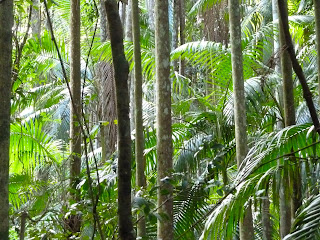
The Blackall Range was created by volcanic activity 25-30 million years ago, but has since been eroded by water, forming ridges and waterfalls cascading over the escarpment edge. Rich basalt soils once supported large tracts of warm subtropical rainforest, but only remnants remain, protected in national parks.

In the Mapleton Falls National Park we walked the Wompoo circuit, which is only short (1.3km). We didn't hear the Wompoo Fruit Dove but Whipbirds and Bell Miners instead, and there were very fine Piccabeen palms in a creek. As usual, most visitors confined themselves to the first couple of hundred metres of the walk or the picnic area so we had the circuit to ourselves. Although the view of the waterfall from the lookout was anything but 'spectacular' (maybe the park rangers need to cut back a few branches), the Obi Obi Valley was a study in lush greens.


If you continue along the Obi Obi road from Mapleton Falls, you can drive a circular route through some lovely country. First up is Kenilworth, a pleasant little town on the Mary River. The road follows the river to Canondale, and then continues to Witta and Maleny. Make a detour at Maleny to drive along Mountain View Road for wonderful distant views of the Glass House Mountains. If you've got time, visit the Mary Cairncross Scenic Reserve, where the rainforest track is well worth walking, early in the day preferably. From Maleny, you can complete the drive via Montville and back to Mapleton.


We were staying very close to the most northerly part of the Sunshine Coast Hinterland Great Walk – the Delicia Section. It's 14km in total, but we just dipped in for about about five or six kilometres. We joined the track a kilometre or so before the Thilba Thalba walkers camp and walked as far as Gheerula Bluff. This was open Scribbly Gum forest rather than thick rainforest: there were fine examples of Banksias, Grass Trees and scribbles.


We kind of wished we had got our act together to do the full day's walk, but this was supposed to be a chilling holiday, during which we spent long periods gazing at lovely views and contemplating what Leichhardt must have thought as he tried to find his way through endless upland barriers on his way across this continent.


* as opposed to being on the Sunday following the paschal full moon, that is the full moon that occurs on or after the March equinox. The paschal full moon was the date of Passover in the Jewish calendar, which is allegedly when the last supper took place


May 9, 2011

On a picnic blanket in the park

Yesterday was Mother's Day here. The day started hazily, before becoming a bit Tupperwary by lunch, and then clearing by mid-arvo into sunshine and warmth. I wasn't feeling well, and spent most of the day either in bed or struggling to get comfortable on the sofa. But I was enticed into Waterline Crescent Park to take the air, on a picnic rug beneath a bottle tree.


There was not a garden gadget to be heard. Nor was the idiot-on-the-park, who can't drive his Audi without constantly gunning the engine, going to and fro between garage and wherever. It was peaceful. Was everyone out visiting?

I have noticed our neighbours don't do what we were doing: maybe their yards catch more sun than ours at this time of year. Only kids seem to use the park. They gather with mates after school; play footie; practise kicking with their dads sometimes; oh, and schoolies stagger out to the swings at 5am after an all-nighter, but that is highly seasonal usage. One neighbour once told me that people would sometimes get together in the park for drinks and a barbie. But you'll never see it happen. This isn't an official day rest area, you see: there's no barbie provided by the council; no picnic benches; just low walls, around the swings, to sit on. It's just a lovely green oasis in the middle of suburbia, where people didn't cut down the trees and name streets after them.

I curled up with my back to the sun, lizard-like. Soon I had to shed a layer. That's the thing about living here: it's the equivalent of November in the UK, and there I was, lying in substantial warmth, and feeling much better for it.

A mackerel sky was developing from the north.


We spotted an old friend.

But then the ants came. It's taken me a long time to respect Australian ants. There are many varieties and all shapes and sizes. We have ants on a mission with large, orange-brown end-bits: they march day and night up and down the front and back walls of the house. The lines are at the same point along the walls, so maybe there's a meeting on the roof. One of these stung my long-been friend when she opened her bedroom window during the night, and her finger swelled up for two days. We get small blacks on a particular worktop in the kitchen if we inadvertently leave food crumbs around: these don't sting when I squash them. Other tinies live in a nest by the garage door: they move so fast I can't even focus on them. And angry ants live in similar nests under grass. These go apeshit if you disturb them while mowing the lawn or lying on a picnic blanket. One got my friend on his back once as he lay recovering from a run, and the puncture wound was reluctant to heal for a while. And I had many a painful toe before I started wearing proper shoes for gardening.

On this occasion, we moved three times to escape the cross ones. Then the sun went in, and so did we.