February 18, 2011

Return to Rainbow

It wasn't planned. We were staying in Noosa, and my friend thought our visitor would enjoy a drive on the endless Cooloola (Teewah) Beach, which we could see in all its misty splendour from our apartment on Noosa Hill. But the South African who hired us the very large and very expensive 4WD ambushed our sketchy plan. He came up with a hard day's drive that included dolphin spotting. So we did it. (He told us completely different stories about tide times on two consecutive days so I suppose we took a chance.)

It meant a 5.30am wake-up and 6 o'clock departure, without breakfast. Almost immediately there was challenging navigation required (of me - my friend always drives 4WDs) as we cut across from Tewantin, 8km west of Noosa Heads, to the main Tin Can Bay Road. This involved a mixture of minor paved roads and not-too-spine-jarring unsealed tracks through bush and forest: some of them had great names – Boreen Point, Junction, Cootharaba, Dr Pages, Kin Kin and Counter. There were one or two roos and whole plantations of Out of Focus trees.

We got to Tin Can Bay just before 8, in almost exactly the time the South African had predicted. And even though I always doubt that animals will behave according to human expectations, the dolphin turned up at 8.10 (see Dolphin Days, February 2011).

After a full English in a dolphin-spotters' greasy spoon, we drove to Rainbow Beach. We had a couple of hours to kill at least before the tides would allow us on to Cooloola and we needed a decent coffee. It was raining in Rainbow...

I had to pop into the supermarket where I had previously come across one of the few stroppy Aussies (in public service) I've met. On this occasion a very helpful lady planted a seed in my mind. Back at the car, I announced that I wished to see up close the coloured sands that give Rainbow Beach its name. They were looking particularly fine, I had been told, as a result of all the rain. There was opposition; and despite my chatting up a very fit surf life saver on the beach, he could not make the sea recede beyond Eight Mile Rocks so that we could access the famous cliffs from the town and not risk the South African's 4x4.

We headed off for Cooloola and bumped 16km down Freshwater Road. Neither my friend nor I had anticipated we would be doing this again so soon. We arrived at about 1.30, half an hour ahead of the recommended time. The waves were still breaking high up the beach as we cautiously picked our way towards Double Island Point. I now had it in mind, of course, to approach the cliffs from the lagoon end of Rainbow Beach, but this was still a heavily tide-dependent notion.

We crossed the shoulder of Double Island headland via the Leisha Track, parked and paddled in the bath-warm shallow water of the lagoon. The sun was out sporadically.

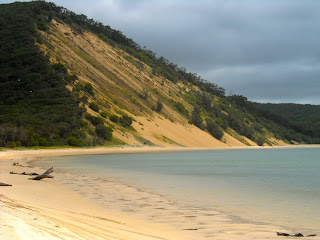
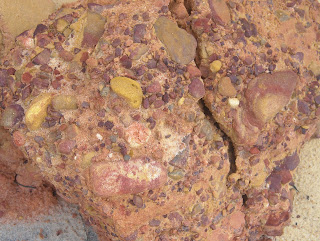
We watched while one car attempted to reach the parts I wanted to reach, but they turned back. I willed the outgoing tide on its way. We had talked to a ranger on the way down Freshwater Road and he had warned of debris on the beach, too. Thwarted? Not us. We're in Oz, where you can go where you want to go. We drove so far, left the car and continued on foot towards the especially red cliff. I have already described how these sands were formed (see Rainbow's magic, November 2011): this is what we saw.


Unfortunately, we ran out of time: we had to get back to Brisbane that evening. We drove back over Leisha on to Cooloola and headed down almost its entire length (about 50km), occasionally in driving rain. Awesome.


February 16, 2011

The aftermath

What a wonderful sight this was 48 hours ago: the return of the ferries* to the Brisbane River. It meant that our very important visitor – who arrived ten days ago on his first visit to Brisbane – was able to sail into town, get his bearings on the city and photograph the Story Bridge from the water. And see the forlorn remains of ferry terminal pontoons that had not been restored in time for today's resumption of service, and the remnants of the Floating Walkway, several hundred metres of which sheared off during the January flood.

I have never seen people so excited about getting back to work as the ferry staff. They almost welcomed passengers with open arms; certainly with grins from ear to ear. It was a joy to behold. One of them at Bulimba's terminal, as well as handing out new timetables, gave my 24-year-old visitor a cardboard cut-out CityCat model to make! From the info around the pieces I learned that a third-generation City Cat can carry 165 passengers and travel at a maximum speed of 25 knots.

Not all parts of Brisbane are back to normal by any means. Six weeks on, in the very heart of the city, there are businesses, apartment blocks, hotels, restaurants, offices and underground car parks that remain closed and in need of repairs running into millions of dollars. One hotel alone in the CBD expects its final bill for water damage and lost revenue to exceed $10 million.

For many home-owners affected by flooding, in cities and towns and regional Queensland alike, life is still grim. Up to half of them don't have insurance that covers what has happened to their homes. Others sit in limbo in caravans or other temporary accommodation while their insurance companies quibble about whether the damage that triggered the claims was the work of riverine or storm (flash flood) water while they await hydrologists' reports.

When we went to bed on Wednesday 2 February, it seemed more than likely we would wake up to loss of life as well as devastation across Far North Queensland in the wake of Severe Tropical Cyclone Yasi, due to hit land at around midnight. Yet, miraculously, we didn't. The centre of the storm had passed over Mission Beach – lovely Mission Beach (see Roadtrip Part 1: Heading up north, July 2010) – and the larger nearby towns of Tully and Cardwell had also been seriously impacted. (Cyclone Larry, the last STC to cross the Queensland coast, in 2006, struck Innisfail, not far north of there.) But the cities of Cairns and Townsville had been spared the worst, and there were huge sighs of relief across the entire country. Banana plants and buildings may have been flattened and Queenslanders badly shaken, but there were no serious injuries or deaths**.

Now it is two weeks later and Yasi is no longer making headlines. A friend emailed me from the UK yesterday to say there is no longer any news about how Queenslanders are faring, post-flood or post-cyclone.

Well, there are still thousands of people without power or water in the north of the state. Transmission poles are damaged or snapped off, and thousands of kilometres of wire need to be restrung. The breakdown of equipment in pumping stations is a big problem.

Some banana farmers, cane growers and exotic fruit producers have lost almost all their crops, especially if they're near the coast: trees have been uprooted and plants snapped off or completely razed. Bananas may take only a few months to get back to production, but papayas may take a year and lychees as many as four. Tropical flower and plant nurseries and timber growers have also been badly hit. Some farmers counting the costs today had only just re-established themselves since Cyclone Larry. Yasi may prove a setback too far.

The cyclone wreaked havoc with the Great Barrier Reef. Coral sand cays on Taylor Reef that once stood four metres out of the water and provided refuge for migrating birds and turtles have been wiped off the map. Around the Bedarra group of inshore reefs water clarity is poor, although there are signs of marine life returning. Outer reefs may require only another couple of weeks to recover: ocean currents will improve water quality there a lot quicker.

And what of the endangered birds that give this stretch of devastated coast its name? Since the cyclone, Cassowaries have been deprived of the forest fruits that make up their diet, so they are approaching houses in search of food, where some have been attacked by dogs. Rangers are setting up feeding stations in the rainforest and fruit is being dropped by helicopter, but these hungry animals are currently at greater risk than ever. Half a million dollars will be spent to try to ensure their survival.


Even people not directly in the path of the monster storm or inland, where it gradually degraded, are far from back to normal. Today I was in touch with the Barking Owl Retreat in the Atherton Tablelands where we stayed on our roadtrip last June. They prepared extensively for Yasi, having learned from Larry: they tied things down and locked things up and bolted things down and taped things up. After an almost sleepless night of howling, terrifying wind and lashing rain – worse because it was dark and they couldn't see what was happening – they had to assess the damage and quickly get on with the clean-up. Several trees were down, everything had to be unpacked or untied and the house hosed down (tape leaves a residue that needs dealing with immediately).

Two weeks on, there are serious shortages of goods that are normally freighted into the region, which affects everyone, not least retailers. And those involved in tourism are seriously affected. Tourists don't visit disaster zones as a rule. Since the floods in southeast Queensland began generating negative publicity for the state, and now a big scary cyclone, visitors to the Tablelands and big tourist centres on the coast such as Cairns and Port Douglas are noticeably fewer. People in Noosa said much the same thing last week when we were there - and Noosa hasn't been flooded or battered.

And the cost of the great clean-up and reconstruction of Queensland? $8 billion for the damage done by Yasi, according to Queensland Treasurer Andrew Fraser, on top of $5 billion following the floods. These costs will be met by the Natural Disaster Recovery and Relief Arrangements (NDRRA) between the state and federal governments. Some of the Queensland government's plans and projects have already been postponed, as have the national government's. In addition, Julia Gillard has finally managed to garner enough cross-bench support for her $1.8 billion flood levy, although plenty of Australians are not in favour of such a measure, having donated money already.

The Premier's (Anna Bligh's) Disaster Relief Appeal has so far raised almost $220 million. $66 million of that was distributed within two weeks to many of those in need. I suspect the people of Haiti might be envious of such efficiency.

Many questions are inevitably asked in the wake of such disasters. Why does building continue apace in flood-prone areas? Why is electricity supply not underground? Why do building regulations not ensure better cyclone-proof construction? Should control of dam releases be in private hands? But it is my belief that the loss of life, especially during Cyclone Yasi, was not far greater because of the degree of preparedness on the part of the authorities and the people of Queensland. I listened to local radio for a whole day preceding each event and the supply of information, advice and warning was impressive.

Last week one of my daughters asked me to return to the UK so that she could stop worrying about me being washed or blown away – or caught up in a bushfire. 'What is it with that country?' she asked, only half in jest. Today a weather man declared that the intensity of the La Niña effect – the greatest for 150 years – has decreased, but that tropical Australia will not be completely out of the wood until March.

The weather has been much more settled of late, and we've had gloriously hot and sunny Queensland summer days. But, as I write, Cyclone Carlos is approaching the Top End and it's Darwin's turn to batten down the hatches.


* 15 out of 23 ferry terminals were operational from Monday 14 February, two weeks ahead of schedule. Eight remain closed until further notice

** A young man was found dead a couple of days later near Ingham. He had been asphyxiated from diesel fumes after using a generator in a closed room

February 3, 2011

Acronymity


An acronym is a word created from the initial letters of several words that make up the name of something. Many acronyms are TLAs (Three Letter Acronyms). Technically, the letters should form a word itself, as in ASH (Action on Smoking and Health) or MADD (Mothers Against Drunk Driving), otherwise it's an initialism, or even an abbreviation, but let's not get purist.

Acronyms can be very useful, if you're familiar with them, but if you've no idea what they stand for, they're damned annoying. I've always loved them; and my life changed for the better one day years ago when a colleague introduced me to acronymfinder.com.

My friend works in a business (the construction industry) that loves them, too. He favours ECI (Early Contractor Involvement) in projects that may include TBMs (Tunnel Boring Machines) and often necessitate NCRs (Non Conformance Reports). I once looked over an important document to be used in litigation by a company he worked for in Denmark (I was a copy editor in book publishing in those days). It had been written by English-speakers but it still took me half an hour to proofread a page.

The Aussies love acronyms even more. Listening to ABC (Australian Broadcasting Corporation) News, you'll need a basic grounding in current acronym usage otherwise you won't know what they're on about... even in a traffic report. You'll hear about congestion on the ICB (Inner City Bypass) and in the CBD (Central Business District) and maybe by the RWH (Royal Women's Hospital) on the Lutwyche Road.

This summer in Queensland has been dominated by harsh weather: we've had serious flooding in SEQ (South East Queensland), although the GC (Gold Coast, below) escaped; and FNQ (Far North Queensland) experienced the scariest category 5 STC (Severe Tropical Cyclone) in living memory. Watching the massive storm's approach on BOM's (Bureau of Meteorology) radar maps was disturbing. The system extended inland as far as the border with NT (Northern Territory), which is practically unheard of. The SES (State Emergency Services) were outstanding throughout. There are fears about the impact of both these events on the GBR (Great Barrier Reef).


Elsewhere in recent weeks there have been floods in NSW (New South Wales) and northern Victoria. Fortunately the GOR (Great Ocean Road) was spared a weather catastrophe. And there have been raging bushfires in WA (Western Australia). ACT (Australian Capital Territory) and SA (South Australia) seem to have escaped so far.

When we first moved to Queensland we were warned about controversial issues such as DST (Daylight Saving Time*); the MDB (Murray Darling Basin**); and ATSIs (Aboriginal and Torres Straight Islanders). We witnessed a federal election last winter and that highlighted a whole host of other issues. The ALP (Australian Labour Party) and the LNP (Liberal National Party) locked horns over the NBN (National Broadband Network); IDPs (Indigenous Displaced Persons); MDGs (Millenium Development Goals); IR (Industrial Relations); the impact of the GFC (Global Financial Crisis... or more likely Geelong Football Club if you live in Victoria); OC (Organised Crime); and the processing of asylum seekers in PNG (Papua New Guinea). Unfortunately, there was precious little debate about AGW (Anthropogenic Global Warming)... or RIFAs (Red Imported Fire Ants) for that matter.

If you live here, you have to have EFTPOS (Electronic Financial Transaction at Point of Sale) in order to go shopping, when you might venture into BCF (Boating Camping Fishing) or BWS (Beer Wine Spirits). Be careful in the latter, however, because they have RBTs (Random Breath Tests) in Australia. Never mess with the QPS (Queensland Police Service) or the ATO (Australian Tax Office). And make sure you know what PWD (People With Disability) signs mean.

If you live in the outback, you're sure to have an ATV (All Terrain Vehicle) and you may even own an ACD (Australian Cattle Dog).


Wherever you are, there'll be an RSL (Returned and Services League) club, where you can hang out – not worrying about having to BYO (Bring Your Own) liquor – and talk about sport, principally the AFL (Australian Football League), which isn't football as the rest of the world knows it, of course. This summer you might have got excited about the Ashes, and even been to the MCG (Melbourne Cricket Ground) or SCG (Sydney Cricket Ground). If you couldn't get a ticket, you could have followed it OBO (Over By Over) on the SMH (Sydney Morning Herald) website. The Ashes were quickly followed by ODIs (One Day Internationals).

Some people like acronyms so much they claim the word acronym is an acronym – Abbreviated Coded Rendition of Name Yielding Meaning. Clever-arse acronymising is the very worst acronymic sin, IMHO.

* Queenslanders are divided on whether or not to stick with AEST (Australian Eastern Standard Time) all year round or observe DST during the southern hemisphere summer

** A huge river catchment extending into QLD, NSW, SA and Victoria, covering 1,061,469 square kilometres, or 14 per cent of Australia's landmass, and containing more than 40 per cent of the country's farms, hence its nickname, the 'food basket of Australia'. The MDBC (Murray Darling Basin Commission) steers a perilous course between profitability and sustainability in the management of the region's resources

† In My Humble Opinion

February 2, 2011

Queensland holds its breath... again

Waiting for a major weather event – or the aftermath of one, such as severe flooding – reminds me of pregnancy, at about the 37th week. There's an awful sense of inevitability. You know there's a good chance the event will be painful, but it's impossible to avoid it. And a part of you is desperate for it to happen, so that you can get on with a different life beyond.

We got up this morning to the news that Tropical Cyclone* Yasi has been upgraded to a category 5. The last time a Severe Tropical Cyclone came ashore in Queensland was in 1918. It means wind gusts of up to 320km/hr near the centre. I can't begin to imagine that. Presumably, it can literally blow you away. But the main danger to life is not damaging wind but storm surge**. The cyclone's landfall – between Cairns and Townsville – will coincide with high tide; typically, there'll be 2-4 metres of surge plus the high tide. More than 700mm of rainfall are expected.

Tropical cyclones normally dissipate quickly as they pass over land: friction slows the wind and the system is deprived of its 'fuel', warm tropical sea water. But it is expected that huge Yasi, even 500 kilometres inland and 12 hours after landfall, may still be of category 3 intensity; and there is likely to be torrential rain (category 1 or a 'tropical low') as far into Queensland's interior as Mount Isa (900km from the Coral Sea) and the border with Northern Territory.

Mandatory evacuations began during the night, including the largest movement of hospital patients in Australia's history, including intensive-care patients, heavily pregnant women and newborns – by air to Brisbane, which is well to the south of the cyclonic action.

I have never lived in a country where events are such that politicians or State Emergency Services personnel or weather bureau spokespeople gravely describe them as the 'most catastrophic storm to ever hit our coast'. 'Evacuate now,' they warn. 'Don't bother to pack'. And 'This impact is likely to be more life-threatening than any experienced during recent generations'. Media headlines include words such as 'monster', 'horror' and 'deadliest'.

It's roughly 12 hours till landfall (10pm AEST). There are still several unknowns, principally where it will cross the coast and how high the storm surge will be. What is certain is that it will be dark. And the noise of the wind will be terrifying – like a high-pitched scream, those with experience say. As the storm does its worst, there will be few, if any, communications channels open, and SES personnel must protect themselves as well. The weather bureau's radar system and wind measuring equipment on Willis Island, 450km east of Cairns, has already been knocked out – at 9am this morning. Queensland Premier Anna Bligh is stressing the mental preparation necessary for this event as much as survival tactics such as stockpiling fresh water and stacking mattresses in the smallest (most structurally sound) room.

This morning I am thinking of all the beautiful places we saw on our travels that now sit in the path of destruction: Shute Harbour, Mission Beach, Dunk Island, Palm Cove, Cow Bay, Cape Tribulation and the Atherton Tablelands. One thousand kilometres of coastline are at risk, such is the scale of this thing.

One or two listeners have reported to ABC Radio that there are no birds or insects to be seen or heard in the calm before the storm. And a friend near Atherton emailed this morning that she has never seen so many frogs trying to sneak into the house. Not-so-dumb animals, then.

* A non-frontal low-pressure system that forms over warm tropical seas and produces powerful winds and torrential rain that may extend for hundreds of kilometres from the cyclone's centre. A category 5, the highest grade, is described as 'extremely dangerous with widespread destruction'. Wind speeds are in excess of 280km/hr. Tropical cyclones are known as hurricanes or typhoons in different regions of the world

** An offshore rise in water level associated with onshore winds that are part of a low pressure system


January 30, 2011

Random in Jan

January was eventful – excessive downpours, floods, endurance trials, leeches – but it wasn't all dramas. There were a few less newsworthy happenings.

New Farm Park market
We go to New Farm Park on the second and fourth Saturdays of every month to the excellent farmers' market at the Powerhouse. We used to go by CityCat, of course, pre-flood. We buy the tastiest orange juice this side of Winnetcut (sorry, family saying); the best-value prawns in Australia, and the best-tasting since a sherry-laced lunch in Sanlúcar de Barrameda in southern Spain in the mid-90s; the most delicious jam I've tasted since I ate Scotch pancakes with locally-produced raspberry jam while on holiday in Blairgowrie (Perthshire, Scotland) when I was about 9; refreshing lime cordial from Noosa; wonderful local lamb; Glass House Mountain pineapples; olives from Bunnyconnellen, way out west of Brisbane; Swiss-style cheese; superbly chocolatey, handmade, luxury mini brownies; fresh herbs and salad; and a cornucopia of fresh fruit and veg.

Sometimes we haven't got a clue what a fruit or vegetable is, or what you do with it, such as...

jackfruit,
bell fruit
or soursop.
(Up the road in the James Street deli, my friend was particularly pleased recently to find what are known as paraguayos in Spain, or doughnut peaches in the UK and Oz. I prefer an alternative name – Saturn peaches. They are delicious... and very pretty.)

When we've got all we need in the market, we sit in the park with a coffee and observe: there's always something going on, even if it's just frolicking playmates in the dog off-leash area. The Australian White Ibis (below) completely underestimated the toddler's dogged determination in pursuit and in the end had to take flight to escape.

This possum was quite happy scurrying about on the ground behind the stalls...

until confronted by this...

...after which there was a prolonged poodle-possum stand-off. Possums can sometimes be mistaken for cats, you see.

Other beasties
The smallest geckos ever seen were a feature of this month's wildlife. We have several babies in the house at the moment... I think. (The spoon, below, is a teaspoon.) You have to be careful not to squash geckos when rolling up the blinds in the mornings because they tend to sit on top of them waiting for moths to flutter by. Today I have cleaned up the remains of five 'moth-strikes' from last night.


They like crevices and the gaps between tiles or wood panelling. And this adult (below) took my fancy as he calmly sunbaked on warm wood while the flood waters rose steadily below him. He probably didn't remember '74.

A praying mantis was a first-time visitor to our 'yard' one fine day, settling on the Claret Top. This insect is more closely related to a cockroach than a stick insect or grasshopper. Its green was stunningly limey.

Dunnies with dignity
During the flood clean-up, thousands of volunteers hit the streets in affected areas. Blue tardises sprang up on pavements and verges to cater for their needs. They're still there.


Sunsets
The occasional sunset was oddly comforting during the days of increasingly threatening heavy rain.


Sign of the month
Spotted in Woodford on Australia Day.

I can't.