
It was exciting to fly away very early on Christmas Eve. We were in Melbourne by 9, with practically a full day ahead of us. We'd previously visited Melbourne in 2006 and had good memories. I've never come across anyone, in fact, who doesn't like Melbourne.
We were staying that night at The Cullen, in Melbourne's southern suburb of Prahan, which I I've never known how to pronounce so I call Piranha. I've since learned that it's affectionately known by locals as Pran, which makes life easier. Opened in late 2009, The Cullen is one of the Art Series hotels, three boutique hotels in south Melbourne, each one of which was inspired by and features a 'unique and celebrated artist', Adam Cullen in this case.

Cullen is a 'bad boy' of Australian art, taking a wacky, irreverent look at society without fear of offending – a bit like Damien Hirst was before he got rich and started sticking diamonds on skulls. Cullen's work is not to my taste, although one or two of the paintings made me smile, but our room – which was incidentally one of the most beautifully lit hotel rooms I've ever stayed in – had the coolest shower screen.


As soon as we'd checked in and breakfasted, we took the tram to Fed(eration) Square.

Façade of the Ian Potter Centre, National Gallery of Victoria

We love Melbourne's trams and only wish they'd make it easier to pay (no cards, no change given, and a balancing act while you fiddle with the machines in motion).
I recently read The Australian Ugliness by Robin Boyd, possibly Australia's most influential architect ever, who died in 1971 but whose celebrated book – a social commentary as well as an architectural critique – was re-released last year, half a century after it was first published. So I wandered around Melbourne with my eyes peeled for examples of Featurism, which he rails against in the book. As usual in Australian cities, I was struck by the quirky juxtaposition of architectural styles as much as anything.


And this just beyond our window on Pran...

...as well as a fine example of Boyd's ugliness just across Commercial Road from the hotel.

In the centre, we saw the ostentatious Flinders Street Station...

...and the much more pleasing in Bourke Street.

I was on a quest to find funky jewellery. Gallery Funaki, in Crossley Street off Bourke, is jewellery cool mecca. There are drawers of delights that you can open at your leisure and dip into temptation. The one or two items I really really wanted were unfortunately way beyond budget.
There was little sense of manic, last-minute pressie-buying among Melburnians. But shops and cafes were closing up early, and we wandered back to Pran about 4.
We'd only just been out in Brisbane for a slap-up meal (to celebrate the solstice), so we decided to stay in the hotel's Terrace Bistro on the night before Christmas, and very enjoyable it was too. Christmas morning didn't feel like Christmas morning particularly. Oh, there were festooned fake little Christmas trees on the breakfast tables and the odd waitress in a Santa hat, but locals sauntered in for their coffees as they would on any other day.
We left about 9.30, headed for Portarlington on the northernmost tip of the Bellarine Peninsula, on the southwest of The Bay (Port Phillip), joining a steady stream of cars on the Princes Highway. We passed signs introducing new parts of speech – 'Report Litterers' – and threatening '3000 police. No warning. No Escape'. There was flat, flat country to either side of us. Our outdated sat nav, provided by Avis along with the car, somehow missed the Geelong turnoff and then directed us to veer left where there wasn't an exit. I discarded it into the glove compartment in disgust. This is the same hire car company, of course, that won't allow you to drive their 4x4s off-road.
Our Christmas day festivities with friends began about midday. There were oysters with salmon roe and chilli and lemon, enormous prawns, vegetable spring rolls, roast lamb, roast pork, grilled salmon and a selection of salads. I seemed to be eating for hours, long after everyone else. And then there was dessert – pavlova, trifle and Christmas pudding. We waited a long time for the sun to shine on a grey day – another Aussie weather myth exploded – and for the ghostly skyline of Melbourne to appear out of nothing on the horizon across the bay. Eventually the sun obliged and we stirred ourselves for a stroll along the beach, collecting sea urchin shells and admiring fluffy rabbit tails. The city never did put in an appearance.
We stayed in a well-renovated pub on Portarlington's main drag, Newcombe Street. The Ol' Duke dates from 1855 in a succession of guises. Next morning after breakfast, we walked around the harbour. It was bustling with fishermen and freshly-caught-prawn sellers. Melbourne has the largest Greek city population outside Greece and a lot of them were promenading with us. I found it rather photogenic and had to be dragged away.

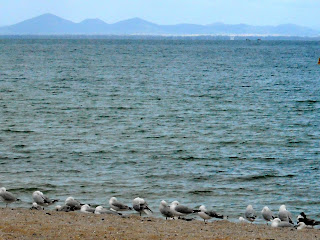
Gulls and You Yangs (more later)


Eleven-armed Seastar

We called to pick up our friends and off we went to Queenscliff. With its wide avenues, Victorian wrought ironwork, and delightful shops, galleries and cafes, this charming seaside town is well worth the drive across the Bellarine.

Our friends have recently opened a gallery, Brush, Lens & Clay, at 2 Hobson Street, so if you do visit Queenscliff, pop in and peruse their carefully selected artworks, jewellery and glass. I'd also recommend lunch or tea at Hobson's Garden Cafe next door.
Many of the town's houses are beautifully maintained, and it was a joy to spot architectural detail and peep into lovely, almost English country, gardens.


'Fried egg' plant

At risk of ridicule about my eyesight or photography skills, I must just mention the 'Out of Focus' trees. These were not the first, which were on the road to Rainbow. I thought nothing more of those after speeding past them back in October, until I came across the phenomenon again in Queenscliff. If anyone can identify this plant, or explain the effect, please do so.

The only black lighthouse in the southern hemisphere, and one of only three in the world, is within Fort Queenscliff, positioned on one of 'The Heads' at the entrance to Port Phillip Bay. Made of basalt, the Shortland Bluff Lighthouse, or Black Light, was constructed in 1863. Alongside it is a wooden Signal Station, also built in the mid-19th century.

The gap between The Heads is three kilometres wide, although the largest ships headed for the ports of Melbourne and Geelong have to use a channel only 200 metres across. The Rip, as the gap is known, has strong tidal currents. It was sunny but chilly and blustery as we looked out over the Bass Strait. Actually, I was frozen to the marrow. Even the Silver Gulls kept a low profile in the car park.


Fort Queenscliff is typical of coastal defences that have been constructed around Australia from colonial times through to the Second World War. The forts at both Queenscliff and Point Nepean, at the tip of the Mornington Peninsula on the opposite side of the entrance to Port Phillip, were built in the second half of the 19th century to protect the wealth Melbourne had garnered from its gold rush from sea raiders. I wonder if the irony of this sign has been lost on the custodians of this historic site?

Late in the afternoon, after tea and cakes at Apostle in Queenscliff's main Hesse Street – a restaurant in a restored, 19th-century former church, a change of usage that my friend heartily applauded – we headed off for the next stage of our mini tour of southern Victoria, the Surf Coast at the start of the Great Ocean Road.
We arrived in Bellbrae, in the Torquay hinterland, less than an hour later. This was to be another Little House on the Prairie-type experience, at Bellbrae Harvest, in the middle of pretty rolling countryside that reminded me of home. Our cabin looked nothing special from the outside but was well designed and equipped inside. The bedroom was on an upper level and was fortunately stocked with fine merino blankets: I'm sure the night temps were down to single figures. Our main neighbours were ducks and geese and fairy wrens, and we overlooked a delightful lily pond.


It was only a ten-minute drive – and a lovely drive at that – into Torquay, where we went each evening to meet my son and his Australian family. Torquay has a beautiful beach and Esplanade with a string of very fine Norfolk Island Pines, while on the Surf Coast Highway on the other side of town are more surf shops than in a surfie's wildest dreams. Surf City Plaza has all the brands and all the gear, and not far away, in Beach Road, is the Surf World Museum.
The following day was a public holiday, and half the population of Victoria seemed to have the same idea as we did – to head down the Great Ocean Road. The weather was very iffy – showers with sunbursts – and most definitely not hot. What with rugs around sitters-on-beaches, queues into cute little towns, and angst about parking – the experience was very English bank holiday.
Except that the Great Ocean Road is exceptionally beautiful and you could forgive it almost anything. It is, after all, considered to be one of the world's great drives. You've scarcely left Torquay before the loveliness begins. (If you're alert, you'll spot the perfect weather at Southside Beach, below: this pic was taken when I was last on the GOR, in February 2010.)

Between Anglesea and Aireys Inlet is an attractive lighthouse, Split Point, built in 1891 after 10 shipwrecks along the Surf Coast. (It was called Eagles Nest Point until 1913, which I think I prefer.) Also known as the White Lady or the White Queen, it has a splendid red top and sits amid attractive coastal heathland, in which you can spot Rufous Bristlebirds (I may have done). According to Lighthouses of Australia by John Ibbotson, lighthouses have distinguishing patterns or structural details that act as a daymark, enabling them to be identified during daylight hours.


A short walk through the heathland – which, fortunately, most of the visitors to the lighthouse didn't do – produced some fine coastal views to Aireys Inlet and beyond.

We continued on to Lorne, which was mobbed. There was a long queue to get into town and a race to nab every carparking space being vacated. We didn't stay long: I identified a couple of shops where I'd found nice clothes on a previous visit, but they must have changed hands and downmarketed; we gave up waiting for a menu in one cafe; and the wait for the lunch we ordered in the next one was definitely not worth it.
Here's more of the Great Ocean Road...


A cautionary note: there may well be stringent planning laws these days along this magnificent coastline, but it can't always have been thus. We were horrified to see this self-indulgent monstrosity overlooking everything and spoiling the view for anyone else.

Someone please tell me this would never be allowed now. May this stand as a warning to those approving planning applications in as yet unspoilt stretches of Australia's magnificent coastline.
The next morning we left Torquay and headed north to Geelong and the You Yangs, en route for Melbourne. These granite 'peaks' dominate the flat Werribee lava plains west of the state capital, yet they rise only to 352 metres. I remarked upon this feature of the landscape when I first visited my LBF (long-been friend) in Geelong in 2006, and laughed when she told me the name. It derives from the Aboriginal name, Wurdi Youang, which you won't be surprised to learn means 'big mountain in the middle of a plain'.

The first European to visit the You Yangs was navigator, cartographer and explorer Matthew Flinders, who climbed to the highest point in 1802, before circumnavigating Australia. We followed suit more than two hundred years later, climbing Flinders Peak along with many other people on a sunny Boxing Day, which for the first time in my life fell on 27 December.


Unidentified 'broccoli' plant*

Unidentified flutterby (there were lots of these)*

Unidentified fat lizard*

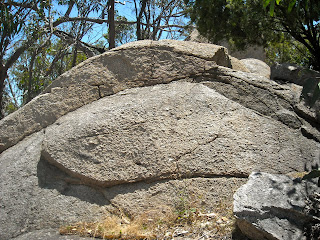
Exfoliated granite slab
Despite far too many fellow walkers and very warm temps (this part of the world was hotting up and reached nearly 40C the day after we flew home to soggy Brisbane), this was an extremely pleasing walk and a great thing to do before returning to urbanness. The view from the top is 360 degrees, over patchwork agricultural plain and indented bay and distant city skyline. The hillside vegetation is my Aussie favourite treescape - gums and Drooping She-oaks (members of the Casuarina family). Unfortunately the You Yang Regional Park is infested with Boneseed. According to weeds.gov.au, Boneseed is a 'Weed of National Significance', an aggressive invader of native Australian bushland with a massive ability to spread. This yellow-daisied monster soon dominates native species, inhibiting eucalypt seedlings, which in turn impacts on canopy trees and fauna in the forest. The You Yangs have a Boneseed Control Program in place: this takes many forms, including the encouragement of visitors to pull out the wretched plant as they walk. My friend did his bit, but the weed seemed to be winning the battle of the You Yangs.
From the regional park, we took narrow back roads across sun-kissed golden meadows to join the Princes Freeway at Werribee. Having returned to The Cullen, we went into town earlyish in order to go for tapas at Movida, 'bar de tapas y vino' in 'Graffiti Street' (Hosier Lane). In Spain, even in renowned bars in the old-city centres, you wander in and squash yourself into a corner or at the bar: you don't book. We turned up at Movida without a reservation and were quickly turned away by a woman who'd taken glacial disinterest, if not antipathy, to new heights. When we asked if it was fully booked the following evening, she couldn't tell us, nor did she care, and suggested we ring a number to find out. We didn't.
Whenever our dinner plans go awry, my friend gets rather agitated. It is imperative we find a substitute as soon as possible because he hates wandering around on the off chance. It wasn't looking good for our prospects for about 20 minutes – lots of restaurants were closed for the holidays – until we stumbled across La Citta in Degraves Street, just off Flinders. It's fairly new, its website says. Our tapas (!) starter included a delicious whitebait frittata, and my lamb and artichoke penne was a new combination to me and quite delicious. It was the best meal since Ortiga in Brisbane on the solstice and who would have expected that on the off chance?
The following day was another shopping day, around Collins and Bourke and Flinders Lane. It was strangely unsuccessful for me but not for my friend. As I sat in the men's department of RM Williams, England won the Fourth Ashes Test at the MGC, thus retaining the unspectacular urn. What a very fine day. I looked in many clothes departments and boutiques but I still couldn't find what I'm looking for.
We headed back to Pran early because we were going for supper in St Kilda at a restaurant where you can't book and therefore need to be early to get a table. St Kilda is a southern, bayside suburb that's famous for virtually everything it seems: its affluence and showy mansions in the Edwardian and Victorian eras; the Luna Park amusement park, which dates from 1912 and looks like it, frankly - tatty and seedy; the post-war red-light district; and, since the Sixties, its bohemianism, artists and music scene. Acland Street, where we were headed, is also famous, and heaving.
It took two trams to get from Pran to St Kilda. There was standing room only and progress through the rush hour was painful. A blustery southerly blew off the bay. St Kilda's famous beach was dirty, as was the sea, but there were people on the sand and in the water. As the sun went down, none of that mattered...


My little camera eventually cannot cope with the rapidly fading light so it becomes creative with colour.

We went to St Kilda for the best pasta joint in town. Cicciolina. Isn't that the name of an Italian porn star and 'politician', we mused. (It is.) It took some finding, and pleading, and we were led to a backroom bar where we had to wait, and drink, and not move until we were called. The restaurant itself is tightly packed and full of hard surfaces so it's noisy as hell. Everybody raises their voice to be heard, which becomes rather tiresome after a while rather than hubbuby and atmospheric. Our pasta was good, there's no doubt about it, but mine was too garlicky. I have to say, I preferred the food at La Citta.
One tram home and a long walk along Commercial Road to our beds. Why are hotel rooms full of lights that blink and glow bright in the night?
To our last day in Melbourne. My last chance for shopping, this time in Pran's Chapel Street. Rather like my Lorne experience, I couldn't find the nice little individual shops where in 2006 I'd bought items by up-and-coming, yet-to-be-frighteningly-expensive Aussie designers. I sort of liked a dress but it didn't have a price tag and the sales assistant didn't have any initiative. 'Twas not meant to be. We wandered through Pran's famous covered market, but even that proved frustrating. How could we carry a load of wonderfully fresh-looking fruit and veg home on the plane? We did buy lunch, however, and caught a tram to the Royal Botanic Gardens where we sat under a shady tree and relaxed.


From there we went down to the Yarra, which is by no means as mighty as the Brisbane, although pleasant enough to walk by on the south side, if only to admire the Melbourne Park sports complex, the MCG and the CBD across the water.


We walked round to Princes Bridge, the site of one of the oldest river crossings in Australia, which takes trams as well as road traffic across into Fed Square. This is the focal point of the city. (Such an obvious candidate is lacking in Brisbane: King George Square doesn't quite do it for me.)


Southgate pedestrian bridge

Preparations for New Year's Eve were ongoing along the river bank. It seems no major city these days can get away without staging a big firework event to mark the occasion. We left them to it and returned by tram to retrieve our car from The Cullen's underground parking.
One last word on the hotel. Despite not being very old, The Cullen seems challenged on the maintenance and cleaning fronts. On each of our visits, the roller blind became unravelled into a heap on the floor during the night. The bathroom fan the first time came on for merely walking past the door, whereas the second time it worked intermittently at best. Room service debris was left on trays outside rooms for too long, and when I looked beneath the bed to make sure we'd packed everything prior to departure, I found a used condom packet. This may just reflect staff too thin on the ground. I loved the wackiness and many other aspects of The Cullen, but I did expect higher standards in this 'new concept in boutique hotels'.

* If anyone recognises this, please let me know what it is.


